Indiana Corporation Biennial Report
By Edmond Hui · Facts verified July 29, 2026 against primary state sources
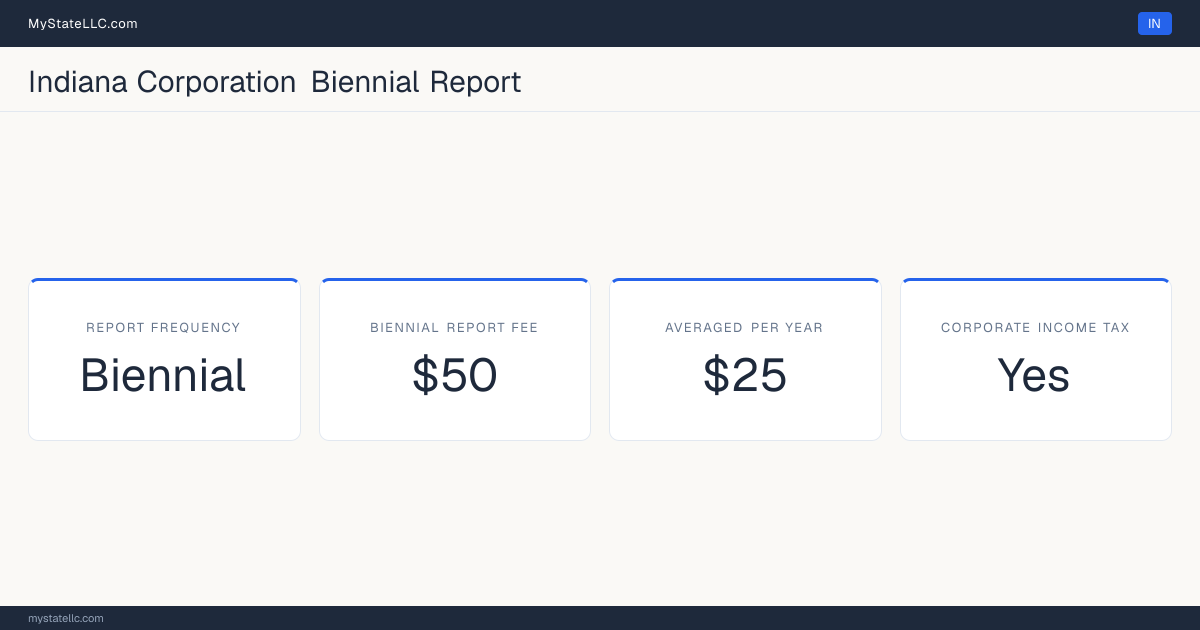
What Indiana requires
Business Entity Report
| Frequency | every two years |
| Due | Business Entity Report due every two years (biennial), during the anniversary month of formation; ~$31 online via INBiz, $50 by mail |
| Fee | $50 |
| Form | Business Entity Report |
Indiana is one of 7 states on a biennial corporate reporting cycle , which works out to $25 a year once averaged, the number to use when comparing against annual-filing states. Nationally, 41 states require an annual corporate report, 7 require one every two years, and 2 require none.
What the filings cost over five years
State filing charges only, incorporation plus five years of reporting, annualized. Because this state reports every two years, the yearly figure is the fee halved; a biennial filer actually writes two or three cheques over five years, not five. Corporate income tax and franchise tax are excluded, because both depend on income or net worth.
| Period | State filing charges |
|---|---|
| Incorporation | $90 |
| Each year after (report, annualized) | $25 |
| Five-year equivalent (annualized) | $215 |
That ranks Indiana 19th cheapest of 49 states on five-year corporate filing charges.
Indiana corporation vs Indiana LLC
State filing charges only. Corporate income tax and franchise tax are excluded because both depend on income or net worth, so no flat figure exists for either entity.
| Corporation | LLC | |
|---|---|---|
| Formation filing fee | $90 | $95 |
| Report cadence | Every two years | Every two years |
| Report fee | $50 | $31 |
Worth noticing: a corporation is $5 cheaper to file here than an LLC. That is the exception nationally. Corporations are the cheaper filing in only 15 of the 50 states, the two entities cost the same in 25, and the LLC is cheaper in 10.
Full Indiana LLC cost breakdown · LLC vs C-corp explained · LLC vs S-corp explained
State taxes a Indiana corporation pays
Corporate income tax
| Applies | Yes |
| Rate | 4.9% flat adjusted gross income tax (in effect since July 1, 2021; applies for 2025 and 2026) |
Indiana publishes no corporate franchise or gross-receipts tax.
What these totals leave out: the filing-charge figures on this page are what you pay the business filing office. They exclude corporate income tax and any franchise or gross-receipts tax, because both depend on income, net worth or receipts. The section above sets out what Indiana levies, or that it levies neither. Where a state's franchise tax carries a flat minimum, that minimum is an unavoidable annual cost these totals do not include, and over five years it can be the larger number.
C-corp return: Form IT-20 (Corporate Adjusted Gross Income Tax Return, State Form 44275)
Frequently Asked Questions
Where these numbers come from
This page covers the recurring report a for-profit corporation files with Indiana. Every figure was checked against Indiana's own published sources on July 29, 2026, the state business filing agency's fee schedule, the governing statute, and where a state tax applies, the state Department of Revenue. Commercial formation-service pages were used as leads only and are never cited. Anything the review could not confirm from an official source is left blank on this page rather than filled with an estimate.
Corporate income tax and franchise tax are quoted as the state publishes them, as rate schedules and thresholds, and are excluded from every dollar total here. They depend on income or net worth, so there is no flat figure that would be true for every corporation.

Edmond Hui · Founder, MyStateLLC
Edmond Hui is a software engineer and serial entrepreneur based in New York who has founded multiple online businesses across e-commerce, media, and information publishing. Before transitioning into tech, he spent years as a commercial real estate professional closing deals totaling over 100,000 square feet, giving him firsthand experience with business formation and entity structuring. He built MyStateLLC to provide the free, state-specific LLC guidance he wished existed when forming his own companies.