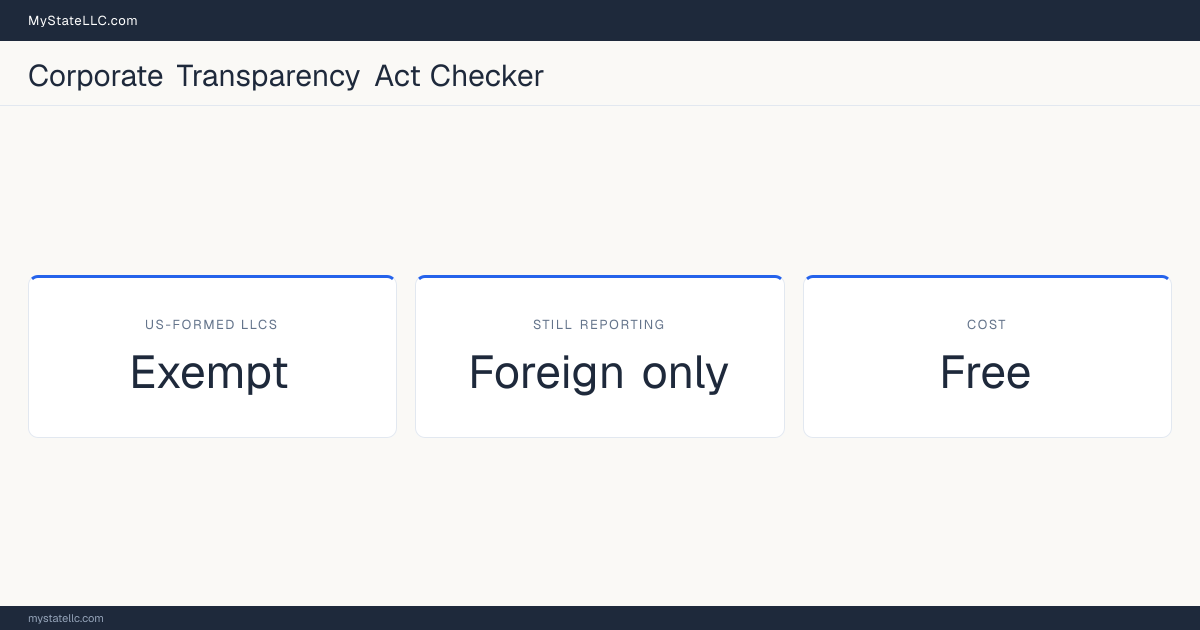
Since March 2025, entities created in the United States are exempt from Beneficial Ownership Information reporting. Answer a few questions to confirm where your business stands, and, if you are a foreign reporting company, get your deadline.
⚠️
The rule that exempts US companies is still interim
FinCEN's interim final rule of March 26, 2025 narrowed “reporting company” to foreign-formed entities registered in the US, and the agency has said it intends to finalize it, a final rule went to the Office of Management and Budget on June 5, 2026, had not been published as of July 2026, and FinCEN’s director said that month that finalization was close. The statute is still in force and still in litigation. Verify current guidance at fincen.gov/boi before filing or concluding you are exempt. This tool is for informational purposes only, not legal advice.
Since FinCEN's March 26, 2025 interim final rule, only foreign-formed entities registered in the US must file a BOI report. Source: FinCEN interim final rule, March 26, 2025 (31 CFR 1010.380).
1. Does your business have a registered legal entity?
Sole proprietors and general partnerships file nothing with a state to exist, so they are not reporting companies.
Paste both lines anywhere on your page. The second one auto-fits the height, so the tool never sits in a scrollbar or leaves a band of empty space, works in WordPress, Squarespace, Webflow, Ghost, and plain HTML.
Editor strips <script> tags? Paste the iframe on its own. It keeps a fixed height and scrolls internally.
What the Corporate Transparency Act means for your LLC
The Corporate Transparency Act (CTA), enacted in 2021 and effective January 1, 2024, originally required most US LLCs and corporations to file a Beneficial Ownership Information (BOI) report with FinCEN, the Treasury Department's financial crimes bureau, disclosing who ultimately owns or controls the company. That is no longer the rule. On March 26, 2025 FinCEN published an interim final rule redefining “reporting company” to mean only entities formed under the law of a foreign country and registered to do business in a US state or Tribal jurisdiction. Every entity created in the United States is exempt.
US-formed LLCs and corporations do not file, update, or correct BOI reports, whoever owns them
Foreign-formed entities registered in the US before March 26, 2025 were due to file by April 25, 2025; those registering later have 30 days from notice that the registration is effective
A foreign reporting company does not report beneficial owners who are US persons
Willful failure to file still carries civil penalties of up to $606 per day, the 2025 inflation-adjusted figure, carried into 2026 and criminal penalties of up to $10,000 and 2 years in prison, but only for entities that are still reporting companies
The exemption comes from an interim rule, not a final one; the statute is unrepealed, the Eleventh Circuit upheld it as constitutional in December 2025, and a petition for Supreme Court review of that decision is pending
How CTA BOI reporting works
🏛 What is the CTA?
The Corporate Transparency Act (2021) directed FinCEN to collect beneficial ownership information. Its reporting rule was narrowed by an interim final rule in March 2025 and now reaches only foreign-formed companies.
🌎 Who is a reporting company now?
Only an entity formed under the law of a foreign country that has registered to do business in a US state or Tribal jurisdiction. Entities created in the US are exempt, whatever their size or industry.
👤 Who is a beneficial owner?
Any individual who owns or controls ≥25% of the company, or who exercises "substantial control." Beneficial owners who are US persons are not reported by a foreign reporting company.
⚠️ Ongoing obligations
A foreign reporting company must file updates within 30 days of any change to its reported information. Exempt US-formed entities have no updating obligation at all.
CTA Compliance Matrix, quick reference
Embed this chart on your site with attribution to share the tool with your readers.
Entity type
Where formed
Registered to do business in the US?
BOI filing required?
LLC, Corp, or LP, any size or industry
US state, territory, or Tribal jurisdiction
N/A
EXEMPT
Sole prop / general partnership
Not formed by a state filing
N/A
NOT APPLICABLE
Any entity
Foreign country
No
NOT APPLICABLE
Bank, insurer, SEC-registered, etc.
Foreign country
Yes
EXEMPT
Tax-exempt nonprofit (501(c))
Foreign country
Yes
EXEMPT
>20 US FTE + >$5M US-source receipts
Foreign country
Yes
EXEMPT, large company
All other entities
Foreign country
Yes
REQUIRED
Frequently Asked Questions
In almost all cases, no. FinCEN's interim final rule, published March 26, 2025, redefined "reporting company" to cover only entities formed under the law of a foreign country that have registered to do business in a US state or Tribal jurisdiction. Entities created in the United States, which includes essentially every domestic LLC and corporation, are exempt, and are not required to file, update, or correct a BOI report, regardless of whether their beneficial owners are US persons. This is still an interim rule rather than a final one, so confirm the current position at fincen.gov/boi before relying on it.
The CTA is a federal law enacted in 2021 requiring companies to report their beneficial owners to FinCEN (the Financial Crimes Enforcement Network), so that anonymous shell companies cannot be used for money laundering and other financial crimes. Reporting began January 1, 2024 and originally covered most US LLCs and corporations. FinCEN's interim final rule of March 26, 2025 sharply narrowed that scope by exempting every entity created in the United States. The statute itself has not been repealed, the Eleventh Circuit upheld its constitutionality in National Small Business United v. Department of the Treasury in December 2025, and a petition for Supreme Court review is pending, so the reporting requirement was cut back by regulation, not by Congress.
Only foreign reporting companies: entities formed under the law of a foreign country that have registered to do business in a US state or Tribal jurisdiction by filing a document with a secretary of state or similar office. Most of those registered before March 26, 2025 had until April 25, 2025 to file, the rule gave at least an additional 30 days, so a company whose own deadline already fell later kept it. Those registering on or after that date have 30 calendar days from the date they receive notice that their registration is effective. The 23 statutory exemptions still apply to these companies.
A beneficial owner is any individual who (1) owns or controls 25% or more of the company's ownership interests, or (2) exercises substantial control over the company, senior officers, directors, or anyone who can appoint or remove senior officers. Under the interim final rule, a foreign reporting company does not report the beneficial ownership information of any beneficial owner who is a US person. A foreign reporting company whose beneficial owners are all US persons therefore reports no beneficial owners at all, though it still reports its company information and, if it registered on or after January 1, 2024, its company applicants.
For willful violations, civil penalties of up to $500 per day as adjusted for inflation, $606 per day for 2025, and unchanged for 2026 because the CPI data needed for the annual adjustment was not published, plus criminal penalties of up to $10,000 and 2 years in prison. Penalties can reach both the company and the individuals responsible. Because US-formed entities no longer have a filing obligation under the interim final rule, these penalties now only reach companies that are still reporting companies.
Yes. Twenty-three exemption categories are written into the reporting rule, and the March 2025 interim final rule took every entity created in the United States outside the definition of "reporting company" altogether, so those 23 are now only ever reached by a foreign-formed entity. For a foreign reporting company, the most commonly applicable of the 23 are: (1) large operating companies with more than 20 full-time employees in the US, more than $5 million in US-source gross receipts on a prior-year US federal tax return, and a physical US office; (2) regulated entities such as banks, credit unions, and registered investment advisers; and (3) tax-exempt nonprofits.
For the company: legal name, any trade names (DBAs), principal US address, jurisdiction of formation, and taxpayer identification number. For each reportable beneficial owner: full legal name, date of birth, current residential address, and an image of an identifying document such as a passport or driver's license. Company applicants are also reported by companies that registered on or after January 1, 2024. Beneficial owners who are US persons are not reported under the interim final rule.
Some states have passed their own transparency laws, so a federal exemption is not necessarily the end of the analysis. New York's LLC Transparency Act took effect January 1, 2026. It defines "reporting company" by reference to the federal rules, and Governor Hochul vetoed S8432 on December 19, 2025 (the bill that would have decoupled the two) so as matters stand it reaches only LLCs formed outside the United States that are authorised to do business in New York. Those LLCs must file even when exempt, by way of an initial and annual statement of exemption. A US-formed LLC is not a reporting company under the act at all, though New York has not issued guidance confirming that nothing whatsoever is expected from it. Check the requirements in your own state.
No action is required. The interim final rule provides that exempt entities are not required to file, update, or correct beneficial ownership information reports, so a US-formed company that already filed has nothing further to do, including when its ownership or addresses later change. FinCEN has not published a process for withdrawing a report that was already submitted.
Edmond Hui is a software engineer and serial entrepreneur based in New York who has founded multiple online businesses across e-commerce, media, and information publishing. Before transitioning into tech, he spent years as a commercial real estate professional closing deals totaling over 100,000 square feet, giving him firsthand experience with business formation and entity structuring. He built MyStateLLC to provide the free, state-specific LLC guidance he wished existed when forming his own companies.