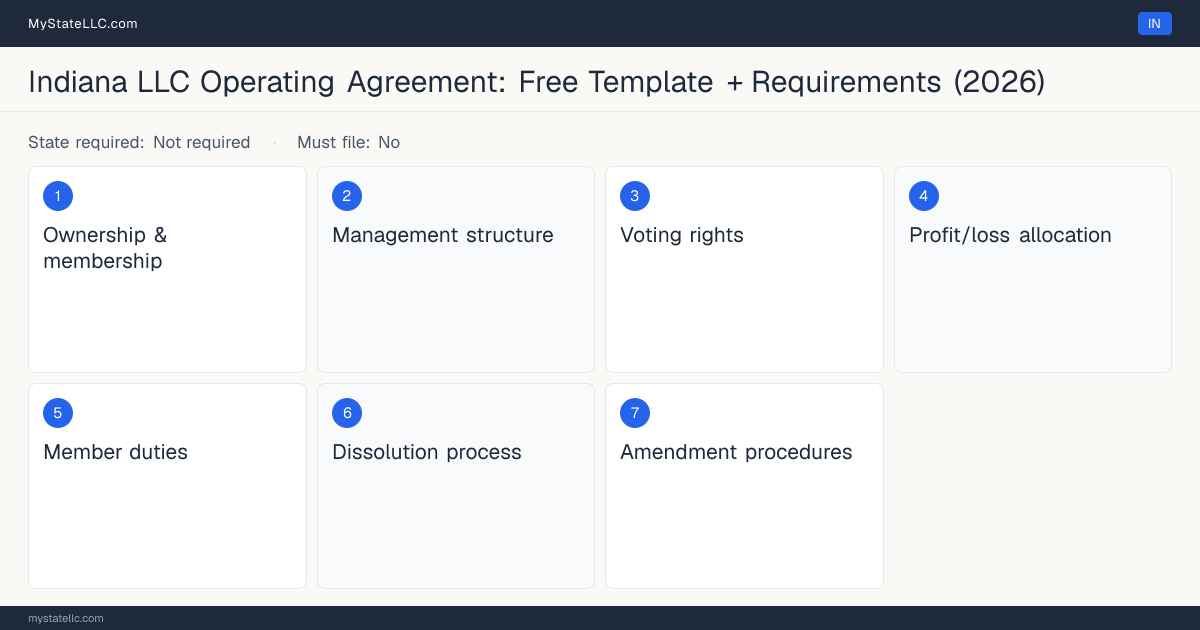
Indiana does not legally require an LLC operating agreement, but having one protects your limited liability status and sets the rules for ownership and profits. See exactly what to include below.
Edmond Hui is a software engineer and serial entrepreneur based in New York who has founded multiple online businesses across e-commerce, media, and information publishing. Before transitioning into tech, he spent years as a commercial real estate professional closing deals totaling over 100,000 square feet, giving him firsthand experience with business formation and entity structuring. He built MyStateLLC to provide the free, state-specific LLC guidance he wished existed when forming his own companies.
Affiliate disclosure: We may earn a commission at no extra cost to you.
Define each member's ownership percentage, initial contributions, and how membership interests can be transferred. This section establishes the foundation of your LLC's ownership structure.
Management structure
Specify whether your LLC is member-managed or manager-managed, and outline the roles and responsibilities of managers or managing members. This clarifies who has authority to make business decisions.
Voting rights
Establish voting procedures for major business decisions, including what percentage of votes is needed for different types of decisions. This prevents disputes and ensures smooth decision-making.
Profit/loss allocation
Detail how profits and losses will be distributed among members, which may differ from ownership percentages. This section is crucial for tax purposes and member expectations.
Member duties
Outline the responsibilities, obligations, and restrictions for each member, including non-compete clauses and confidentiality requirements. This helps prevent conflicts and protects business interests.
Dissolution process
Define the circumstances under which the LLC can be dissolved and the process for winding up business affairs. This provides a clear roadmap if the business needs to end.
Amendment procedures
Establish how the operating agreement can be modified, including what percentage of member approval is required. This ensures the agreement can evolve with your business while maintaining stability.
Frequently Asked Questions
No, Indiana law does not require LLCs to have a written operating agreement under the Indiana Limited Liability Company Act (IC 23-18). However, this omission creates significant legal exposure that most Indiana LLC owners overlook.
Without a written operating agreement, your LLC defaults to Indiana's statutory rules, which treat member interests like general partnership stakes—potentially piercing your liability protection in disputed situations. The Indiana Secretary of State's office cannot enforce member agreements or resolve internal conflicts, leaving you vulnerable to costly litigation.
A written operating agreement accomplishes three critical protections: it documents your limited liability status (essential if challenged in court), establishes binding procedures for member decisions and profit distribution, and creates enforceable dispute resolution mechanisms that avoid expensive lawsuits.
For Indiana LLCs with multiple members, an operating agreement is practically essential. Even single-member LLCs benefit from one, as it demonstrates intentional business formality to creditors and courts.
Your next step: draft an operating agreement addressing Indiana-specific provisions like management structure, profit splits, and member withdrawal terms, then have all members sign and retain copies with your formation documents filed with the Indiana Secretary of State.
Yes, you can write your own operating agreement for your Indiana LLC without filing it with the Indiana Secretary of State—the state doesn't require operating agreements to be submitted or use a specific statutory format. However, Indiana Code § 23-18-105 requires that your agreement address critical areas including member contributions, profit and loss distribution, management structure, voting rights, and dissolution procedures to be enforceable in disputes. The practical benefit is significant: a well-drafted operating agreement becomes your LLC's governing document and protects limited liability status, while a missing or poorly written agreement defaults to Indiana's statutory rules, which may not align with your intentions regarding profit splits or management control. If your LLC involves multiple members, third-party financing, or complex ownership structures, consulting an Indiana business attorney is advisable before finalizing the agreement. Your next step is downloading a state-compliant Indiana LLC operating agreement template, customizing it to your specific circumstances, having all members sign and date it, and maintaining a copy in your LLC's records for at least seven years.
No, Indiana does not require LLC operating agreements to be notarized under Indiana Code § 23-18-1-1 or any other state statute. However, all members must sign the agreement, and signatures should be dated to establish when the agreement became effective. While notarization isn't legally mandated, having a notary public certify member signatures provides significant practical protection: it creates a presumption of authenticity if disputes arise later, strengthens your agreement's enforceability in court, and demonstrates good faith to lenders or investors during financing requests. The Indiana Secretary of State's office does not require notarized copies when filing your Articles of Organization. Store fully executed, signed originals in your LLC's official records—separate from filed documents—along with dated signature pages. This distinction between your internal operating agreement and public filings is crucial for liability protection. For maximum legal defensibility, consider having a notary witness signatures even though it's optional; this costs $5–15 per signature and eliminates future challenges to member intent. Schedule notarization when members sign to avoid reassembling everyone later.
Without an operating agreement, your Indiana LLC is automatically governed by the default provisions of the Indiana Business Flexibility Act (IC 23-18), administered by the Indiana Secretary of State. This means you forfeit control over critical operational decisions, member voting rights, profit and loss distributions, management authority, and ownership transfer procedures—all determined by state law rather than your preferences.
Practically, this creates significant risks for LLC owners. Indiana's default rules assume equal ownership among members regardless of capital contributions, mandate unanimous consent for major decisions, and provide limited protection for member disputes. If you cannot agree on a decision under these default rules, resolving conflicts becomes expensive and time-consuming, potentially requiring court intervention through the state court system.
The immediate consequence is loss of flexibility in structuring your business relationships. For example, if you contribute 70% of startup capital but have no agreement specifying your profit share, Indiana law treats you equally with other members.
Your next step: Draft and execute an operating agreement before conducting business, then file it with your registered agent and retain a copy in your LLC records.
Yes, you can amend your Indiana LLC operating agreement at any time by following the procedures specified in your original agreement. If your agreement doesn't outline amendment procedures, Indiana law requires unanimous written consent from all members to make changes. However, you should document amendments formally by preparing a written amendment document that all members sign and date, then store it with your original operating agreement and corporate records. This protects your LLC if disputes arise later about when changes took effect or what members actually agreed to. Keep in mind that amendments don't require filing with the Indiana Secretary of State unless they affect information on your Articles of Organization. Your next step is to review your current operating agreement's amendment section, then have all members sign any proposed changes in writing and retain copies for your LLC's records.