Your New Hampshire LLC Is Doing Business in Another State
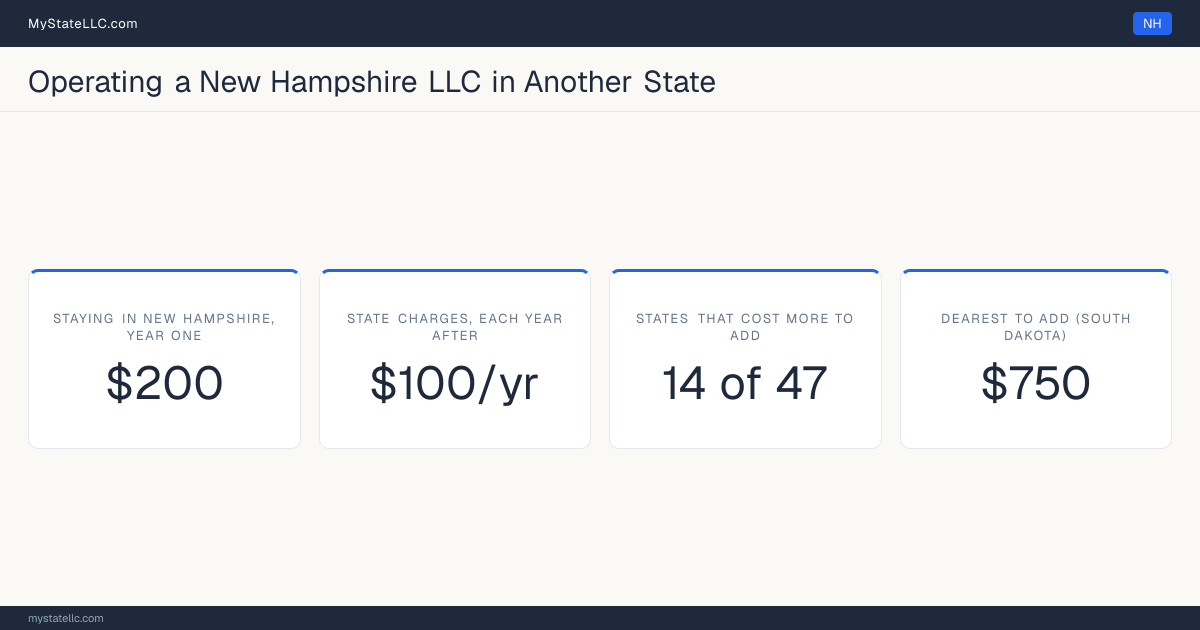
The short answer. You keep one LLC. It stays registered in New Hampshire, which charges $100 a year to keep it in good standing, and a state that finds you are doing business there adds its own registration and its own filings on top. Whether your activity counts is decided by that state's own rule, not by this page. Of the 47 other states that have one figure to compare, 14 cost more in year-one registration than New Hampshire's own first-year total of $200, 32 cost less, and 1 costs the same. Tennessee and Washington are outside those figures: Tennessee's fee scales with member count from $300, and Washington's $180 is before back fees, so neither has one figure to compare.
What you keep paying in New Hampshire
When the Annual Report is due. Between January 1 and April 1 of each year
Every New Hampshire fee behind these figures is broken out on what an LLC costs in New Hampshire.
What a second state adds
These are the states closest to New Hampshire’s own cost line, plus the three dearest to enter. Each figure is that state’s first-year registration cost for an out-of-state LLC, beside what it charges every year after. Whether your activity counts as doing business there depends on the facts, and each state defines it differently.
| State | Year one to register | State charges, each year after | Against your year one ($200) |
|---|---|---|---|
| South Dakota | $750 | $55/yr | $550 more |
| Texas | $750 | None | $550 more |
| Massachusetts | $500 | $520/yr | $300 more |
| Georgia | $235 | $60/yr | $35 more |
| Delaware | $200 | $400/yr | the same |
| Minnesota | $185 | None | $15 less |
| Washington | at least $180 | $70/yr | not comparable, this is a floor |
| Vermont | $155 | $45/yr | $45 less |
| Alabama | $150 | None | $50 less |
| Arizona | $150 | None | $50 less |
| Illinois | $150 | $75/yr | $50 less |
A state charge of None is not a tax of none. The column is the recurring charge our fee dataset records, and a state that asks for no recurring filing may still levy an entity-level tax that sits outside it.
What we verified about New Hampshire's own costs
Our notes, from New Hampshire's published fee schedules and statutes.
New Hampshire is the tidiest fee structure of these five: RSA 304-C:191 sets a flat $100 for the Certificate of Formation (LLC-1), a flat $100 annual report due between January 1 and April 1, and a $50 additional late fee if the report or fee is not in by April 1 - so a late report costs $150. Reinstatement is $135, or $500 for late reinstatement. Certificates are cheap: $5 for a certificate of good standing, $10 for a certificate reciting all of an LLC's filings, and $1 per document plus $5 for a certified copy. A name reservation is $15. The genuine New Hampshire cost is tax, not filing fees: the Business Profits Tax is 7.5% once gross business income exceeds $109,000 and the Business Enterprise Tax is 0.55% once gross receipts or the enterprise value tax base exceeds $298,000.
New Hampshire taxes the LLC itself, not just the members. An LLC with gross business income over $109,000 must file a Business Profits Tax return at 7.5%, and one with gross receipts or an enterprise value tax base over $298,000 owes Business Enterprise Tax at 0.55%. Both apply at the entity level and dwarf the $100 annual report.
The $50 late fee is automatic on April 2. RSA 304-C:191, II(f) adds a $50 late filing fee for failure to file the annual report or pay the fee on or before April 1, taking the report from $100 to $150. Let it lapse into dissolution and reinstatement is $135, or $500 for late reinstatement.
Forming in December can legally skip a whole annual report. Under RSA 304-C:194, III(b), an LLC formed between December 1 and April 1 is not required to file an annual report that year - a genuine $100 saving that also means a first-year founder should not assume a report is due.
Frequently Asked Questions

Edmond Hui · Founder, MyStateLLC
Edmond Hui is a software engineer and serial entrepreneur based in New York who has founded multiple online businesses across e-commerce, media, and information publishing. Before transitioning into tech, he spent years as a commercial real estate professional closing deals totaling over 100,000 square feet, giving him firsthand experience with business formation and entity structuring. He built MyStateLLC to provide the free, state-specific LLC guidance he wished existed when forming his own companies.