How to Register a Foreign LLC in Vermont
By Edmond Hui · Last updated: August 20, 2026
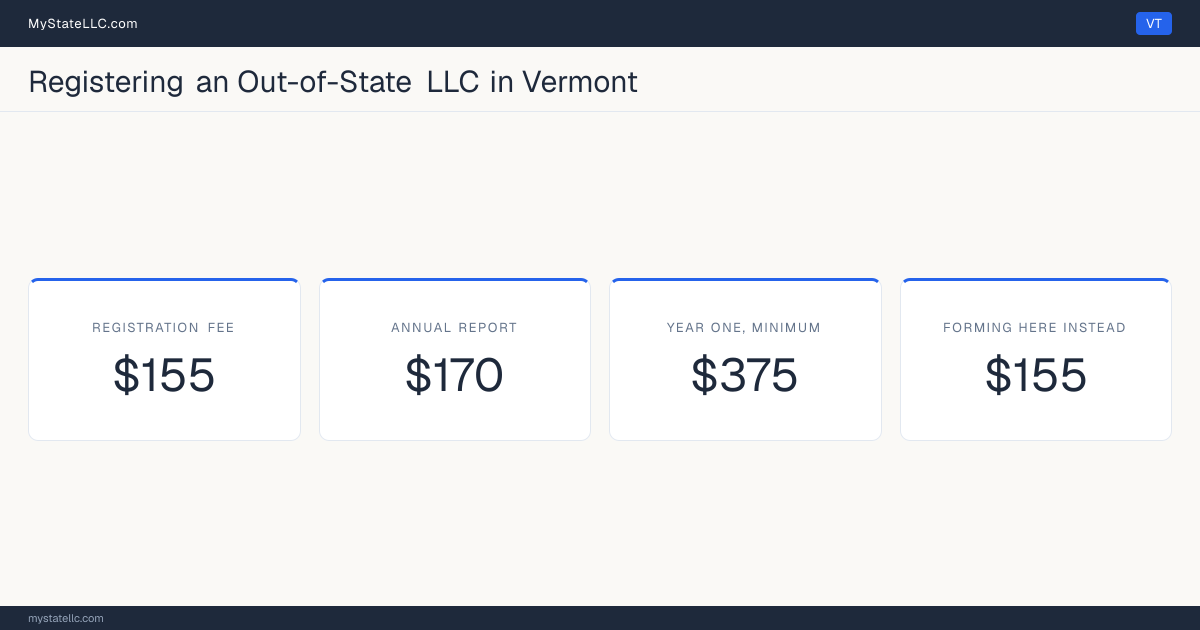
If your LLC was formed in another state but you plan to conduct business activities in Vermont, you must register as a foreign LLC through Vermont's foreign qualification process. This legal requirement protects your LLC's ability to enforce contracts, sue in Vermont courts, and maintain good standing across all states where you operate. The Vermont Secretary of State requires foreign LLCs to file an Application for Certificate of Authority to Transact Business in Vermont, which costs $155 and typically processes within 5-7 business days. Failing to complete foreign LLC registration in Vermont can result in significant penalties, back fees, and the inability to access Vermont's court system to resolve business disputes. Vermont's requirements include appointing a registered agent, obtaining a recent Certificate of Good Standing from your home state, and maintaining ongoing compliance through annual reports due March 15 each year.
Before You File: Prerequisites
- Certificate of Good Standing (or Certificate of Status) from your home state, dated within 60 days
- A registered agent with a physical address in Vermont
- Your LLC's Articles of Organization or equivalent formation documents from the home state
- A distinguishable business name or plans to file for an assumed name if your current name conflicts with existing Vermont entities
- Payment method for the $155 filing fee and any expedited processing fees
- Complete information about your LLC's principal office, management structure, and business purpose
How to Register a Foreign LLC in Vermont: Step-by-Step
- 1
Obtain a Certificate of Good Standing
Contact your home state's Secretary of State office to request a Certificate of Good Standing or Certificate of Status for your LLC. This document must be dated within 60 days of filing your Vermont foreign registration application. Most states offer online ordering through their Secretary of State websites, with fees typically ranging from $10-50 and processing times of 3-10 business days. Order this document first since it has the shortest expiration window for Vermont's requirements.
- 2
Appoint a Registered Agent in Vermont
Vermont law requires you to designate a Vermont registered agent with a physical Vermont street address who is available during normal business hours to receive legal documents. You can't use a P.O. Box for this purpose. You can hire a professional registered agent service for $50-300 annually, or appoint an individual Vermont resident who consents to serve in this role. Professional services offer reliability and privacy protection for your business.
- 3
Check Your LLC Name Availability
Vermont requires a distinguishable name that doesn't conflict with existing business entities. Search the Vermont Secretary of State's business database to verify your LLC name is available. If your current name is already taken or too similar to another entity, you may register under an assumed name by filing a Trade Name Registration with the Secretary of State. This allows you to operate under a different name while maintaining your original LLC identity.
- 4
File the Application for Certificate of Authority to Transact Business in Vermont (Foreign LLC)
Submit your Application for Certificate of Authority to Transact Business in Vermont through the Secretary of State's online portal at https://sos.vermont.gov/corporations/registration/foreign-entity/. The form requires your LLC's legal name, principal office address, registered agent information, management structure details, and business purpose. Include your Certificate of Good Standing and pay the $155 filing fee. The application must be signed by an authorized member or manager of the LLC.
- 5
Understand Your Ongoing Tax Obligations
While Vermont doesn't impose a franchise tax on foreign LLCs, you must register with the Vermont Department of Taxes for applicable state taxes. This includes income tax withholding if you've employees, sales tax if you sell taxable goods or services, and meals and rooms tax if you operate in the hospitality industry. Register within 30 days of beginning business activities to avoid penalties. Vermont also requires foreign LLCs to comply with unemployment insurance and workers' compensation requirements if they have employees.
- 6
File Your Annual Report / Ongoing Compliance
Vermont requires foreign LLCs to file an Annual Report each year with a $170 fee, where a domestic Vermont LLC pays $45 for the same report. This early deadline means you should file in January or February to allow processing time and avoid the $25 late fee. The report updates your registered agent information, principal office address, and management details. Failure to file results in administrative dissolution and the loss of your authority to transact business in Vermont.
Cost Breakdown
Your total first-year cost to foreign qualify in Vermont ranges from $375 to $625, depending on your registered agent choice. This includes the $155 Secretary of State filing fee, the $170 annual report fee, and $50-$300 for registered agent services. Fees shown are the state's standard (non-expedited) rates; expedited processing is available at additional cost.
Fees
| Fee | Amount | Frequency |
|---|---|---|
| SOS Foreign Registration Filing Fee | $155 | One-time |
| Registered Agent | $50-300 | Annual |
| First-Year Total (estimated) | $375 to $625 |
Processing Timeline
Plan to start your foreign qualification process 2-3 weeks before you need to operate in Vermont to account for obtaining your Certificate of Good Standing and standard processing times. Your foreign qualification becomes effective on the date the Secretary of State approves your application and issues the Certificate of Authority.
Vermont-Specific Warnings
Vermont's March 15 annual report deadline is early in the year
Unlike many states that use calendar year-end or formation anniversary dates, Vermont's March 15 annual report deadline comes early in the year and catches many businesses off guard. File your annual report in January or February to ensure processing before the deadline and avoid the automatic $25 late fee. Missing this deadline can lead to administrative dissolution, requiring costly reinstatement procedures and potential loss of your Vermont business authority.
Vermont requires a Certificate of Good Standing from your home state dated within 60 days of the foreign LLC registration application.
Vermont's 60-day requirement for Certificate of Good Standing documents is stricter than many states. Time your request carefully since some states take 1-2 weeks to process these certificates. If your Certificate of Good Standing expires before Vermont processes your application, you'll need to obtain a new one and refile, causing delays and additional expenses in your foreign qualification process.
Foreign LLCs in Vermont must also register with the Vermont Department of Taxes for applicable state taxes, including meals and rooms tax if applicable.
Vermont's tax registration requirements are separate from your Secretary of State filing and must be completed within 30 days of beginning business activities. Restaurants, hotels, and short-term rental operators face particularly complex requirements including meals and rooms tax registration. Failure to register for applicable taxes results in penalties, interest, and potential business license issues that can halt your Vermont operations.
Frequently Asked Questions
Sources
Each entry below is a document recorded in our verified Vermont sources, and each entry says what the document is. Some statutory text is read from an accurate mirror rather than from the state's own host, and those say so.
- sos.vermont.gov/business-services/business-filings/domestic-formation/llcVermont Secretary of State: business entity filings
- sos.vermont.gov/business-services/fees-statutesVermont LLC filing fees

Edmond Hui · Founder, MyStateLLC
Edmond Hui is a software engineer and serial entrepreneur based in New York who has founded multiple online businesses across e-commerce, media, and information publishing. Before transitioning into tech, he spent years as a commercial real estate professional closing deals totaling over 100,000 square feet, giving him firsthand experience with business formation and entity structuring. He built MyStateLLC to provide the free, state-specific LLC guidance he wished existed when forming his own companies.