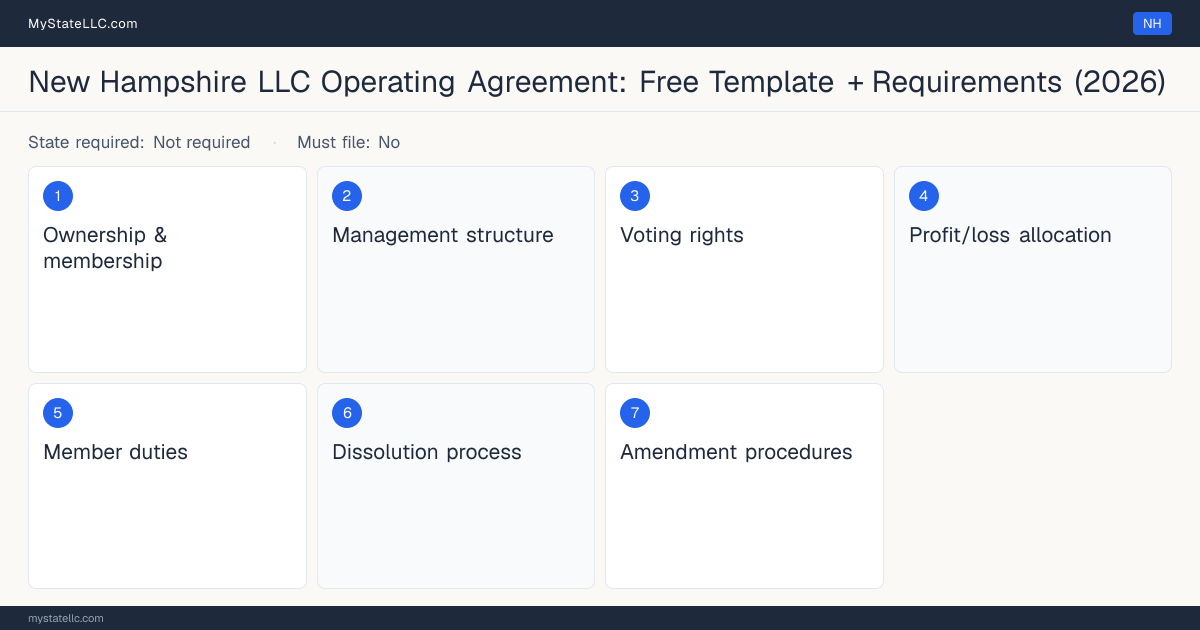
New Hampshire does not legally require an LLC operating agreement, but having one protects your limited liability status and sets the rules for ownership and profits. See exactly what to include below.
Edmond Hui is a software engineer and serial entrepreneur based in New York who has founded multiple online businesses across e-commerce, media, and information publishing. Before transitioning into tech, he spent years as a commercial real estate professional closing deals totaling over 100,000 square feet, giving him firsthand experience with business formation and entity structuring. He built MyStateLLC to provide the free, state-specific LLC guidance he wished existed when forming his own companies.
Affiliate disclosure: We may earn a commission at no extra cost to you.
New Hampshire follows default LLC rules under RSA Chapter 304-C if no operating agreement exists. The state strongly recommends having an operating agreement to override default statutory provisions.
What to Include in Your Operating Agreement
Ownership & membership
Define each member's ownership percentage, capital contributions, and membership interests. This section establishes who owns what portion of your New Hampshire LLC.
Management structure
Specify whether your LLC is member-managed or manager-managed and outline decision-making authority. New Hampshire law allows flexible management structures for LLCs.
Voting rights
Establish how members vote on important decisions and what constitutes a majority. Include procedures for regular business decisions versus major company changes.
Profit/loss allocation
Detail how profits and losses are distributed among members and when distributions occur. This affects both business operations and tax reporting for your New Hampshire LLC.
Member duties
Outline each member's responsibilities, time commitments, and fiduciary duties. Clear expectations prevent disputes and ensure smooth LLC operations in New Hampshire.
Dissolution process
Establish procedures for dissolving the LLC, including triggering events and asset distribution. New Hampshire requires proper dissolution procedures to avoid ongoing legal obligations.
Amendment procedures
Define how the operating agreement can be modified in the future, including required member approval. This ensures your agreement can evolve with your business needs.
Frequently Asked Questions
No, New Hampshire does not legally require LLCs to have an operating agreement. However, this creates significant practical risk for LLC owners. Without an operating agreement, your LLC automatically falls under the default provisions of RSA Chapter 304-C (New Hampshire's Limited Liability Company Act), which imposes standardized rules that may conflict with your actual business intentions. This means the state dictates how profits are distributed, management responsibilities are allocated, and ownership changes are handled—potentially creating disputes among members. For example, default law assumes equal profit distribution regardless of capital contributions, which rarely matches real business arrangements. Additionally, lenders and investors typically require an operating agreement before providing funding, and the IRS may challenge your LLC's tax classification without documented governance. To protect your business structure and maintain operational flexibility, you should draft and adopt an operating agreement immediately, even though it's not mandated. Contact the New Hampshire Department of State (603-271-3246) for guidance, then have a business attorney review your agreement before execution.
Yes, you can draft your own New Hampshire LLC operating agreement without legal assistance. New Hampshire does not require operating agreements to be filed with the Secretary of State or notarized, giving you flexibility to create one independently using templates or DIY resources.
However, this approach carries risks for your business. New Hampshire's default LLC rules under RSA 304-C apply automatically if your agreement doesn't address specific provisions like profit distribution, voting rights, member withdrawal procedures, or dissolution terms. Missing or ambiguous clauses can lead to disputes that become expensive to litigate through New Hampshire courts.
For straightforward single-member LLCs with uncomplicated ownership structures, a template-based agreement may suffice. For multi-member LLCs, those involving capital contributions, or businesses with non-standard management arrangements, consulting a New Hampshire business attorney is worthwhile. An attorney ensures your agreement explicitly governs management structure, buyout provisions, and liability protections specific to your situation.
Next step: Start by reviewing free New Hampshire LLC operating agreement templates online, then schedule a consultation with a business attorney to review your draft before finalizing it.
No, New Hampshire does not require LLC operating agreements to be notarized. The New Hampshire Secretary of State does not mandate notarization as a filing requirement, and the state's LLC statutes (RSA Chapter 304-C) contain no notarization language for internal governance documents.
However, notarization remains optional but strategically valuable. Having your operating agreement notarized creates a certified record of execution, which strengthens its enforceability if members later dispute the document's authenticity or claim they didn't authorize it. This is particularly important if your LLC has multiple members or significant assets.
If you choose notarization, any New Hampshire notary public can authenticate the signatures for approximately $5–$10 per signature. You'll need to appear in person with valid identification.
The practical implication: while notarization won't affect your LLC's legal status, it eliminates a common dispute tactic and adds credibility during litigation or lender reviews.
Next step: Draft your operating agreement using New Hampshire's statutory requirements (including capital contributions and profit distribution terms), then decide whether notarization fits your risk profile before finalizing it with all members.
Without an operating agreement, your New Hampshire LLC will be governed by the default provisions in RSA Chapter 304-C (New Hampshire's Limited Liability Company Act). This means the state mandates equal profit sharing among all members regardless of capital contributions, requires unanimous member consent for major decisions like selling assets or admitting new members, and imposes standard dissolution procedures that may force a sale of your business assets at unfavorable terms. The practical implication is significant: you lose control over your business structure and decision-making authority, expose yourself to personal liability disputes between members, and forfeit tax flexibility options that an operating agreement provides. Additionally, without a written agreement, New Hampshire courts may impose statutory default rules that contradict your actual business intentions, potentially triggering costly litigation to clarify member rights. To protect your LLC, file an operating agreement with the New Hampshire Secretary of State's Division of Corporations, Elections & Securities, or retain one internally—either approach provides legal protection and documented governance structure before disputes arise.
Yes, you can amend your New Hampshire LLC operating agreement after formation, but the process depends on what your original agreement specifies. If your operating agreement includes amendment procedures—such as requiring a simple majority vote, supermajority approval, or manager approval—you must follow those exact steps. If no amendment procedures are outlined in your agreement, New Hampshire RSA 304-C requires unanimous consent from all members to make any changes. This means a single dissenting member can block amendments without unanimous agreement procedures in place. When you amend your agreement, document the change in writing and have all required parties sign the amendment. While New Hampshire doesn't mandate filing amendments with the Secretary of State, keeping detailed records protects your LLC during disputes. The practical implication: vague or missing amendment language can create deadlock situations, especially as membership changes. Review your current operating agreement now to identify what amendment process applies to your LLC, then ensure any future changes follow that procedure precisely.