How to Dissolve an LLC in New Hampshire: Complete 2026 Guide
Close your New Hampshire LLC in the right order. The $35 Certificate of Cancellation is the last filing, and the state takes about 10 business days with it.
By Edmond Hui · Last updated: September 2026
At $35, New Hampshire's LLC dissolution filing fee ranks 28th cheapest of the 50 states, and it ties with 4 other states at the same price.
The filing fee puts New Hampshire squarely in the middle of the pack, which makes it a poor guide to the real effort involved. What sets this state apart is sequence, not price: a Department of Revenue Administration certificate has to be in hand before members are paid, and that is what determines how long a closure actually takes.
Source: MyStateLLC 50-state dissolution index, verified 2026-08-13
Dissolution at a Glance
| Filing Fee | $35 |
| Form Name | Certificate of Cancellation (Form LLC-7) |
| Processing Time | 10 business days |
| Creditor Notice Period | 120 days |
| Tax Clearance Required | No |
| Publication Required | No |
| File Online | SoS Dissolution Page → |
How to Form an LLC: Step-by-Step
- 1
Vote to Dissolve
New Hampshire treats dissolution as a two-stage process under RSA 304-C, and this is stage one. Dissolution itself occurs when one of the triggers in RSA 304-C:129 happens: an event specified in the operating agreement, a vote of the members, a judicial decree, or administrative dissolution by the state. For a voluntary closure, that means starting with your operating agreement and following whatever procedure the members wrote there. If the agreement is silent, get written consent signed by every member so there is no later argument about whether the vote carried. Put the decision in a dated written resolution that names the company, records the members' approval, and states the effective date of dissolution. The effective date is load-bearing in New Hampshire: creditor notice deadlines under RSA 304-C:143 are measured from it, so it needs to be a date you can point to rather than one you reconstruct later.
Pro tip: Decide the effective date before you sign, not after. Two statutory deadlines run from it, and moving it later to tidy up the paperwork moves both of those deadlines with it. - 2
File the Certificate of Cancellation (Form LLC-7) with the New Hampshire Secretary of State
This is the last filing, not the first. Under RSA 304-C:142 the Certificate of Cancellation of Certificate of Formation, Form LLC-7, is filed with the Secretary of State after winding up and liquidation are complete, which means steps 3 through 6 below come before you submit it. Plan the sequence that way. The state filing fee is $35. Filing online through the NH QuickStart portal at quickstart.sos.nh.gov, under Business Services and then Business Withdraw, Dissolve or Cancel, adds a $2.00 online handling fee on top of the $35. The form itself is at https://www.sos.nh.gov/sites/g/files/ehbemt561/files/documents/2023-12/form_llc-7_-09-2015.pdf. Budget about 10 business days for standard processing, and be aware that non-expedited turnaround moves with the Secretary of State's backlog. Walk-in or expedited service costs an extra $25 and can be same-day. Both the $2.00 handling fee and the $25 expedite charge are additions to the $35 filing fee, not substitutes for it.
Pro tip: Do not file Form LLC-7 the same week you decide to close. Filing it before winding up is finished puts the cancellation on record while the company still has open obligations, which is the opposite of the order the statute contemplates. - 3
Notify Creditors and Settle Debts
New Hampshire is specific here. Under RSA 304-C:143, known claimants must be notified in writing within 60 days of the dissolution's effective date, and each one must be given no fewer than 120 days to submit a claim before that claim can be barred. If you reject a claim in writing, the claimant then has 90 days to sue on it. So the 120 days the statute names is a real scheduling constraint on the wind-up, and the 60-day notice window means the letters cannot wait. Write to every creditor you know of: the amount you believe is owed, where to send a claim, and the deadline. Pay or reserve for each balance before anything reaches the members. On publication, be clear about what the law actually says: publishing a newspaper notice is not mandatory to dissolve a New Hampshire LLC. RSA 304-C:144 makes it an optional mechanism that shortens the bar on unknown and contingent claims to three years from the publication date, and nothing requires you to buy it.
Pro tip: Send the known-creditor letters by a method that produces a delivery record and calendar the 120-day date on the day you mail them. The deadline only protects you if you can prove when notice went out. - 4
Get the DRA Certificate of Dissolution Before Distributions and Close New Hampshire Tax Accounts
New Hampshire's Department of Revenue Administration certificate is real, and most write-ups attach it to the wrong event. RSA 304-C:141 I says that before making any distributions of assets to any members and managers upon the winding up, the LLC shall first obtain a certificate of dissolution from the department of revenue administration in accordance with RSA 77-A:18, and RSA 77-A:18 I(a) confirms that the trigger is the transfer of the property, not the filing. The Secretary of State filing is governed by RSA 304-C:142 II, which asks only for the name, the reason for filing, the effective date and any other information the members deem proper, and Form LLC-7 matches that list with no tax item on it. So the certificate does not gate Form LLC-7. It gates paying the members, which nearly every dissolving LLC eventually does, so treat it as a real obligation rather than an optional one. Request it through Granite Tax Connect or by filing Form AU-22 with the Department of Revenue Administration. RSA 77-A:18 I(b) sets a separate $30 fee for the certification, which is its own charge and has nothing to do with the $35 Secretary of State filing fee, and the Department states up to 60 days to respond. File your final New Hampshire returns and close the LLC's state tax accounts in the same pass, including Business Profits Tax and Business Enterprise Tax obligations if the company had them.
Pro tip: Start this step early, ideally the same week you approve the dissolution. The Department states up to 60 days to respond, and because distributions cannot happen until the certificate is in hand, it is usually the longest item on the whole timeline. - 5
Deactivate Your EIN with the IRS
The IRS cannot cancel an EIN, but it can deactivate it once any outstanding returns are filed and taxes owed are paid. See the FAQ below for the letter and mailing addresses. Do the federal returns first. A multi-member LLC taxed as a partnership files a final Form 1065 with the final return box checked and issues final Schedules K-1; an LLC taxed as a corporation files Form 1120 or 1120-S, also with the final return box checked; a single-member LLC that never elected corporate treatment reports the activity on the owner's return. If the company had employees, the final employment tax returns come before the deactivation letter, not after.
Pro tip: Keep the deactivation letter and proof of mailing, because your mailing record is the evidence of when the request went out. - 6
Distribute Remaining Assets to Members
Two things have to be true before members are paid. Creditor claims must be settled or reserved for, and the Department of Revenue Administration Certificate of Dissolution must be in hand, because RSA 304-C:141 requires that certificate before any distribution of assets to members or managers. That order is not a formality; it is the statute. Once both conditions are met, distribute what remains according to the operating agreement, which controls the percentages and any liquidation waterfall the members agreed to. Where a claim is still open under the 120-day window, hold a reserve rather than estimating. Record every distribution with the date, the amount, the recipient and the ownership percentage it reflects, and treat non-cash property the same way, since transferring equipment or a vehicle to a member is a distribution too.
Pro tip: Have each member sign a receipt describing what they received and confirming it is a liquidating distribution. Attach a copy of the DRA Certificate of Dissolution to the same file so the record shows the certificate came first. - 7
Confirm Dissolution is Complete
After the Secretary of State processes Form LLC-7, verify it rather than assuming. Check the company's record in the Secretary of State's business search and confirm the cancellation appears in the filing history; QuickStart filings return confirmation through the portal, so download it and save it somewhere other than the filing account. Then assemble one package and keep it: the members' dissolution resolution, the written creditor notices and any claim responses, the Department of Revenue Administration Certificate of Dissolution, the final federal and New Hampshire returns, the EIN deactivation letter, the member distribution receipts, and the filed Certificate of Cancellation. Keep it for at least seven years. A rejected claim gives the claimant 90 days to sue, unknown claims can surface later still, and the file is what answers them.
Pro tip: Save a PDF of the filed Certificate of Cancellation before you close the business bank account. Banks ask for it as proof of closure, and retrieving a copy afterward is slower than saving one now.
Winding-Up Checklist
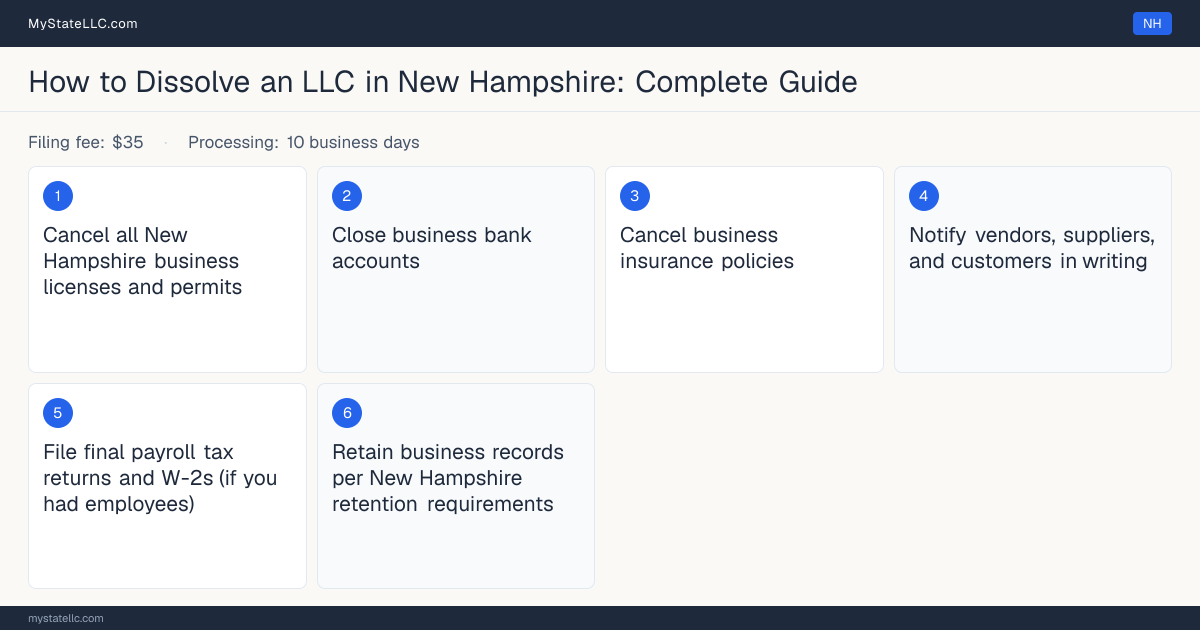
- Cancel all New Hampshire business licenses and permits
Cancel every state, municipal and industry license or permit the LLC held, each with the body that issued it. Licenses renew on their own schedules, so one left open keeps billing after the company has closed.
- Close business bank accounts
Close accounts only after creditors are paid and final distributions have cleared. Download the complete statement history first and get written confirmation of closure, because access usually ends the day the account does.
- Cancel business insurance policies
Notify each carrier in writing with the dissolution date and ask about unearned premium refunds. For professional liability, ask specifically whether tail coverage is worth buying, since claims can arrive after the policy period ends.
- Notify vendors, suppliers, and customers in writing
Send dated written notice stating that the company is dissolving, where to send a final invoice, and by when. In New Hampshire this overlaps with the known-creditor notice, so send one letter that satisfies both rather than two that conflict.
- File final payroll tax returns and W-2s (if you had employees)
File the final federal employment tax returns, issue W-2s to every employee, and close the LLC's New Hampshire employer and unemployment accounts. An open payroll account keeps generating filing obligations even at zero wages.
- Retain business records per New Hampshire retention requirements
Keep the dissolution resolution, creditor notices, DRA Certificate of Dissolution, tax returns and the filed Certificate of Cancellation for at least seven years. A rejected claimant has 90 days to sue and unknown claims can surface later, so the file has to outlast the company.
Frequently Asked Questions
Sources
Each entry below is a document recorded in our verified New Hampshire sources, and each entry says what the document is. Some statutory text is read from an accurate mirror rather than from the state's own host, and those say so.
- sos.nh.gov/corporations-0New Hampshire Secretary of State: business entity filings
- sos.nh.gov/sites/g/files/ehbemt561/files/documents/2023-12/form_llc-7_-09-2015.pdfNew Hampshire Secretary of State: LLC dissolution
- sos.nh.gov/corporations-0/business-faqsNew Hampshire filing processing times
- gc.nh.gov/rsa/html/XXVIII/304-C/304-C-143.htmNew Hampshire creditor notice period
- gc.nh.gov/rsa/html/XXVIII/304-C/304-C-142.htmNew Hampshire tax clearance requirement
- gc.nh.gov/rsa/html/XXVIII/304-C/304-C-144.htmNew Hampshire publication requirement on dissolution
- quickstart.sos.nh.gov/onlineNew Hampshire online dissolution filing
Formation Services Compared
Forming an LLC in New Hampshire?
See how Northwest Registered Agent, Bizee, ZenBusiness and LegalZoom, the formation services we partner with, compare on 3-year cost, BBB rating and Trustpilot score before you choose.

Edmond Hui · Founder, MyStateLLC
Edmond Hui is a software engineer and serial entrepreneur based in New York who has founded multiple online businesses across e-commerce, media, and information publishing. Before transitioning into tech, he spent years as a commercial real estate professional closing deals totaling over 100,000 square feet, giving him firsthand experience with business formation and entity structuring. He built MyStateLLC to provide the free, state-specific LLC guidance he wished existed when forming his own companies.