Your Texas LLC Is Doing Business in Another State
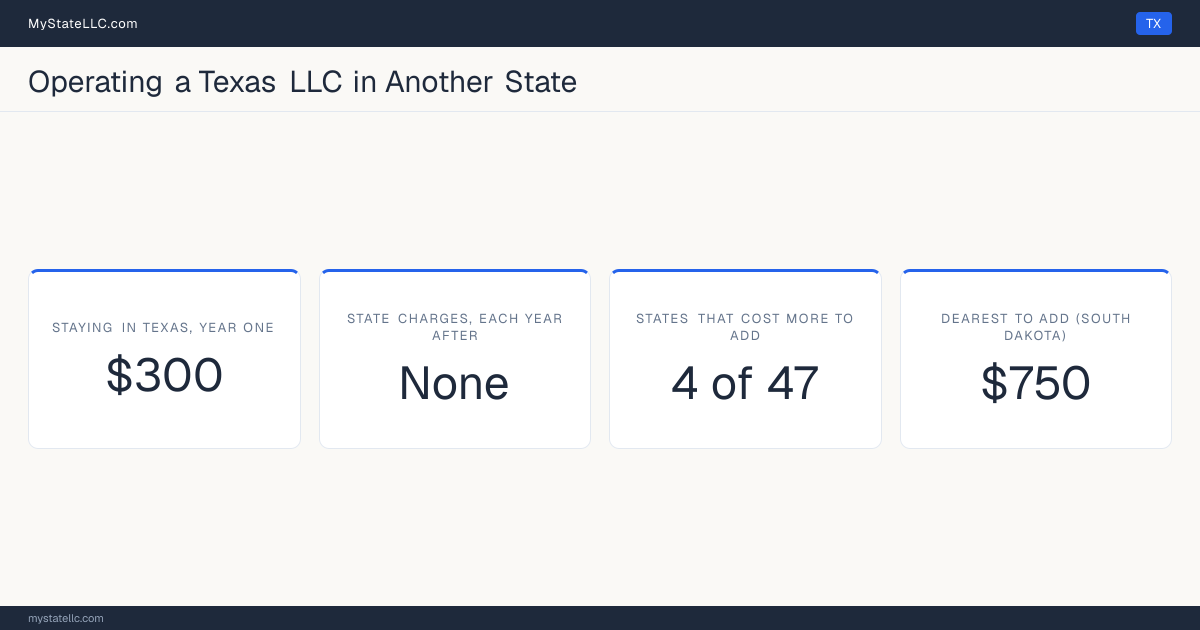
The short answer. You keep one LLC. It stays registered in Texas, which charges no recurring state filing fee, though the LLC keeps whatever obligations Texas attaches to it, and a state that finds you are doing business there adds its own registration and its own filings on top. Whether your activity counts is decided by that state's own rule, not by this page. Of the 47 other states that have one figure to compare, 4 cost more in year-one registration than Texas's own first-year total of $300, 42 cost less, and 1 costs the same. Tennessee and Washington are outside those figures: Tennessee's fee scales with member count from $300, and Washington's $180 is before back fees, so neither has one figure to compare.
What you keep paying in Texas
When the Annual Report is due. May 15. "If May 15 falls on a weekend or holiday, the due date will be the next business day."
Every Texas fee behind these figures is broken out on what an LLC costs in Texas.
What a second state adds
These are the states closest to Texas’s own cost line, plus the three dearest to enter. Each figure is that state’s first-year registration cost for an out-of-state LLC, beside what it charges every year after. Whether your activity counts as doing business there depends on the facts, and each state defines it differently.
| State | Year one to register | State charges, each year after | Against your year one ($300) |
|---|---|---|---|
| South Dakota | $750 | $55/yr | $450 more |
| Massachusetts | $500 | $520/yr | $200 more |
| Nevada | $425 | $350/yr | $125 more |
| Alaska | $350 | $50/yr | $50 more |
| Oklahoma | $300 | $25/yr | the same |
| Tennessee | at least $300 | from $400/yr | not comparable, this is a floor |
| Oregon | $275 | $100/yr | $25 less |
| Arkansas | $270 | $150/yr | $30 less |
| Maine | $250 | $85/yr | $50 less |
| Mississippi | $250 | None | $50 less |
| North Carolina | $250 | $200/yr | $50 less |
A state charge of None is not a tax of none. The column is the recurring charge our fee dataset records, and a state that asks for no recurring filing may still levy an entity-level tax that sits outside it.
Nevada's figure is the mandatory first-year bundle (filing fee, initial list and state business licence), not the $75 filing fee alone.
What we verified about Texas's own costs
Our notes, from Texas's published fee schedules and statutes.
Texas charges $300 to file a Certificate of Formation for an LLC (Form 205), one of the highest flat formation fees in the country, and adds a statutory 2.7% convenience fee on credit card payments. There is no fee for the annual Public Information Report, but it is filed with the Comptroller rather than the Secretary of State and is still required at $0 tax: the no-tax-due threshold for 2026 reports is $2,650,000 of total revenue, and the Comptroller tells below-threshold filers to "simply file your 2026 Public Information Report or Ownership Report" by May 15. Certificates of fact (including existence or status) are $15, the long-form certificate of existence is $25, certified copies are $1 per page plus $15 per certificate, and a 120-day name reservation is $40. Expedited service is now tiered: $50 standard, $500 next-day, or $750 same-day, per document.
You must still file even when you owe $0 franchise tax. Total revenue at or below $2,650,000 means no franchise tax is due for a 2026 report, but the Comptroller still requires the Public Information Report or Ownership Report by May 15; skipping it puts the LLC on the path to tax forfeiture and a $75 reinstatement.
Credit card payments carry a 2.7% surcharge. The Secretary of State applies a statutory convenience fee of 2.7% of the amount charged to credit card payments, so a $300 Certificate of Formation costs about $308.10 on a card and $300 by check or money order.
Fast expedited service is expensive under Texas Express. Texas Express prices same-day review at $750 per document and next-day review at $500 per document, on top of the filing fee; the ordinary expedited tier is $50 per document for roughly 2-3 business days.
Frequently Asked Questions

Edmond Hui · Founder, MyStateLLC
Edmond Hui is a software engineer and serial entrepreneur based in New York who has founded multiple online businesses across e-commerce, media, and information publishing. Before transitioning into tech, he spent years as a commercial real estate professional closing deals totaling over 100,000 square feet, giving him firsthand experience with business formation and entity structuring. He built MyStateLLC to provide the free, state-specific LLC guidance he wished existed when forming his own companies.