How to Dissolve an LLC in Texas: Complete 2026 Guide
Texas charges a $40 filing fee for Form 651 and processing time varies. The filing will not be accepted without a Comptroller Certificate of Account Status attached.
By Edmond Hui · Last updated: September 2026
Texas's $40 LLC dissolution filing fee ranks #33 cheapest of 50 states, a rank it ties with 1 other states
The fee is the least demanding part of a Texas termination. What governs the calendar is the Comptroller certificate that has to arrive before the Secretary of State will accept the filing at all.
Source: MyStateLLC 50-state dissolution index, verified 2026-08-13
Dissolution at a Glance
| Filing Fee | $40 |
| Form Name | Form 651 - Certificate of Termination of a Domestic Entity |
| Processing Time | varies |
| Creditor Notice Period | None set by statute |
| Tax Clearance Required | Yes |
| Publication Required | No |
| File Online | SoS Dissolution Page → |
How to Form an LLC: Step-by-Step
- 1
Vote to Dissolve
Your company agreement, the document most owners call an operating agreement, controls how a Texas LLC decides to wind up. Read its dissolution clause and follow the threshold it sets, whether that is a majority of membership interests, a manager decision, or unanimous written consent. If the agreement is silent, or if the LLC never adopted one, get written consent signed by every member so the authority behind the termination cannot be questioned afterwards. Record the date, the participants and the result in a short written resolution and keep it with the LLC's books. Texas does not ask you to file that resolution, but the person signing Form 651 is representing that the entity actually approved the termination and that winding up is complete or under way.
Pro tip: Assign responsibility for the Comptroller certificate at the same meeting. It is the item that sets the schedule for everything else, and it is the one most likely to sit unowned while members assume someone else requested it. - 2
File Form 651, Certificate of Termination of a Domestic Entity, with the Texas Secretary of State
Texas terminates a domestic LLC with Form 651, the Certificate of Termination of a Domestic Entity, filed with the Secretary of State. The filing fee is $40 and the certificate is submitted in duplicate. A Certificate of Account Status for termination issued by the Texas Comptroller of Public Accounts, Comptroller Form 05-305, must accompany Form 651, so get that first, as described in step 4. Online filing is available through SOSDirect. Processing time varies, and the Secretary of State does not publish a fixed turnaround for this filing, so treat any specific number you see quoted elsewhere as unsourced. Instructions and the current form are at https://www.sos.state.tx.us/corp/instructions/651.shtml.
Pro tip: Submitting in duplicate is not a formatting suggestion. Send both copies, because a single copy is an incomplete submission and comes back to you rather than being processed. - 3
Notify Creditors and Settle Debts
Texas does not set a creditor notice period for LLCs by statute, and it does not impose the uniform 120 day known claim bar that many other states use. That absence is not permission to ignore creditors, it just means the protection works differently here. A terminated filing entity survives for three years after termination for purposes of claims, and existing claims are extinguished three years after termination unless suit is brought within that window, under Texas Business Organizations Code sections 11.356 and 11.359. In practice that means your exposure is measured in years rather than closed by a short notice period, so the right move is to pay or settle everything you can identify before you file Form 651. Write to suppliers, lenders, landlords and anyone holding a deposit, give them a settlement contact, and keep proof of what you paid and when.
Pro tip: Because the three year window runs from termination rather than from a notice you send, there is nothing to gain from filing early to start a clock. Settle first, file second. - 4
Obtain Your Certificate of Account Status and Close Texas Tax Accounts
This step is a gate, not a formality. A Certificate of Account Status for termination from the Texas Comptroller of Public Accounts, Comptroller Form 05-305, must accompany Form 651, and it has to show that all Title 2 taxes are paid and that the entity is in good standing for termination. A self serve franchise tax account printout pulled from the Comptroller's website is not sufficient, and substituting one is a common reason a termination package comes back. Request the certificate from the Comptroller, file your final franchise tax report, and pay any balance owing. While you are there, file final returns and close every other account the LLC held, including sales and use tax if you collected it and withholding if you had employees.
Pro tip: Start this step before you fill in Form 651, not after. The certificate is issued on the Comptroller's schedule rather than yours, and the Secretary of State filing simply cannot proceed without it. - 5
Deactivate Your EIN with the IRS
The IRS cannot cancel an EIN, but it can deactivate it once any outstanding returns are filed and taxes owed are paid. See the FAQ below for the letter and mailing addresses. File your final federal return alongside the deactivation letter: Form 1065 for a multi member LLC, Form 1120-S if the LLC elected S corporation treatment or Form 1120 if the LLC elected C corporation treatment, each with the final return box checked, or the owner's return (Schedule C for most business activity) for a single member LLC that made no election. If the LLC had employees, file the closing employment tax returns and issue W-2s for the year.
Pro tip: Send the deactivation letter certified and keep the receipt and your copy of the letter with your termination file. - 6
Distribute Remaining Assets to Members
Members are paid last, after creditors. Discharge the LLC's debts and liabilities or make adequate provision for them, return member capital contributions, then divide whatever remains according to the sharing ratios in your company agreement. If the agreement does not address a final distribution, members typically take the remainder in proportion to their ownership percentages, but write down the method and have each member sign an acknowledgement of what they received. The three year survival window matters here: a claim can still be brought against the terminated entity during that period, so distributing every last dollar the week you file leaves nothing to meet a claim that surfaces in year two.
Pro tip: Keep a modest reserve rather than distributing to the cent. Funding a late claim from a reserve is administrative, while clawing distributions back from members is a dispute. - 7
Confirm Dissolution is Complete
Confirm that the Secretary of State has accepted Form 651 and check the entity's status in the state's business records rather than assuming a mailed package arrived. Save the acknowledgement the Secretary of State returns, because it is the document that fixes your termination date, and that date is what the three year claims window runs from. Keep a permanent file containing the accepted Certificate of Termination, the Comptroller Certificate of Account Status, the dissolution resolution, evidence of the debts you paid or settled, the final federal and Texas filings, and the schedule of member distributions. Texas does not require newspaper publication of a termination notice, so there is no publisher's affidavit to collect and no advertising invoice to pay.
Pro tip: Diary the third anniversary of your termination date. Until it passes, the entity is still capable of being sued, and the records that would defend it are the ones people throw away first.
Winding-Up Checklist
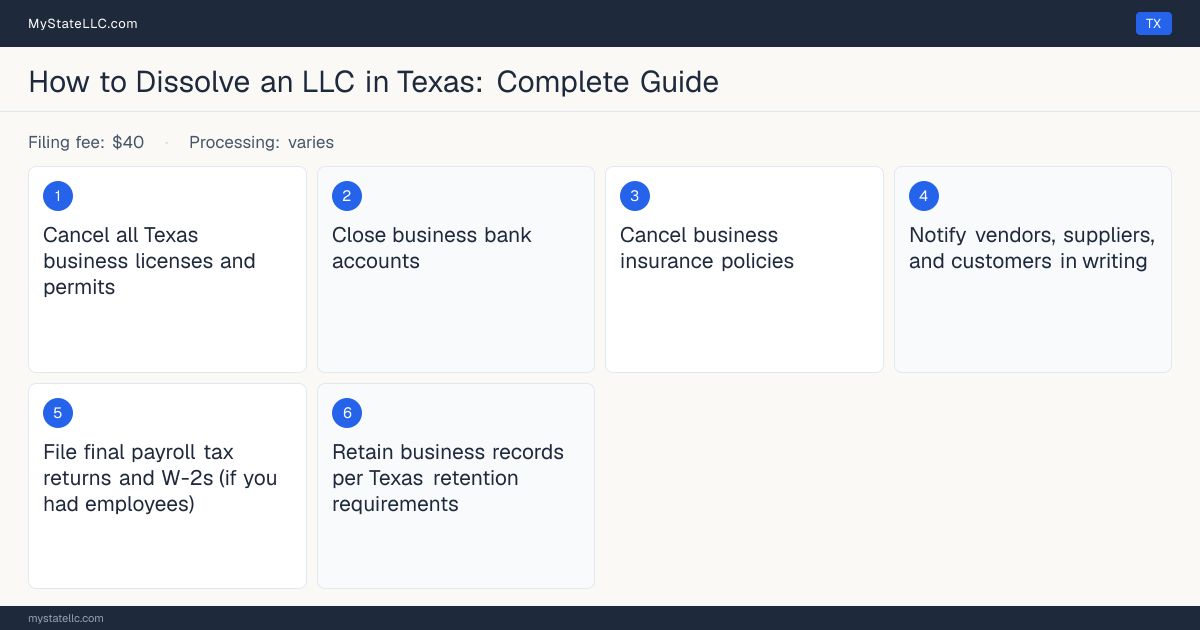
- Cancel all Texas business licenses and permits
Terminating with the Secretary of State does not cancel anything issued by another agency or by your city or county. Contact each issuer directly and get written confirmation so renewal notices and fees stop arriving.
- Close business bank accounts
Close accounts only after the final distributions clear and the last payment settles, since a closed account cannot receive a refund or a late customer payment. Ask for closing statements and file them with your termination records.
- Cancel business insurance policies
Give each carrier the termination date in writing and ask about unearned premium refunds on general liability, property and workers' compensation cover. Because claims can be brought for three years after termination, ask about tail cover before cancelling a claims made policy.
- Notify vendors, suppliers, and customers in writing
Texas sets no statutory creditor notice period for LLCs, so this is commercial housekeeping rather than a legal deadline, and it is still worth doing well. Give a final transaction date, a contact for settling open balances, and an address for anything that arrives after you close.
- File final payroll tax returns and W-2s (if you had employees)
Issue final paycheques, file the closing federal employment tax returns, and send W-2s for the year, then close the state accounts the LLC held for employment purposes. Do this before you request the Certificate of Account Status so nothing outstanding blocks it.
- Retain business records per Texas retention requirements
Let your actual exposure set the period rather than a number someone quoted you. A terminated entity survives three years for claims purposes, so keep the accepted Form 651, the Comptroller certificate, final returns and distribution schedules at least until that window closes and every tax year is settled.
Frequently Asked Questions
Sources
Each entry below is a document recorded in our verified Texas sources, and each entry says what the document is. Some statutory text is read from an accurate mirror rather than from the state's own host, and those say so.
- sos.state.tx.us/corp/index.shtmlTexas Secretary of State: business entity filings
- sos.state.tx.us/corp/instructions/651.shtmlTexas Secretary of State: LLC dissolution
- sos.state.tx.us/corp/termreinfaqs.shtmlTexas online dissolution filing
Formation Services Compared
Forming an LLC in Texas?
See how Northwest Registered Agent, Bizee, ZenBusiness and LegalZoom, the formation services we partner with, compare on 3-year cost, BBB rating and Trustpilot score before you choose.

Edmond Hui · Founder, MyStateLLC
Edmond Hui is a software engineer and serial entrepreneur based in New York who has founded multiple online businesses across e-commerce, media, and information publishing. Before transitioning into tech, he spent years as a commercial real estate professional closing deals totaling over 100,000 square feet, giving him firsthand experience with business formation and entity structuring. He built MyStateLLC to provide the free, state-specific LLC guidance he wished existed when forming his own companies.