Florida LLC vs Texas LLC (2026)
Written for owners based in Florida.
Based in Texas? Read Texas LLC vs Florida LLC →
Compare Florida LLC vs Texas LLC on filing fees, taxes, privacy laws, and annual costs. Find out which state is actually better for your business.
By Edmond Hui · Last updated: September 13, 2026
Verdict: for most owners, form where the business is based
Texas charges $300 to form, $175 more than Florida, and then nothing for the Public Information Report, against $138.75 every year here. Neither state taxes personal income. The Texas filing must still be made even when no franchise tax is owed: total revenue at or below $2,650,000 on a 2026 report means no tax but not no return, and skipping it starts the road to forfeiture. Five years in Texas cost $300 against $818.75, though a Texas LLC working here adds $125 of registration plus the Florida report.
Using a formation service? We compare the 4 formation services that pay us a commission, on three-year service cost, BBB rating and Trustpilot score.
Compare LLC formation services →Ready to file? Our affiliate partner ZenBusiness files your LLC formation paperwork, from $0 + state fee.
Start your LLC with ZenBusiness →Affiliate link. We may earn a commission at no cost to you. MyStateLLC is not a law firm and does not provide legal advice.
| Factor | Florida | Texas |
|---|---|---|
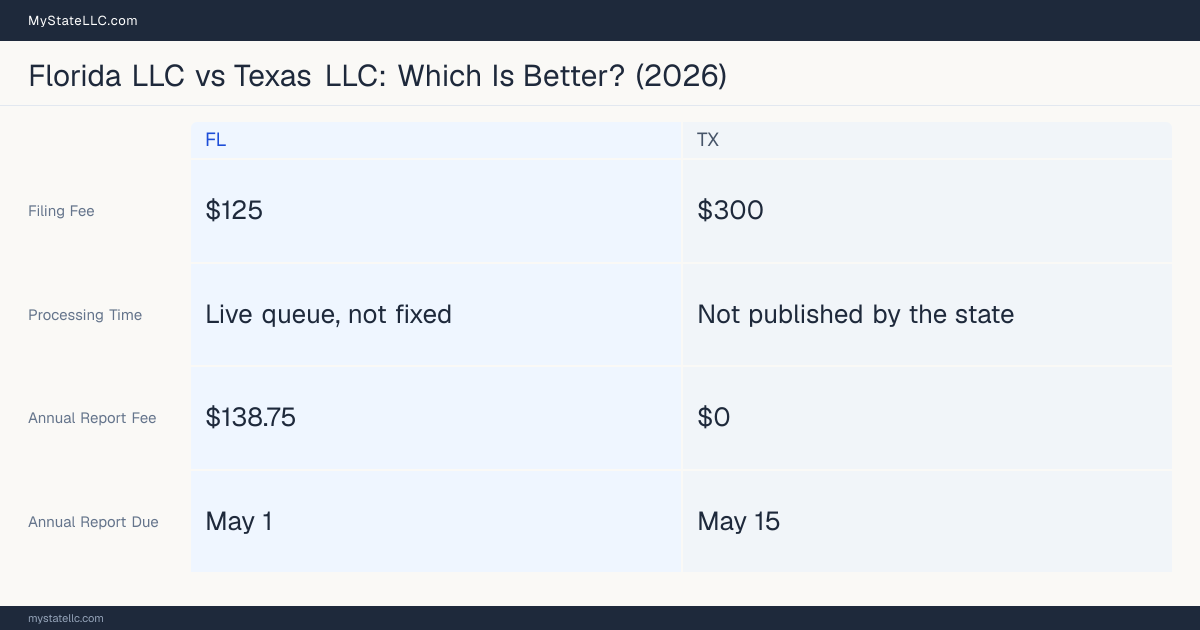
| Filing Fee | $125 | $300 |
| Processing Time | Live queue, not fixed | Not published by the state |
| Annual Report Fee | $138.75 | $0 |
| Annual Report Due | May 1 | May 15 |
| State Income Tax | No | No |
| Anonymous LLC | No | No |
| Publication Requirement | No | No |
| Foreign LLC Cost (if forming out-of-state) | N/A, you're in your home state | $125 + registered agent ~$150/yr |
Full fee breakdown for either state: Florida LLC cost and Texas LLC cost.
Business Climate: Florida vs Texas
| Factor | Florida | Texas |
|---|---|---|
| 5-year business survival rate | 49.5% (#34 of 51) | 52.5% (#20 of 51) |
| Business application growth (2026 YTD (Jan to Jul) vs 2025 YTD (same months)) | +15.5% YoY (#1 of 51 by volume) | +13.7% YoY (#3 of 51 by volume) |
Sources: U.S. Bureau of Labor Statistics, Business Employment Dynamics · U.S. Census Bureau, Business Formation Statistics (BFS)
Compare LLC Costs: Florida vs Texas
Florida
Texas
Costs include every mandatory state charge: the filing fee, the report fee (annualised where a state files biennially), any state entity-level tax shown in its own row above, a one-time publication cost where the state publishes a rate for it, and any one-time registration charge a state requires before the LLC may trade. Two exclusions follow from that wording. Arizona and Nebraska require publication and publish no rate, so no newspaper cost is carried for either and their totals are not the whole cost. Alaska's $50 annual state business licence is a separate charge from the Secretary of State fees and is not carried here either. Annualising makes the 1, 3 and 5 year rows a cost of ownership rather than a payment schedule: a biennial state charges its whole report fee in the years it falls due and nothing in between. Entity-level taxes that only apply after a corporate election, or above an owner or income threshold, are excluded and flagged on the state's own cost page. New York's publication cost is carried at a $250 floor, roughly $200 of newspaper cost in a low-cost county plus the $50 Certificate of Publication fee. No county-clerk-designated New York City newspaper publishes a rate card, so the four-figure NYC estimates in wide circulation cannot be traced to a primary source and are not asserted here; budget for materially more than the floor if you file in a NYC county. Montana's annual report is free when filed by April 15 and $35 after, a waiver that applies to reports filed between January 1 and April 15. Every fee was verified against the state's own fee schedule, statute, or revenue authority on 29 July 2026. Excludes registered agent and legal fees. For informational purposes only, not legal or tax advice.
Filing Fees & Formation Costs
Florida charges $125 to form an LLC, while Texas charges $300. Florida is $175 cheaper upfront. The cost that usually gets overlooked: if you form in Texas but operate in Florida, you must also register as a foreign LLC in Florida (a $125 filing) and maintain a registered agent in Texas (typically around $150 per year). That puts the realistic first-year cost of the Texas route at roughly $575, versus $125 for simply forming in Florida. Speed isn't a basis for choosing between them: neither Florida nor Texas publishes a standard processing time, so any figure comparing the two is guesswork.
Taxes: Florida vs Texas
Neither Florida nor Texas levies a personal income tax, so there's no income-tax advantage to forming in either state. Texas imposes a franchise tax; LLCs under the no-tax-due threshold ($2,650,000 total revenue for 2026-27 reports) owe $0 but must still file an annual Public Information Report.
Privacy & Asset Protection
Neither Florida nor Texas offers anonymous LLC formation: both states require owner or manager information on public filings. The Certificate of Formation (Form 205) must name at least one governing person (member or manager), a public record; the annual Public Information Report also discloses management. Business owners who prioritize privacy typically form a holding company in a state like Wyoming or New Mexico instead. Both states provide charging-order protection for LLC members, and for most small businesses the practical difference in asset protection between the two is minimal.
Annual Maintenance Costs
Florida LLCs file an annual report ($138.75, due May 1), and Texas LLCs file a free annual report (due May 15). If you form in Texas while operating in Florida, you maintain filings in both states (Texas's report plus Florida's equivalent for your foreign registration) and pay a Texas registered agent roughly $150 per year. That brings ongoing costs of the Texas route to roughly $288.75 per year, versus about $138.75 to keep a domestic Florida LLC in good standing. One more recurring cost to budget for: Texas imposes a franchise tax; LLCs under the no-tax-due threshold ($2,650,000 total revenue for 2026-27 reports) owe $0 but must still file an annual Public Information Report.
When Texas Actually Makes Sense
Forming in Texas makes sense in a few specific situations: your business genuinely operates in Texas, with a real office, employees, or property there, or you're relocating to Texas in the near future. For a typical small business based in Florida, none of these usually apply. Registering a Texas LLC to do business back home means $125 in Florida foreign-registration fees, on top of Texas's $300 formation fee, while Florida's own annual report runs $138.75 a year and is due May 1. When in doubt, form where you actually do business.
Frequently Asked Questions
Ready to form your LLC?
Using a formation service? We compare the 4 formation services that pay us a commission, on three-year service cost, BBB rating and Trustpilot score.
Compare LLC formation services →Our affiliate partner ZenBusiness files your LLC formation paperwork, from $0 + state fee.
Start your LLC with ZenBusiness →Affiliate link. We may earn a commission at no cost to you. MyStateLLC is not a law firm and does not provide legal advice.
More State Comparisons
Embed this comparison, free
Add the Florida vs Texas cost calculator to any page. Works in WordPress, Squarespace, Webflow, and any HTML site.
<iframe src="https://www.mystatellc.com/tools/compare-states?embed=1&stateA=FL&stateB=TX" width="100%" height="720" frameborder="0" style="border:0;max-width:900px;display:block;margin:0 auto;" title="Florida vs Texas LLC Cost Comparison" loading="lazy"></iframe>
<p style="text-align:center;font-size:.8125rem;color:#6b7280">Source: <a href="https://www.mystatellc.com/llc/compare/florida-llc-vs-texas-llc">MyStateLLC, Florida vs Texas LLC Comparison</a></p>

Edmond Hui · Founder, MyStateLLC
Edmond Hui is a software engineer and serial entrepreneur based in New York who has founded multiple online businesses across e-commerce, media, and information publishing. Before transitioning into tech, he spent years as a commercial real estate professional closing deals totaling over 100,000 square feet, giving him firsthand experience with business formation and entity structuring. He built MyStateLLC to provide the free, state-specific LLC guidance he wished existed when forming his own companies.