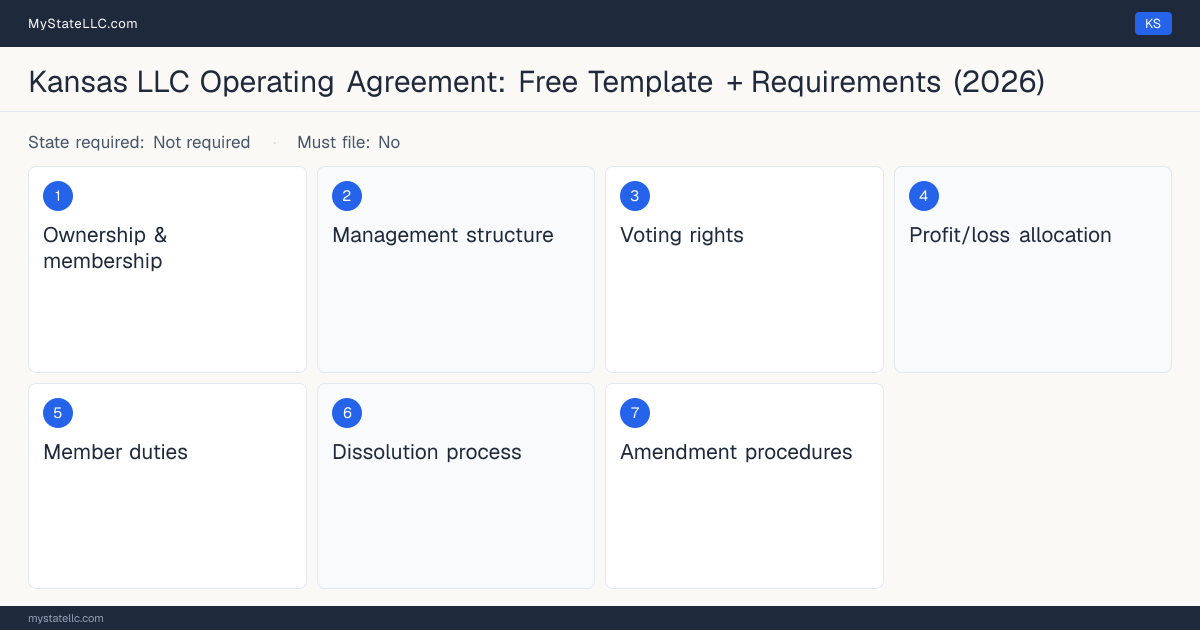
Kansas does not legally require an LLC operating agreement, but having one protects your limited liability status and sets the rules for ownership and profits. See exactly what to include below.
Edmond Hui is a software engineer and serial entrepreneur based in New York who has founded multiple online businesses across e-commerce, media, and information publishing. Before transitioning into tech, he spent years as a commercial real estate professional closing deals totaling over 100,000 square feet, giving him firsthand experience with business formation and entity structuring. He built MyStateLLC to provide the free, state-specific LLC guidance he wished existed when forming his own companies.
Affiliate disclosure: We may earn a commission at no extra cost to you.
Define each member's ownership percentage and capital contributions. This section establishes who owns what portion of your Kansas LLC and how initial investments are tracked.
Management structure
Specify whether your LLC will be member-managed or manager-managed. This determines who has authority to make business decisions and bind the company in Kansas.
Voting rights
Outline how decisions are made, including voting thresholds for major decisions. Clear voting procedures prevent disputes and ensure smooth operations for your Kansas LLC.
Profit/loss allocation
Detail how profits and losses are distributed among members. This section affects your tax obligations and ensures fair distribution according to your Kansas LLC's agreement.
Member duties
Define each member's responsibilities, time commitments, and restrictions on competing activities. This prevents conflicts and clarifies expectations for all Kansas LLC members.
Dissolution process
Establish procedures for ending the LLC, including asset distribution and member buyout rights. Having clear dissolution terms protects all parties if your Kansas LLC needs to close.
Amendment procedures
Set rules for modifying the operating agreement as your business evolves. This ensures changes can be made legally and with proper member consent in your Kansas LLC.
Frequently Asked Questions
No, Kansas does not legally require LLCs to have an operating agreement. The Kansas Secretary of State does not mandate one as a condition of formation or ongoing compliance. However, this legal flexibility creates practical risk: without a written agreement, Kansas's default LLC statutes (Kansas Statutes Annotated Chapter 17, Article 76) automatically govern your business structure, ownership percentages, profit distribution, and decision-making processes—often in ways that don't match your intentions. For example, if you have two equal members but haven't documented profit splits, Kansas law presumes equal distribution regardless of capital contributions. More critically, courts may disregard your liability protection if you operate without documented governance, treating the LLC as a partnership. An operating agreement also prevents internal disputes over voting rights, member withdrawal procedures, and buy-sell provisions. Download a Kansas-specific template and have each member sign it before your Articles of Organization are filed with the Kansas Secretary of State—this single document protects both your legal shield and your business relationships.
Yes, you can draft your own Kansas LLC operating agreement, and Kansas law doesn't require you to file it with the Kansas Secretary of State. However, your agreement must comply with Kansas Statutes Annotated Chapter 17, which governs LLC formation and operation. Self-drafted agreements often miss critical provisions addressing member buyouts, profit distribution percentages, and dissolution procedures—gaps that become costly during disputes. Kansas courts will default to statutory rules if your agreement is silent on key issues, potentially overriding your intentions. An attorney review typically costs $300–$800 in Kansas but protects you from ambiguous language that could trigger litigation exceeding $5,000 in legal fees. If you proceed solo, use Kansas-specific templates that reference the Kansas LLC Act, not generic multistate versions. Download the Kansas Secretary of State's LLC formation guide to understand mandatory statutory requirements. Have an attorney at least review your draft before signatures, ensuring your agreement truly reflects your operating structure and member protections.
No, Kansas does not require LLC operating agreements to be notarized. The agreement only needs to be signed by all members to be valid and enforceable under Kansas law. However, having your operating agreement notarized offers practical protection: a notarized document carries stronger legal weight if disputes arise and can simplify matters if you need to prove the agreement's authenticity in court or with lenders. Kansas notaries are available through banks, law offices, and the Kansas Secretary of State's office, typically charging $5–15 per signature. While notarization is optional under Kansas Statutes Annotated § 17-7604, many LLC owners choose this step to strengthen enforceability when dealing with financial institutions or resolving member disagreements. If you're obtaining financing or expect potential conflicts among members, consider having all member signatures notarized before finalizing your operating agreement. Visit a local Kansas notary or contact your bank's notary services to have signatures witnessed and certified.
Without an operating agreement, your Kansas LLC will be governed by the default provisions in the Kansas Limited Liability Company Act (K.S.A. 17-7601 et seq.). This means you surrender control over critical operational decisions, including how profits and losses are distributed among members, whether management is member-managed or manager-managed, voting rights on major decisions, and procedures for adding or removing members.
Under Kansas's default rules, profits are distributed equally regardless of capital contributions, and all members have equal voting rights and management authority—potentially creating deadlock situations. You'll also lack written documentation of member agreements, making disputes harder to resolve and exposing your LLC to increased litigation risk.
For single-member LLCs, this creates particular vulnerability: without a written agreement, you lose the documented separation between personal and business assets that protects your liability shield.
Your immediate next step is to draft and have all members sign a Kansas LLC operating agreement before conducting any significant business transactions or major decisions. This document should address profit distribution, management structure, member roles, and dispute resolution procedures specific to your business needs.
Yes, you can amend your Kansas LLC operating agreement at any time by following the procedures specified in your original agreement. Kansas law allows flexibility here—most operating agreements require either unanimous or majority member consent, depending on what you're changing. Major modifications like membership percentages or profit distributions typically demand unanimous approval, while administrative updates may only need majority consent. You must document amendments in writing and keep records with your LLC's permanent files, as the Kansas Secretary of State doesn't require filing amendment documents unless your Articles of Organization also change. The practical benefit is that you can adapt your agreement as your business evolves without dissolving or reforming your LLC. To proceed, review your current operating agreement's amendment clause first, obtain the required member signatures, then store the signed amendment with your LLC records indefinitely.