Florida does not legally require an LLC operating agreement, but having one protects your limited liability status and sets the rules for ownership and profits. See exactly what to include below.
Edmond Hui is a software engineer and serial entrepreneur based in New York who has founded multiple online businesses across e-commerce, media, and information publishing. Before transitioning into tech, he spent years as a commercial real estate professional closing deals totaling over 100,000 square feet, giving him firsthand experience with business formation and entity structuring. He built MyStateLLC to provide the free, state-specific LLC guidance he wished existed when forming his own companies.
Affiliate disclosure: We may earn a commission at no extra cost to you.
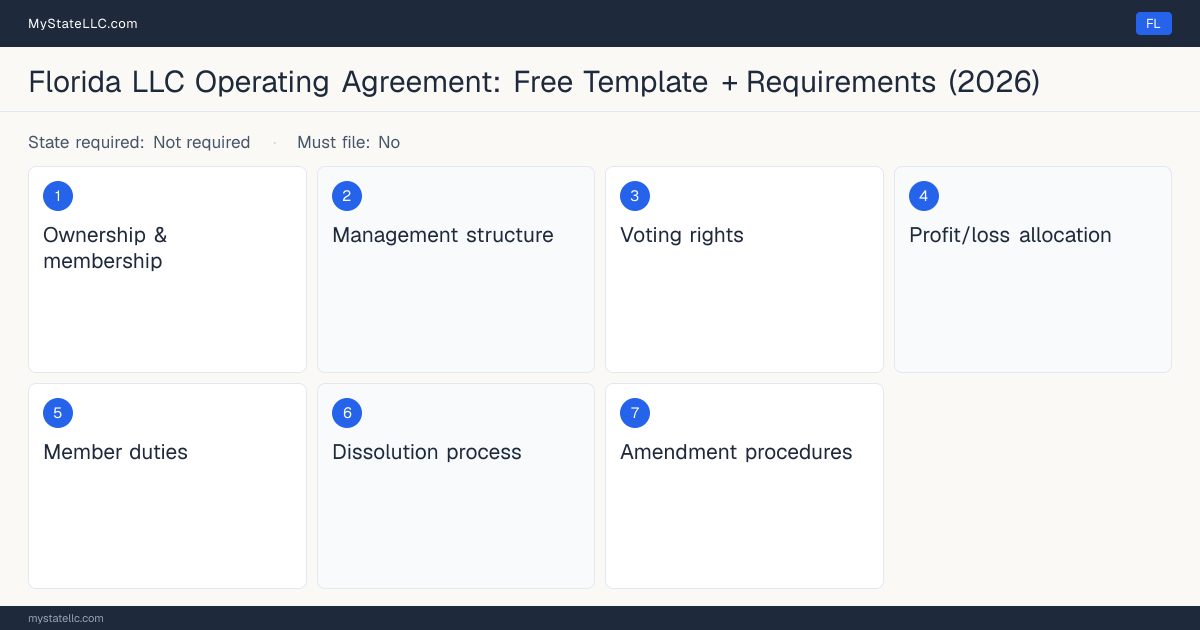
Define each member's ownership percentage, capital contributions, and membership interests. This establishes clear ownership rights and prevents future disputes over who owns what portion of the LLC.
Management structure
Specify whether your LLC is member-managed or manager-managed and outline decision-making authority. This clarifies who has the power to bind the LLC in contracts and daily operations.
Voting rights
Establish voting procedures, quorum requirements, and what decisions require member approval. Clear voting rules prevent deadlocks and ensure important business decisions can be made efficiently.
Profit/loss allocation
Detail how profits and losses will be distributed among members, including timing and method of distributions. This section is crucial for tax planning and member expectations.
Member duties
Outline each member's responsibilities, time commitments, and restrictions on competing businesses. This prevents conflicts by setting clear expectations for member involvement and loyalty.
Dissolution process
Define the circumstances that trigger dissolution and the process for winding up the LLC's affairs. A clear dissolution plan protects members' interests and ensures orderly business closure.
Amendment procedures
Specify how the operating agreement can be modified, including required approval percentages and documentation. This allows the agreement to evolve with your business while maintaining stability.
Frequently Asked Questions
No, Florida law does not require LLCs to have a written operating agreement under Florida Statutes Chapter 605. However, this legal absence creates significant risk: without a documented agreement, Florida courts will apply default statutory provisions, which may not reflect your business intentions or member relationships. Having an operating agreement is strongly recommended to protect your limited liability status, establish clear governance procedures, define member voting rights and profit distributions, outline procedures for adding or removing members, and prevent costly disputes. The practical implication is substantial—if a member dispute arises and you lack an agreement, Florida's default LLC rules treat the company more like a partnership, potentially exposing all members to personal liability. Additionally, many lenders and investors require operating agreements before providing capital or credit. Your next step is to create a comprehensive operating agreement before conducting business, outlining member contributions, management structure, and dissolution procedures specific to your Florida LLC's needs.
Yes, you can draft your own Florida LLC operating agreement, and Florida Statutes Chapter 605 does not require attorney involvement. However, Florida law mandates specific provisions for multi-member LLCs, including profit distribution percentages, member voting rights, and dissolution procedures—areas where self-drafted agreements commonly contain gaps that create costly disputes later.
The Florida Department of State does not provide official templates, meaning you'll need to use third-party resources or templates that comply with Florida's statutory requirements. If your LLC has multiple members, omitting required provisions could leave your personal assets vulnerable in litigation, since courts may default to statutory rules rather than enforcing your intended arrangements.
The practical implication: a $200–500 attorney review typically costs far less than litigation over ambiguous ownership terms or management authority. At minimum, have a Florida business attorney review any self-drafted agreement before all members sign, ensuring it addresses member withdrawal, capital contributions, and dispute resolution specific to your arrangement.
No, Florida law does not require LLC operating agreements to be notarized. The Florida Limited Liability Company Act (Chapter 605, Florida Statutes) contains no notarization mandate for internal governance documents. However, notarization becomes practically necessary when third parties—particularly banks, lenders, and commercial landlords—request certified copies before approving business loans, lines of credit, or lease agreements. Many Florida financial institutions require notarized operating agreements as proof of authority before releasing funds or entering contracts. Additionally, if your LLC will conduct real estate transactions, a notarized agreement strengthens your position in title disputes or foreclosure proceedings. The cost is minimal: Florida notary fees typically range from $10–$25 per signature, and most banks have notaries on-site. To protect your interests, have your operating agreement notarized by a Florida-certified notary public before approaching lenders or executing significant business contracts. Request at least three certified copies—one for your LLC records, one for your business bank account application, and one for your attorney's files.
Without an operating agreement, your Florida LLC will be governed by Florida Statutes Chapter 605, which imposes default provisions that may not align with your business needs. Specifically, Florida law mandates equal profit distribution among members regardless of capital contributions, requires unanimous consent for major decisions, and designates all members as managers unless you file Articles of Organization stating otherwise with the Florida Department of State, Division of Corporations.
This creates practical risks: if you contributed 70% of startup capital but have an equal partner, you'll receive only 50% of profits under statute. Any member can bind the LLC to contracts without others' approval. Disputes over management control become costly litigation rather than contractual resolution.
Additionally, without a written agreement, the Florida Department of State cannot help clarify internal ownership disputes, forcing you to pursue court intervention—a process costing $2,000–$5,000+ in legal fees.
Your next step: Draft or download a Florida LLC Operating Agreement template, customize it for your ownership structure and profit-sharing terms, and have all members sign before conducting business.
Yes, a Florida LLC operating agreement can be amended at any time, but the amendment process must strictly follow the procedures outlined in your original agreement. Most Florida LLCs require unanimous member approval for amendments, though your agreement may specify a different threshold—such as a majority vote or supermajority consent. When amending, you must document the change in writing using either an amendment form or a restatement of the entire operating agreement, depending on the scope of changes. The Florida Department of State does not require you to file amendments to your operating agreement, unlike Articles of Organization changes, which means amendments remain internal documents. However, if your amendment affects matters registered with the state—such as the registered agent or principal place of business—you'll need to file an amended Articles of Organization (Form LLC1A.1) with a $50 filing fee. This distinction is critical: operating agreement amendments are flexible and private, but changes affecting your LLC's state registration require formal filings. Review your current operating agreement's amendment clause immediately to confirm your specific approval requirements, then prepare your amendment in writing and maintain it with your LLC records.