West Virginia does not legally require an LLC operating agreement, but having one protects your limited liability status and sets the rules for ownership and profits. See exactly what to include below.
Edmond Hui is a software engineer and serial entrepreneur based in New York who has founded multiple online businesses across e-commerce, media, and information publishing. Before transitioning into tech, he spent years as a commercial real estate professional closing deals totaling over 100,000 square feet, giving him firsthand experience with business formation and entity structuring. He built MyStateLLC to provide the free, state-specific LLC guidance he wished existed when forming his own companies.
Affiliate disclosure: We may earn a commission at no extra cost to you.
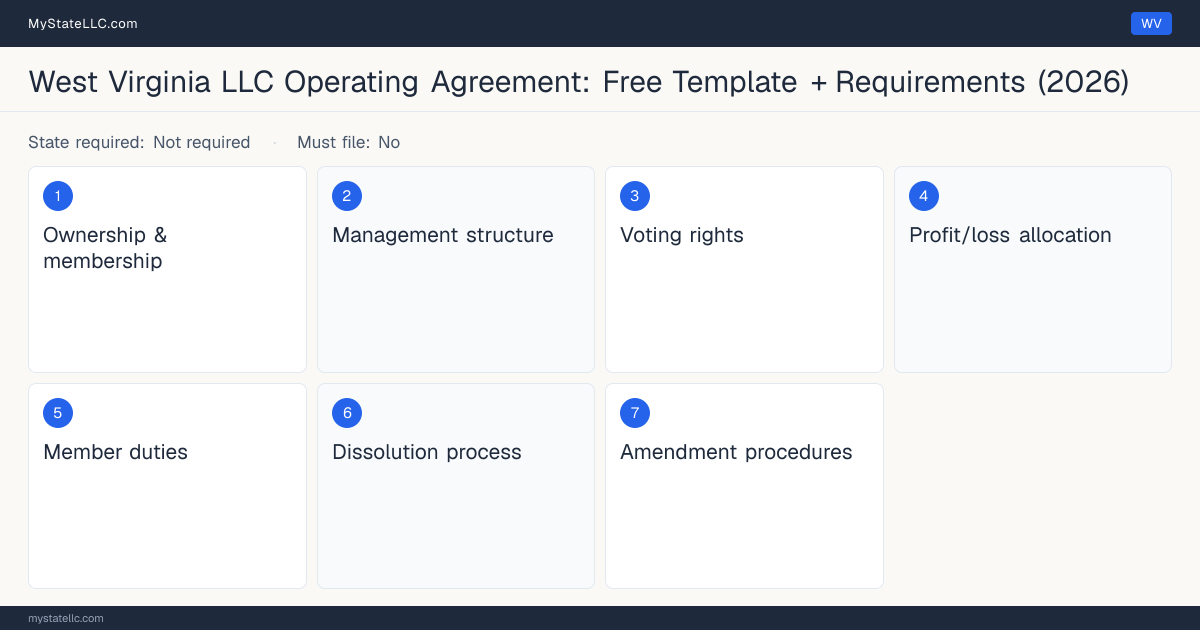
Define each member's ownership percentage and initial capital contributions. This section establishes who owns what portion of the LLC and prevents future disputes over ownership stakes.
Management structure
Specify whether your LLC is member-managed or manager-managed and outline decision-making authority. This clarifies who has the power to make business decisions and bind the company.
Voting rights
Establish voting procedures and thresholds for different types of decisions. This ensures all members understand how votes are counted and what constitutes approval for various business matters.
Profit/loss allocation
Detail how profits and losses will be distributed among members and specify timing of distributions. This prevents confusion about financial expectations and tax obligations.
Member duties
Outline each member's responsibilities, time commitments, and any restrictions on competing activities. This sets clear expectations and helps avoid conflicts over member obligations.
Dissolution process
Define the circumstances that trigger dissolution and the procedures for winding up the business. This provides a clear roadmap for ending the LLC if necessary and protects all parties' interests.
Amendment procedures
Establish how the operating agreement can be modified, including required votes and documentation. This ensures changes to the agreement follow a proper process and all members are protected.
Frequently Asked Questions
No, West Virginia law does not require LLCs to have a written operating agreement. However, this omission carries significant practical consequences. Without a documented agreement, West Virginia's default LLC rules under W.Va. Code §31D-1-101 et seq. automatically govern your business, which may not align with your intentions. This means profit distributions default to equal splits regardless of capital contributions, management decisions require unanimous consent, and members face reduced liability protection in disputes. The West Virginia Secretary of State's office, located in Charleston, does not require operating agreements for formation or annual filings. However, creating one costs minimal effort and protects your liability shield considerably—courts have pierced veils in LLCs lacking clear governance documents. Additionally, most banks and commercial lenders demand operating agreements before extending credit. Practically, without a written agreement, internal conflicts over profit-sharing or management authority often escalate to costly litigation. Your next step is downloading a West Virginia-specific template and having each member sign it before conducting business, then retaining copies with your formation documents and Articles of Organization.
Yes, you can write your own West Virginia LLC operating agreement—the state does not require you to file it with the West Virginia Secretary of State, only to maintain it internally. However, this flexibility comes with significant risk for multi-member LLCs. West Virginia law (W.Va. Code §31D-1-101 et seq.) fills gaps in your operating agreement with default rules that may not protect your interests—for example, profits default to equal distribution regardless of capital contributions. For single-member LLCs with straightforward operations, a template covering membership rights, profit distribution, and management structure may suffice. For multi-member LLCs, partnerships involving substantial capital, or businesses with complex profit-sharing arrangements, an attorney review costs $300–500 and prevents costly disputes later. Inadequate agreements frequently lead to deadlock situations where members cannot agree on critical decisions without expensive litigation. Your next step: download a West Virginia-specific template from the Secretary of State's website, complete it with your specific terms, then consult a local attorney to ensure it addresses your business structure and protects all members' interests before operations begin.
No, West Virginia does not require operating agreements to be notarized. The West Virginia Secretary of State does not mandate notarization as a legal prerequisite for LLC formation or operation.
However, having all members sign the document is essential to make it legally binding and enforceable. Without signatures, your operating agreement lacks the contractual force needed to govern member relationships, profit distribution, and management decisions.
While notarization isn't legally required, many West Virginia LLC owners choose to have their operating agreements notarized anyway. This creates a certified record with a date stamp and witness verification, which strengthens the document's credibility if disputes arise in court. A notary public in West Virginia typically charges $5–$10 per signature for this service.
The practical implication: if your LLC faces internal conflict or litigation, a notarized operating agreement carries more evidentiary weight than an unsigned or unwitnessed version, potentially saving expensive legal battles.
Your concrete next step: gather all LLC members, ensure each person signs the operating agreement, and consider having a West Virginia notary public witness the signatures for added legal protection.
Without an operating agreement, your West Virginia LLC automatically defaults to the state's statutory rules under West Virginia Code §31D-1-101 et seq., meaning you forfeit control over critical operational decisions. The West Virginia Secretary of State's office won't enforce any custom arrangements you intended, so profit distributions default to equal splits regardless of capital contributions, voting follows a one-member-one-vote structure even if ownership percentages differ, and management authority defaults to all members sharing equal say in daily operations. This creates significant practical problems: if one member wants to sell their stake, you have no contractual buyout terms; if a dispute arises, you lack predetermined resolution procedures and may face costly litigation; and if a member becomes incapacitated or dies, succession becomes legally murky. For multi-member LLCs especially, this exposes you to unexpected liability and operational deadlock. File your operating agreement with the Secretary of State in Charleston immediately—it costs nothing to draft using their template resources, but the protection it provides is invaluable when conflicts emerge.
Yes, you can amend your West Virginia LLC operating agreement after formation, but the process depends on your original agreement's terms. If your operating agreement specifies amendment procedures—such as requiring a majority vote, unanimous consent, or a designated amendment process—you must follow those exact procedures. If no amendment procedures were outlined, West Virginia law requires unanimous written consent from all members to modify the agreement. Any amendments must be documented in writing and signed by all members who consent; verbal modifications are not legally binding and create liability exposure. The amended agreement should be retained with your LLC records and provided to all members. This distinction matters significantly: if you fail to follow your agreement's amendment procedures or don't obtain proper consent, the amendment may be unenforceable, leaving your LLC governed by the outdated original agreement and potentially causing disputes among members. To proceed, review your current operating agreement's amendment section, determine whether you need majority or unanimous approval, draft the specific changes in writing, and obtain all required signatures before implementing any operational changes based on the amendment.