How to Start an LLC in Nevada: Your Complete 2026 Guide
Form your Nevada LLC in just one business day with our step-by-step guide covering everything from name selection to tax registration.
By Edmond Hui · Last updated: August 2026
Nevada is one of 34 states that publish no standard LLC turnaround: its fee schedule prices expedited service but attaches no figure to the ordinary $75 filing
The Nevada Secretary of State sells speed instead of promising it: $125 for 24-hour (any other special service, more than 2 but within 24 hours), $500 for 2-hour (more than 1 but within 2 hours), and $1,000 for 1-hour. Treat any specific day count you see quoted for Nevada with suspicion. It didn't come from the state. Plan around the filing itself, and buy an expedite tier if your timing is genuinely fixed.
Source: MyStateLLC 50-state primary-source processing verification, July 2026
Formation Services Compared
Choosing an LLC formation service for Nevada?
We compared Northwest Registered Agent, Bizee, ZenBusiness and LegalZoom, the formation services we partner with, on 3-year cost, BBB rating and Trustpilot score.
$0 ZenBusiness service fee, or $39 with Northwest, plus your $75 state fee. Registered agent renews from year two.
Affiliate disclosure: We may earn a commission at no extra cost to you.
Start your LLC with ZenBusinessIncludes 1 year registered agent + operating agreementForm your LLC with Northwest ($39 + state fee)Includes a year of registered agent service. That enrolls you by default in annual report filing at $100 plus state fees, cancellable any time.Prefer to file directly? File yourself at the Secretary of State → ($75 state fee, no service fee)
Not sure which service is right? Compare formation services →
Quick Facts
| State filing fee | $75 |
| Processing time | Not published by the state |
| Annual report due | Anniversary month |
| Annual report fee | $150 |
| State income tax | No state income tax. Every LLC owes a $200 State Business License each year, and Commerce Tax applies only above $4 million of Nevada gross revenue |
Source: Nevada Secretary of State (verified July 2026)
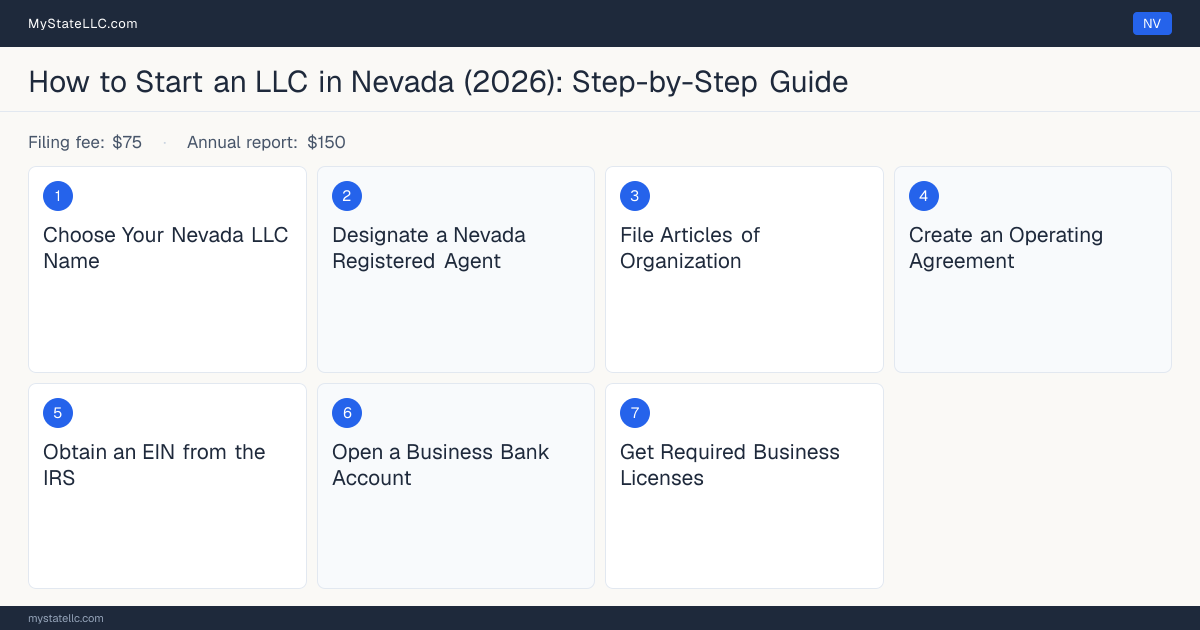
How to Form an LLC: Step-by-Step
- 1
Choose Your Nevada LLC Name
Select a unique name that ends with 'LLC' or 'Limited Liability Company' and isn't already taken by another Nevada business. Search the Nevada Secretary of State's business database to verify availability before filing.
Choosing the right name for your Nevada LLC is more than a branding decision. It's a legal requirement that must be satisfied before you can file your formation documents. Your name must be distinguishable from every other active business entity already on file with the Nevada Secretary of State (or equivalent agency), meaning a name can't simply swap a common word or use a variant spelling to get around an existing registration. Before you invest in a logo or website, run a thorough name search using the Nevada Secretary of State SilverFlume at https://esos.nv.gov/EntitySearch/OnlineEntitySearch. The search is free and returns results in real time. If your first choice is taken, try variations: adding your city, a descriptor (e.g., 'Group', 'Solutions', 'Services'), or your own name. Once you confirm availability in the state database, also check the U.S. Patent and Trademark Office (USPTO) trademark database at tmsearch.uspto.gov to avoid federal trademark conflicts. State approval doesn't protect you from trademark infringement suits.
What to Fill In
- Entity name exactly as it should appear in Nevada records
- Required designator: 'Limited Liability Company', 'LLC', or 'L.L.C.' (or state-approved abbreviation)
- Name reservation applicant name and address (if filing a separate name reservation)
- Name reservation term: typically 60 to 120 days depending on the state
Common Rejection Reasons
- Name isn't distinguishable from an existing business already registered in Nevada
- Missing the required LLC designator ('LLC', 'L.L.C.', or 'Limited Liability Company')
- Name contains a restricted or prohibited word (e.g., 'Bank', 'Insurance', 'Engineer') that requires additional state agency approval
- Name is identical or deceptively similar to a name reserved by another applicant
- Name implies a government affiliation (e.g., 'Federal', 'State', 'Bureau') without proper authorization
Processing Times
- Online: Name availability search results are instant; name reservation approval typically takes 1 to 3 business days
- Mail: Name reservation by mail takes 1 to 2 weeks depending on state volume
After Approval
Once the name clears, write it down exactly as it will appear on the filing, capitalization and spacing included. Use that exact string everywhere else in the process. If you want to secure the name before you're ready to file, submit a name reservation for the applicable fee. With your name locked in, proceed immediately to selecting your registered agent so you've all the information you need for the filing form.
Pro tip: Nevada allows you to reserve your chosen name for 90 days for $25 if you need time to prepare your filing documents. - 2
Designate a Nevada Registered Agent
Appoint a registered agent with a Nevada street address to receive legal documents and state correspondence. You can serve as your own registered agent or hire a professional service for privacy and reliability.
A registered agent (sometimes called a 'statutory agent', 'agent for service of process', or 'resident agent' depending on the state) is the person or business entity officially designated to receive legal documents on your LLC's behalf, lawsuit service of process, tax notices, and compliance warnings routed through Nevada Secretary of State SilverFlume. The registered agent must have a physical street address in Nevada, a P.O. Box is never acceptable. You have three options: serve as your own registered agent (if you have a Nevada street address and can be there 9am to 5pm on business days), name another individual who agrees to serve in this role, or hire a professional registered agent service. Professional services typically cost $49 to $299 per year and provide guaranteed document handling, compliance reminders, and continuity if you move or travel. Nevada does require ownership information in state filings, so a professional registered agent mainly protects your home address rather than your identity, for full anonymity, owners typically pair a Nevada LLC with a holding company formed in a state that allows it. Confirmed not anonymous despite marketing: both the domestic Initial/Annual List (NRS 86.263(1)) and the foreign LLC list (NRS 86.5461(1)) must state the names, titles, and addresses of all managers or, if none, all managing members, and these lists are public record filed at formation and annually.
What to Fill In
- Registered agent's full legal name (individual or business entity name)
- Registered agent's street address in Nevada (no P.O. Boxes, must be a physical location)
- Registered agent's mailing address (if different from street address)
- Registered agent consent or acceptance (some states require a signed consent form or a checkbox on the Articles)
Common Rejection Reasons
- Registered agent address is a P.O. Box, virtual office, or mail drop service
- Address provided is outside Nevada. The agent must be a Nevada resident or entity
- The named entity as registered agent isn't authorized to do business in the state
- Registered agent consent is missing when required by the state
- Registered agent's street address is incomplete (missing suite or unit number for a multi-tenant building)
Processing Times
- Online: The registered agent designation is part of your Articles/Certificate filing, no separate processing time
- Mail: Same as the formation document. RA information is reviewed with the full filing
After Approval
Notify your registered agent immediately after your LLC is approved. They need to know they're officially listed and to be on the lookout for any documents from the state. If you used a professional service, complete their onboarding process and set up document forwarding preferences. Keep your registered agent's information current: if your RA moves, resigns, or if you switch services, you must file a statement of change with Nevada Secretary of State SilverFlume (typically a $10 to $30 fee) before your next Annual List and State Business License is due, failure to maintain a valid registered agent can result in your LLC being administratively dissolved.
Pro tip: Professional registered agents ensure you never miss important legal notices and keep your personal address off public records. - 3
File Articles of Organization
Submit your Articles of Organization to the Nevada Secretary of State with the $75 filing fee, which Nevada requires you to file together with the $150 Initial List and the $200 State Business License, $425 in total at filing. Include your LLC name, registered agent information, and management structure details.
Filing the Articles of Organization is the official, legally binding step that creates your LLC under Nevada law. This document is submitted to the Nevada Secretary of State SilverFlume (https://esos.nv.gov) along with the required filing fee. Before you start the form, gather your LLC name (exactly as confirmed available), your registered agent's full name and Nevada street address, the names and addresses of all organizers (the people filing the document), and a decision on management structure (member-managed, where all members run the business, vs. manager-managed, where designated managers handle operations). Filing online is strongly recommended: you get instant confirmation of receipt, can track your filing status, and avoid mail delays. Online filers also typically receive the approved document as a downloadable PDF immediately upon approval. Nevada requires both an Annual List ($150) and a State Business License ($200) renewed annually, making Nevada's ongoing costs higher than many states despite no state income tax.
What to Fill In
- Name of LLC (must include 'Limited Liability Company', 'LLC', or 'L.L.C.')
- Registered agent name and Nevada street address (must be Nevada resident or authorized entity)
- Registered agent signed acceptance
- Nature of business (can be general)
- Management: member-managed or manager-managed
- Name and address of each organizer
Common Rejection Reasons
- LLC name conflicts with an existing Nevada business entity name or reservation
- Registered agent address is a P.O. Box or is located outside the state
- Filing fee payment is missing, incorrect, or made with a non-accepted payment method
- Required fields are left blank (most commonly: management structure not selected, or organizer signature missing)
- Incorrect or outdated form version submitted (states periodically update their official forms)
- Name contains a restricted word (e.g., 'Bank', 'Trust', 'Insurance') without the required supplemental documentation
Processing Times
- Online: Not published, Nevada Secretary of State states no standard turnaround for online filings
- Mail: Not published, Nevada Secretary of State states no standard turnaround for mailed filings, and every state that comments says mail is slower than online
- Expedited: $125 for 24-hour (any other special service, more than 2 but within 24 hours), $500 for 2-hour (more than 1 but within 2 hours), and $1,000 for 1-hour
After Approval
As soon as your Articles of Organization is approved, download and save the stamped/filed copy. This is your official proof that the LLC legally exists. Store it securely in both digital and physical formats. You will need this document four times over. The IRS may ask for it when you apply for your federal EIN. A bank will ask for it to open a business account. You will need it to sign leases and contracts in the LLC's name, and to apply for certain business licenses. Some banks require a 'certified copy' of the Articles. You can typically order one from the Nevada Secretary of State for a small fee ($5 to $30). Your LLC's official formation date is the date stamped on the approved document.
Pro tip: File online through the Nevada SilverFlume system for fastest processing and immediate confirmation of your filing. - 4
Create an Operating Agreement
Draft an operating agreement outlining ownership percentages, member responsibilities, and business procedures. While not required by Nevada law, this document protects your limited liability status and prevents disputes.
While Nevada doesn't legally require LLCs to file or maintain an operating agreement, courts and banks treat the absence of one as a serious red flag. An operating agreement is the internal governing document of your LLC. It sets out who owns what percentage and how profits and losses are split. It names who can make decisions and sign contracts. It says what happens when a member wants to leave or sell, and how the LLC is dissolved. Without an operating agreement, your LLC is governed by Nevada's default LLC statutes, which may not reflect your actual intentions, for example, some states default to equal profit sharing regardless of capital contributions. A single-member LLC benefits from one too. It shows the IRS, banks, and courts that the business is separate from your personal finances, and that separation is what keeps limited liability intact. Operating agreements aren't filed with the state. They're kept internally and shared with members and banks as needed. You can draft one yourself using a template, have an attorney prepare it, or use a formation service.
What to Fill In
- LLC name and state of formation
- Formation date and registered agent information
- Name, address, and ownership percentage of each member
- Capital contributions: how much each member invested
- Profit and loss allocation: proportional to ownership or custom split
- Voting rights: equal votes per member or votes proportional to ownership percentage
- Management structure: member-managed or manager-managed (with manager appointment process)
- Buyout provisions: what happens if a member wants to exit, dies, or becomes incapacitated
- Dissolution procedures: how and when the LLC can be wound up
Common Rejection Reasons
- No rejection risk. Operating agreements are private documents not reviewed by the state
- Banks may reject your bank account application if you can't produce an operating agreement when requested
- Courts may pierce the corporate veil (remove LLC liability protection) if no operating agreement exists and business/personal finances are commingled
Processing Times
- Online: Same day. You can draft and sign an operating agreement immediately after your LLC is approved
- Mail: Not applicable. Operating agreements are internal documents
After Approval
Once every member has signed, and every manager if the LLC has them, give each member a copy. Keep the original in the LLC's records binder. Provide a copy to your bank when opening your business account. Most banks require it. Review and update your operating agreement any time ownership changes, new members join, or the business structure changes significantly. If the LLC has more than one member, have an attorney read the operating agreement before anyone signs. The buyout and dispute-resolution clauses are the ones worth paying to get right.
Pro tip: Even single-member LLCs should have an operating agreement to clearly separate personal and business assets. - 5
Obtain an EIN from the IRS
Apply for an Employer Identification Number directly through the IRS website. This federal tax ID is required for opening business bank accounts, hiring employees, and filing tax returns.
An Employer Identification Number (EIN) is a nine-digit federal tax identification number assigned by the Internal Revenue Service (IRS). Think of it as your LLC's Social Security number for tax and banking purposes. You need an EIN if the LLC has more than one member, plans to hire, files certain federal tax returns, or wants a business bank account. Even single-member LLCs that are sole proprietors for tax purposes benefit from having an EIN. Most banks require one to open a business checking account, and it lets you avoid using your personal Social Security number on vendor forms and contracts. The EIN application is free and takes about 15 minutes online at IRS.gov. You will receive your EIN immediately upon completing the online application during IRS business hours (Monday to Friday, 7 a.m. to 10 p.m. ET). Your Nevada LLC formation document approval is a prerequisite. Apply for the EIN only after Nevada Secretary of State SilverFlume has officially approved your LLC. Nevada has no personal income tax, so once you have your EIN you typically won't need to register for state income tax withholding as a pass-through owner. That doesn't mean the state is fee-free, though. Every LLC must hold a State Business License at $200/year (NRS 76.100; corporations pay $500) and file a $150 Annual List (NRS 86.263/86.5461), $350/year total recurring. The Commerce Tax (NRS ch. 363C) applies only to businesses with Nevada gross revenue over $4 million.
What to Fill In
- Legal name of the LLC (exactly as approved by the state)
- Name of the responsible party (typically the sole member or a managing member for multi-member LLCs)
- Social Security Number (SSN) or Individual Taxpayer Identification Number (ITIN) of the responsible party
- Business address (the LLC's principal place of business)
- Reason for applying (e.g., 'Started a new business')
- Type of entity: Limited Liability Company
- Number of members in the LLC
- Date the LLC was officially formed or started business
- Tax classification: single-member LLC (disregarded entity), multi-member LLC (partnership), or if electing S-Corp or C-Corp taxation
- Highest number of employees expected in the next 12 months
Common Rejection Reasons
- Application submitted before the LLC is approved by the state (IRS may reject if no state-approved entity exists yet)
- Responsible party's SSN or ITIN is incorrect or doesn't match IRS records
- LLC name on the application doesn't match the name on the approved state formation document
- Applying for a second EIN when the LLC already has one assigned (each LLC can only have one EIN)
- Responsible party already received an EIN as an individual. You still need to apply again for the LLC entity
Processing Times
- Online: Immediate. EIN is issued instantly at the end of the IRS online application during business hours (Mon to Fri, 7am to 10pm ET)
- Mail: 4 to 6 weeks via Form SS-4 submitted by mail
- Fax: 4 business days via Form SS-4 submitted by fax (number: 855-641-6935)
After Approval
Print and save your IRS EIN assignment letter (Form CP 575). Banks and government agencies will ask for this document to verify your EIN. Store it with your LLC's formation documents. With your EIN in hand, you can now open a dedicated business bank account, set up business credit cards, register with Nevada Secretary of State SilverFlume or Nevada's tax agency as applicable, and apply for professional licenses that require a tax ID number. Your EIN is also required to hire employees and to file federal tax returns for your LLC.
Pro tip: The IRS EIN application is free when filed directly with the IRS. Avoid third-party services that charge unnecessary fees. - 6
Open a Business Bank Account
Open a dedicated business bank account using your EIN and Articles of Organization. Keep business and personal finances separate to maintain your LLC's legal protections and simplify accounting.
Opening a dedicated business bank account is one of the most important steps for protecting your LLC's limited liability status. Whether you kept business and personal money apart is one of the key tests a court applies when deciding whether to pierce the corporate veil. Commingle the two and a court can hold you personally liable for the LLC's debts. That is the protection you formed the LLC to get. You should never use a personal account for business transactions after your LLC is formed. When choosing a bank, consider minimum balance requirements, monthly fees, transaction limits, integration with accounting software (QuickBooks, Wave, FreshBooks), and whether the bank has physical branches in Nevada. Many founders pick a national bank such as Chase, Bank of America, or Wells Fargo for the ATM network. Others prefer a local credit union, or an online-only account such as Mercury, Relay, or Novo. The online options often charge lower fees and integrate better with accounting software. Before you apply, confirm your LLC is in good standing. Banks routinely run a state status check, and a lapsed Annual List and State Business License or unpaid state fee is one of the most common reasons an otherwise-complete application gets flagged for extra review. (Every LLC must hold a State Business License at $200/year (NRS 76.100; corporations pay $500) and file a $150 Annual List (NRS 86.263/86.5461), $350/year total recurring. The Commerce Tax (NRS ch. 363C) applies only to businesses with Nevada gross revenue over $4 million.) Since Nevada has no personal income tax, your bookkeeping setup can skip state withholding entirely, though track it separately anyway if you ever register as a foreign LLC in a state that does tax pass-through income.
What to Fill In
- LLC's legal name (exactly as it appears on your formation document)
- LLC's EIN (Employer Identification Number)
- Approved/stamped formation document from the state (Articles or Certificate)
- Operating agreement (most banks require this for LLCs)
- Government-issued photo ID for each person authorized on the account
- Initial deposit (varies by bank, can be $0 to $1,500+)
- Business address and phone number
Common Rejection Reasons
- Incomplete documentation, missing EIN confirmation letter, formation document, or operating agreement
- Bank's compliance team flags the business type as high-risk (some industries face additional scrutiny)
- LLC not in good standing with Nevada Secretary of State SilverFlume (e.g., missing your Annual List and State Business License. Check your status first)
- Inconsistencies between LLC name on documents and the name used on the application
Processing Times
- Online: Online bank applications can be approved in minutes to 1 to 2 business days; some banks (Mercury, Novo) offer same-day accounts
- In person: Same-day account opening if you arrive with all required documents at a branch
After Approval
Once your account is open, immediately set it as the destination for all business income and the source for all business expenses. Order a business debit card and consider applying for a small business credit card to begin building your LLC's credit profile. Connect the account to your accounting software to automate transaction categorization and simplify bookkeeping. Pay yourself through owner's draws, meaning transfers from the business account to your personal one. Do not spend from the business account directly. Keep records of all draws and maintain a balance that covers your expected business expenses for at least 60 to 90 days.
Pro tip: Shop around for business accounts with low fees and features that match your business needs, such as online banking and mobile deposits. - 7
Get Required Business Licenses
Research and obtain any business licenses or permits required for your specific industry and location. Check with Nevada state agencies, your county, and city for applicable licensing requirements.
LLC formation alone doesn't automatically authorize your Nevada LLC to operate. You may need one or more licenses and permits at the federal, state, county, and city levels depending on your industry and location. The most common requirement for all businesses is a general business license or business registration certificate from your city or county. Regulated industries need their own professional or occupational license on top. Healthcare, construction, real estate, food service, childcare, and financial services all qualify, and the list runs longer than that. Use the Nevada business license lookup tool at https://esos.nv.gov to identify which licenses apply to your business type and location. Also check your city or county government website for local permits. Some industries need a federal license whatever the state requires. Firearms dealers, alcohol producers, motor carriers, and investment advisers are the common ones. Home-based businesses often need a home occupation permit from their city or county. Nevada requires both an Annual List ($150) and a State Business License ($200) renewed annually, making Nevada's ongoing costs higher than many states despite no state income tax. If you sell taxable goods or services in Nevada, you'll register for a sales tax permit with the state revenue agency separately from anything filed through https://esos.nv.gov.
What to Fill In
- Business type and NAICS code (used to determine applicable licenses)
- Physical business address (determines which local permits apply)
- EIN and LLC name (required on most license applications)
- Professional credentials or certifications (for regulated professions)
- Sales tax permit application (if selling taxable goods or services in your state)
- Zoning compliance certificate or home occupation permit (for home-based businesses)
Common Rejection Reasons
- Business address isn't zoned for the intended business activity
- Missing required professional certifications or proof of licensure for regulated professions
- Delinquent taxes or outstanding fees with state or local agencies
- Business name on the license application doesn't match the LLC's legal name with the state
- Required inspections (health, fire, building) not completed before license application
Processing Times
- Online: State-level licenses: 1 to 10 business days online; some professional licenses require 30 to 90 days for background checks or examinations
- Mail: State licenses by mail: 2 to 6 weeks; local permits may require in-person visits
- Professional licenses: Professional licenses (contractor, CPA, attorney, doctor) can take 30 to 180 days depending on examination and background check requirements
After Approval
Post each required license or permit prominently at your place of business as required by law. Set renewal reminders in your calendar for all licenses. Many expire annually and late renewal brings fines or forced closure. Register for Nevada state sales tax with the state revenue agency if you sell taxable products or services. This is a separate requirement from your LLC formation. If you hire employees, register for Nevada employer withholding and unemployment insurance within the timeframe required by state law (typically within 20 to 30 days of your first hire). Review your license requirements alongside your Annual List and State Business License each year, as your business grows into new product lines or new locations, additional permits may be required.
Pro tip: Many Nevada cities require a general business license regardless of your industry, so check with your local municipality even if you operate online.
This guide is general information, not legal or tax advice, and reading it does not create an attorney-client relationship. It reports what each Secretary of State publishes for forming an LLC, with the sources this page cites. It cannot tell you what your own filing needs: fees and forms change between our reviews, several occupations cannot use an ordinary LLC at all and must use a professional entity, and your city or county may require a registration of its own. Confirm the current fee and form with the filing office named on this page before you send anything.
Frequently Asked Questions
Sources
Each entry below is a document recorded in our verified Nevada sources, and each entry says what the document is. Some statutory text is read from an accurate mirror rather than from the state's own host, and those say so.
- nvsos.gov/sos/businesses/start-a-business/limited-liability-companyNevada Secretary of State: business entity filings
- leg.state.nv.us/NRS/NRS-086.htmlNevada statute: Annual List of Managers or Managing Members
- nvsos.gov/online-servicesNevada Secretary of State: file the Annual List of Managers or Managing Members
- leg.state.nv.us/NRS/NRS-076.htmlNevada statute: State Business License
Ready to Form Your Nevada LLC?
$0 ZenBusiness service fee, or $39 with Northwest, plus your $75 state fee. Registered agent renews from year two.
Affiliate disclosure: We may earn a commission at no extra cost to you.
Start your LLC with ZenBusinessIncludes 1 year registered agent + operating agreementForm your LLC with Northwest ($39 + state fee)Includes a year of registered agent service. That enrolls you by default in annual report filing at $100 plus state fees, cancellable any time.Prefer to file directly? File yourself at the Secretary of State → ($75 state fee, no service fee)
Not sure which service is right? Compare formation services →

Edmond Hui · Founder, MyStateLLC
Edmond Hui is a software engineer and serial entrepreneur based in New York who has founded multiple online businesses across e-commerce, media, and information publishing. Before transitioning into tech, he spent years as a commercial real estate professional closing deals totaling over 100,000 square feet, giving him firsthand experience with business formation and entity structuring. He built MyStateLLC to provide the free, state-specific LLC guidance he wished existed when forming his own companies.