How to Dissolve an LLC in Kansas: Complete 2026 Guide
Closing a Kansas LLC means filing a Certificate of Cancellation with the Kansas Secretary of State for a $35 filing fee. Kansas does not publish a standard turnaround, so processing time varies.
By Edmond Hui · Last updated: September 2026
Kansas charges $35 to dissolve an LLC, which ranks #28 of 50 states from cheapest to most expensive, and it ties with 3 other states at that price.
That puts Kansas just past the middle of the national range, low enough that the filing fee is almost never the reason an owner puts off closing. The expensive part of a Kansas wind-up is usually getting a lapsed entity back into good standing before the cancellation can be accepted.
Source: MyStateLLC 50-state dissolution index, verified 2026-08-13
Dissolution at a Glance
| Filing Fee | $35 |
| Form Name | Certificate of Cancellation - Domestic (Kansas) Limited Liability Company |
| Processing Time | varies |
| Creditor Notice Period | None set by statute |
| Tax Clearance Required | No |
| Publication Required | No |
| File Online | SoS Dissolution Page → |
How to Form an LLC: Step-by-Step
- 1
Vote to Dissolve
Start with your operating agreement. It is the document that says who has to agree to dissolve a Kansas LLC, what percentage of membership interests that takes, and whether the vote has to happen at a meeting or can be done by written consent. Follow it exactly. If your agreement is silent on dissolution, the safest practice is unanimous written consent from every member, signed and dated. Write the result down as a short resolution naming the LLC, the date the members agreed to dissolve, and the person authorized to sign filings and wind up the business. The order matters in Kansas: under K.S.A. 17-7675 the Certificate of Cancellation is filed upon dissolution and completion of winding up, so the vote is the beginning of the process, not the end of it.
Pro tip: Name one member or manager in the resolution as the person authorized to sign the cancellation and close accounts. Banks, insurers and the IRS all ask who has authority, and a single named signer saves you from chasing signatures for months. - 2
File Certificate of Cancellation - Domestic (Kansas) Limited Liability Company with the Kansas Secretary of State
Kansas closes a domestic LLC with the Certificate of Cancellation - Domestic (Kansas) Limited Liability Company, filed with the Kansas Secretary of State under K.S.A. 17-7675. The fee schedule on the form (revised 1/23/26) sets the paper filing at $35 plus $20 per series, and the online filing at $30, with series filings not accepted online. The standard base filing fee is therefore $35 on paper and $30 online. Before the office will accept the cancellation your business must be either in good standing or registered. A business in forfeited status has to reinstate first, and a delinquent business has to file its information report before it can cancel. File online through the Secretary of State's Close a Business portal at https://sos.ks.gov/businesses/close-a-business.html, or mail the form to the Kansas Secretary of State, Docking State Office Building, 915 SW Harrison Street, Topeka KS 66612. Kansas does not require a tax clearance certificate to file this cancellation, and it does not require you to publish a dissolution notice in a newspaper.
Pro tip: Check your entity's status in the Secretary of State's business search before you pay anything. Discovering a forfeited status after you mail the $35 fee turns a one-step filing into a reinstatement project, and the cancellation will not be accepted until that is cleared. - 3
Notify Creditors and Settle Debts
Kansas does not set a creditor notice period an LLC has to observe before filing, and no Kansas statute gives you a notice you can send to cut a known creditor's claim short. Two clocks do exist, and both sit in K.S.A. 17-76,119. Under 17-76,119(b)(3) a dissolved LLC must make provision for claims that are likely to arise or to become known within 10 years after the date of dissolution. That is a mandatory reserve duty, and it is the most consequential obligation Kansas puts on a wind-up. Under 17-76,119(d) a member who receives a distribution has no liability for it after three years from the date of that distribution, so the clock that does exist runs in the member's favor rather than against the creditor's. Send written notice to every known creditor, lender, landlord and vendor telling them the LLC is winding up and where to send a final invoice. Pay what is owed, set money aside for claims that are known but not yet billed, and size the reserve against the 10-year horizon 17-76,119(b)(3) names, all before any member takes a distribution. Resolve open disputes and contract terminations while the LLC still exists and still has assets to work with.
Pro tip: Send creditor notices by certified mail, and write down how you sized the reserve K.S.A. 17-76,119(b)(3) requires for claims likely to arise within 10 years. Record the exact date of every distribution too, because the three-year member liability cutoff in 17-76,119(d) runs from the date of each distribution, not from the cancellation. - 4
Close Kansas State Tax Accounts
File a final return for every Kansas tax account the LLC registered for, and close each account rather than leaving it dormant. That usually means state income or pass-through filings, retailers sales or compensating use tax if you collected it, and withholding if you had payroll. Mark each return as final and pay any balance due. Cancel any sales tax registration certificate so the account stops generating filing obligations for periods after you stopped trading. Kansas does not require a tax clearance certificate to file the Certificate of Cancellation, and the Secretary of State does not ask for one, so do not let a clearance request hold up your filing. Closing the accounts is still the right thing to do, because an open account keeps producing notices and penalties long after the business is gone.
Pro tip: Close tax accounts in the same month you file the cancellation and keep the confirmation for each one. An open withholding or sales tax account will keep generating zero-return delinquency notices even after the LLC no longer exists. - 5
Deactivate Your EIN with the IRS
The IRS cannot cancel an EIN, but it can deactivate it once any outstanding returns are filed and taxes owed are paid. See the FAQ below for the letter and mailing addresses. File the LLC's final federal return first: Form 1065 for a multi-member LLC taxed as a partnership with the final return box checked and final Schedule K-1s issued to every member, Form 1120 or 1120-S for an LLC taxed as a corporation, also with the final return box checked, or the appropriate final schedule for a single-member LLC that never elected corporate treatment. If the LLC elected corporate treatment, file Form 966 as well.
Pro tip: Send the deactivation letter by certified mail with return receipt and staple the green card to your copy. - 6
Distribute Remaining Assets to Members
Creditors come before members. Pay all known debts and taxes, or set aside enough to cover claims that are known but not yet final, and only then distribute what is left. Follow the distribution waterfall in your operating agreement. If the agreement does not address it, distribute in proportion to ownership percentages and document the calculation. Convert what you can to cash first, because splitting equipment, vehicles or receivables in kind creates valuation arguments and messy tax reporting. Record every distribution with a date, an amount, the recipient, and what it was for, and reflect it on the final Schedule K-1s. Distributing before debts are settled is the mistake that most often turns a clean wind-up into a personal problem for the members who took the money.
Pro tip: Have every member sign a one-page receipt for their final distribution showing the amount and the date. It costs nothing and it ends the arguments that surface a year later when someone reads their K-1. - 7
Confirm Dissolution is Complete
Kansas does not publish a standard processing time for the Certificate of Cancellation, so verify rather than assume. Search your LLC in the Kansas Secretary of State's business entity search and confirm the record shows the cancellation. If you filed online through the Close a Business portal, save the confirmation page and any receipt the system generates. If you filed on paper, keep the stamped copy the office returns. Then build a closing file and keep it: the dissolution resolution, the filed Certificate of Cancellation, the final federal and Kansas returns, the EIN deactivation letter and its certified mail receipt, creditor notices, and the final accounting showing what each member received. Keep it for at least seven years, because the IRS and state audit windows outlast the company.
Pro tip: Print the entity search result showing the cancellation and date it. A screenshot from the state's own database is the fastest way to prove the LLC is closed when a bank, an insurer or a county office asks.
Winding-Up Checklist
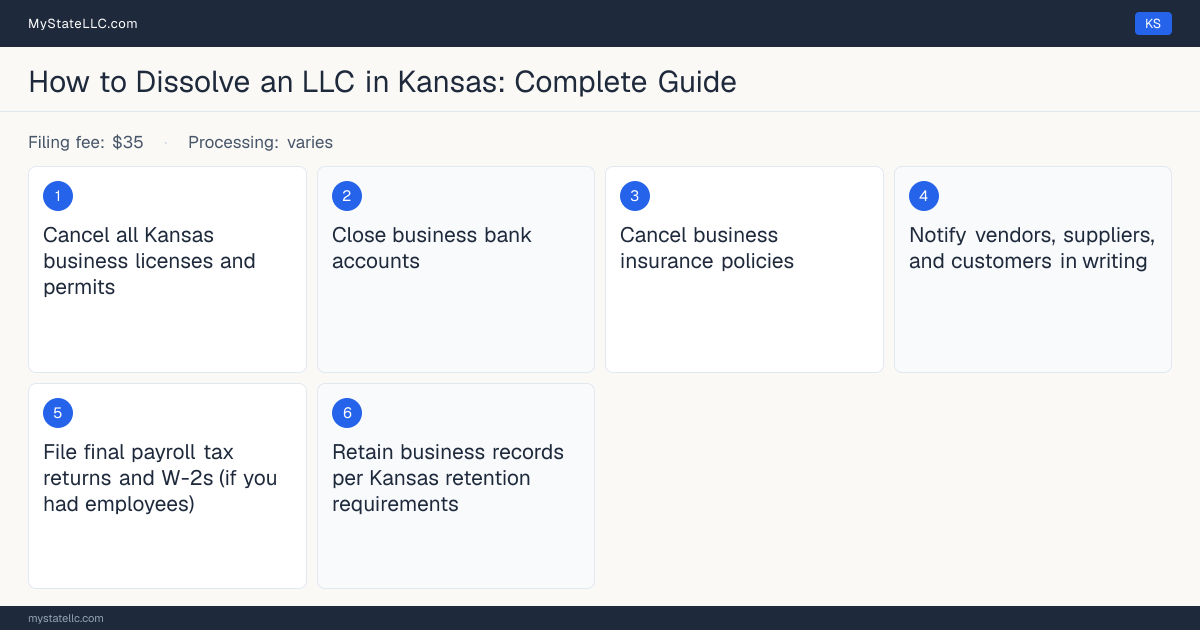
- Cancel all Kansas business licenses and permits
Contact every state, county and city agency that issued the LLC a license, professional registration or permit and cancel each one in writing. A permit left open can carry renewal fees and late penalties long after the business stops trading.
- Close business bank accounts
Wait until every check has cleared, the final tax payments have gone out and member distributions are complete, then close the operating account, any reserve account and all business credit cards. Download the full statement history before you close, because banks stop giving access to closed accounts.
- Cancel business insurance policies
Notify your general liability, property, auto, workers compensation and professional liability carriers of the wind-up date and ask about unearned premium refunds. Ask whether tail or run-off coverage makes sense for claims-made policies, since claims can arrive after the LLC is gone.
- Notify vendors, suppliers, and customers in writing
Send a dated written notice to every supplier, subscription vendor, landlord and active customer stating the closing date and how to submit a final invoice or claim. Cancel recurring charges and auto-renewals directly with each vendor rather than relying on the card being closed.
- File final payroll tax returns and W-2s (if you had employees)
File the final federal employment tax returns, deposit the last withholding, and close the Kansas withholding and unemployment accounts. Issue W-2s to employees and 1099-NEC forms to contractors by the normal deadlines, marking the federal employment return as final.
- Retain business records per Kansas retention requirements
Keep formation documents, the operating agreement, the dissolution resolution, the filed Certificate of Cancellation, ledgers, contracts and all tax returns for at least seven years. Store them where a former member can actually retrieve them, not on a laptop that gets wiped when the office closes.
Frequently Asked Questions
Sources
Each entry below is a document recorded in our verified Kansas sources, and each entry says what the document is. Some statutory text is read from an accurate mirror rather than from the state's own host, and those say so.
- sos.ks.gov/businesses/register-a-business.htmlKansas Secretary of State: business entity filings
- sos.ks.gov/businesses/close-a-business.htmlKansas Secretary of State: LLC dissolution
- sos.ks.gov/forms/business_services/KC.pdfKansas dissolution filing fee
Formation Services Compared
Forming an LLC in Kansas?
See how Northwest Registered Agent, Bizee, ZenBusiness and LegalZoom, the formation services we partner with, compare on 3-year cost, BBB rating and Trustpilot score before you choose.

Edmond Hui · Founder, MyStateLLC
Edmond Hui is a software engineer and serial entrepreneur based in New York who has founded multiple online businesses across e-commerce, media, and information publishing. Before transitioning into tech, he spent years as a commercial real estate professional closing deals totaling over 100,000 square feet, giving him firsthand experience with business formation and entity structuring. He built MyStateLLC to provide the free, state-specific LLC guidance he wished existed when forming his own companies.