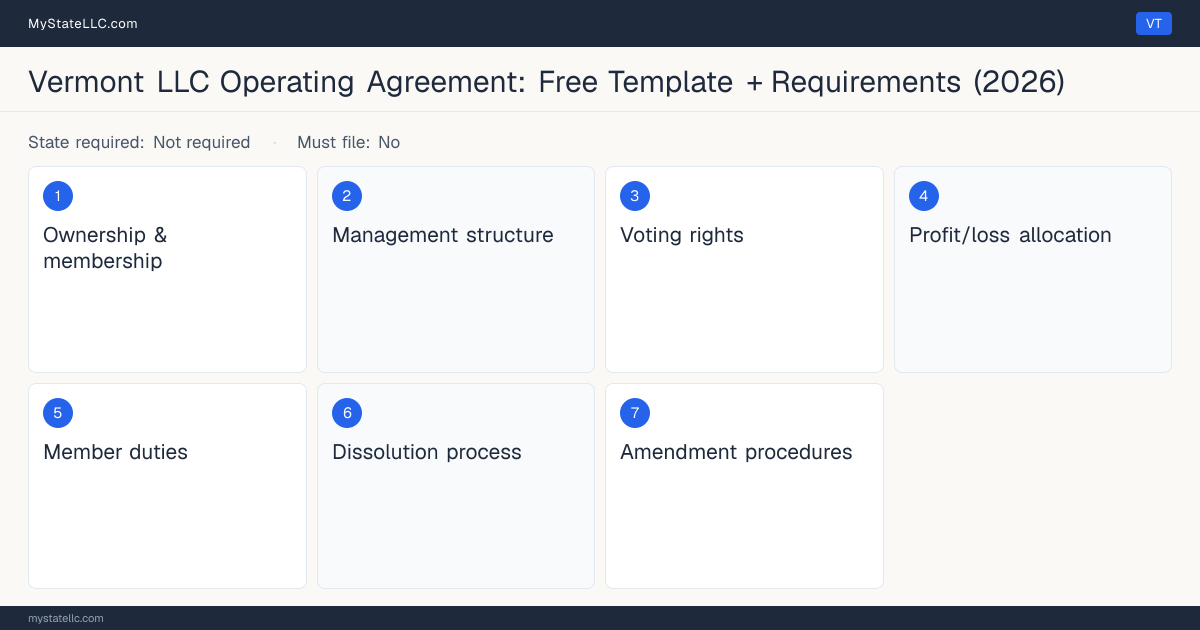
Vermont does not legally require an LLC operating agreement, but having one protects your limited liability status and sets the rules for ownership and profits. See exactly what to include below.
Edmond Hui is a software engineer and serial entrepreneur based in New York who has founded multiple online businesses across e-commerce, media, and information publishing. Before transitioning into tech, he spent years as a commercial real estate professional closing deals totaling over 100,000 square feet, giving him firsthand experience with business formation and entity structuring. He built MyStateLLC to provide the free, state-specific LLC guidance he wished existed when forming his own companies.
Affiliate disclosure: We may earn a commission at no extra cost to you.
Define each member's ownership percentage and capital contributions. This section establishes who owns what portion of your Vermont LLC and their initial investments.
Management structure
Specify whether your LLC is member-managed or manager-managed. This determines who has authority to make business decisions and bind the company legally.
Voting rights
Outline how decisions are made and what voting power each member has. Include procedures for major decisions like admitting new members or changing business direction.
Profit/loss allocation
Detail how profits and losses are distributed among members. This affects tax reporting and ensures everyone understands their share of financial outcomes.
Member duties
Define each member's responsibilities and obligations to the LLC. Include expectations for time commitment, non-compete clauses, and confidentiality requirements.
Dissolution process
Establish procedures for dissolving the LLC if needed. This protects all members by providing a clear roadmap for winding down business operations fairly.
Amendment procedures
Set rules for modifying the operating agreement in the future. This ensures changes can be made when needed while protecting all members' interests.
Frequently Asked Questions
No, Vermont law does not require LLCs to have an operating agreement. However, having one is strongly recommended because without it, your LLC will automatically fall under Vermont's default LLC statutes (Vermont Statutes Annotated Title 11, Chapter 3001–3161), which may not align with your business intentions. An operating agreement protects your personal liability shield by demonstrating that you treat your LLC as a separate legal entity—critical if the Vermont Secretary of State's office or a creditor challenges your LLC's legitimacy in court. It also prevents costly disputes between members by clearly defining profit splits, voting rights, management structure, and buyout procedures. Without one, Vermont default rules give all members equal voting power and equal profit shares regardless of their capital contributions, which rarely matches real-world arrangements. This creates practical problems: lenders won't fund business loans without seeing an operating agreement, and adding members later becomes complicated. Download a Vermont-specific template today and have all members sign it before conducting business, then store the executed copy with your corporate records.
Yes, you can write your own Vermont LLC operating agreement. Vermont law does not require you to file an operating agreement with the Secretary of State's Business Registration Division, giving you complete flexibility to draft your own document. Many Vermont LLC owners use templates or online services to create basic single-member agreements that cover membership interests, profit distribution, and management structure. However, for multi-member LLCs or businesses with complex ownership structures, consulting a Vermont business attorney (typically costing $300–$800 for agreement review) is wise to ensure compliance with Vermont Statutes Annotated Chapter 11 and to address buy-sell provisions, dissolution procedures, and member dispute resolution. An inadequate agreement can create costly conflicts later. Start by downloading Vermont's official LLC filing forms from sos.vermont.gov, then use a reputable template that mirrors Vermont's statutory requirements before finalizing your document.
No, Vermont does not require LLC operating agreements to be notarized. Under Vermont's Limited Liability Company Act (6 V.S.A. § 4811), the agreement is legally valid as long as it's signed by all members—notarization is entirely optional. However, while not mandatory, notarization can provide significant practical benefits. A notarized agreement creates a presumption of authenticity that strengthens your position in potential disputes, making it harder for members to later claim they didn't authorize the document. If you choose notarization, Vermont notaries public are regulated by the Vermont Secretary of State's office and typically charge $2–$5 per signature. This modest investment protects you against future challenges to the agreement's validity, particularly important if you have multiple members or anticipate ownership transitions. Consider having a notary public notarize the signature page when all members sign, even though it's not required by law. Contact the Vermont Secretary of State's office at (802) 828-2363 to locate a qualified notary in your area.
Without an operating agreement, your Vermont LLC automatically falls under Vermont's Limited Liability Company Act (6 V.S.A. § 4701 et seq.), which imposes default statutory rules that may not align with your business structure or member intentions. Specifically, Vermont law will dictate profit and loss distribution equally among all members regardless of capital contributions, grant each member equal voting rights, and require unanimous consent for major decisions like adding members or selling assets. This rigid structure creates significant practical problems: if you have members contributing different amounts of capital or expertise, the default equal distribution could trigger serious disputes. Additionally, without a written agreement, you lose critical protections—courts may disregard your LLC's liability shield in certain circumstances or impose unexpected management requirements during disputes. Vermont requires no specific filing of an operating agreement with the Secretary of State, but its absence means you're essentially operating under state default provisions that likely don't reflect your actual business arrangement. To protect your LLC and clarify member relationships, draft a Vermont LLC operating agreement immediately using Vermont's statutory template or an attorney, even if your business currently has only one member.
Yes, you can amend your Vermont LLC operating agreement at any time after formation, provided you follow the procedures outlined in your original agreement. Vermont law does not require you to file amendments with the Vermont Secretary of State's Business Services Division, though you must document changes in writing and retain them with your LLC records.
Most amendments require unanimous member approval unless your operating agreement specifies a different threshold—commonly a majority or two-thirds vote. The practical implication is significant: without proper amendment documentation, disputes may arise over which terms actually govern your LLC, potentially affecting member rights, profit distributions, and management authority.
Common amendments include adding new members, modifying profit-sharing percentages, changing management structure from member-managed to manager-managed, or updating capital contribution requirements. Draft your amendment using the same formality as your original agreement, have all approving members sign and date it, and store it alongside your operating agreement in your LLC records.
To proceed, review your current operating agreement's amendment clause, determine what approval threshold applies, and draft your specific changes in writing before circulating to members for signatures.