Protect your business with a comprehensive operating agreement that meets Oklahoma state requirements and covers all essential provisions for your LLC.
Oklahoma does not legally require an LLC operating agreement, but having one protects your limited liability status and sets the rules for ownership and profits. See exactly what to include below.
Edmond Hui is a software engineer and serial entrepreneur based in New York who has founded multiple online businesses across e-commerce, media, and information publishing. Before transitioning into tech, he spent years as a commercial real estate professional closing deals totaling over 100,000 square feet, giving him firsthand experience with business formation and entity structuring. He built MyStateLLC to provide the free, state-specific LLC guidance he wished existed when forming his own companies.
Affiliate disclosure: We may earn a commission at no extra cost to you.
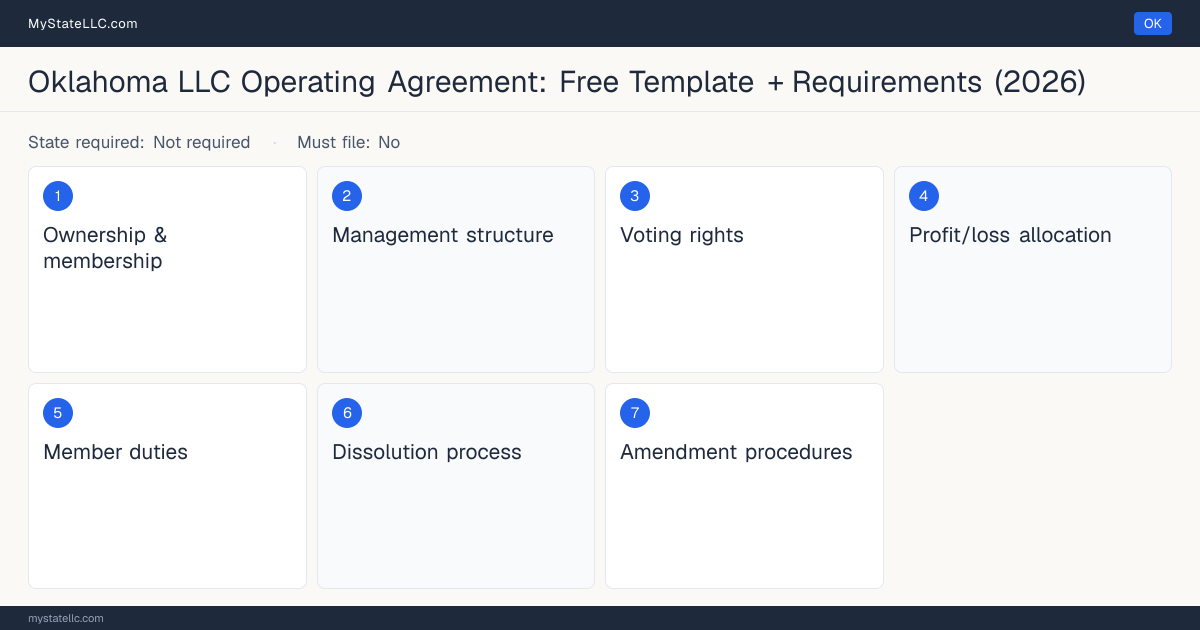
Define each member's ownership percentage, capital contributions, and membership interests. This section establishes who owns what portion of your Oklahoma LLC and prevents future disputes.
Management structure
Specify whether your LLC is member-managed or manager-managed and outline day-to-day operational responsibilities. Clear management structure prevents confusion about who makes business decisions.
Voting rights
Establish voting procedures for major decisions, including what percentage of votes is needed for different types of business actions. This protects minority members and ensures fair decision-making.
Profit/loss allocation
Detail how profits and losses will be distributed among members, which may differ from ownership percentages. Proper allocation rules ensure tax compliance and member satisfaction.
Member duties
Outline each member's responsibilities, time commitments, and restrictions on competing activities. Clear duties prevent conflicts and ensure everyone contributes appropriately to the business.
Dissolution process
Establish procedures for dissolving the LLC, including member buyout provisions and asset distribution. A clear dissolution process protects all parties if the business ends.
Amendment procedures
Define how the operating agreement can be modified, including required member approval and documentation procedures. Proper amendment rules allow for business evolution while maintaining legal protection.
Frequently Asked Questions
No, Oklahoma does not legally require LLCs to have an operating agreement, according to the Oklahoma Secretary of State. However, this doesn't mean you should skip it—operating without one creates serious practical problems. Without a written agreement, your LLC defaults to Oklahoma's statutory default rules under 18 O.S. § 2004, which may not align with your intentions for profit distribution, management roles, or member buyouts. More critically, courts may disregard your LLC's liability protection if you can't demonstrate formal business procedures, exposing your personal assets to creditor claims. Multi-member LLCs face additional risks: disputes over decision-making authority or profit splits often lead to costly litigation that a clear agreement would prevent. Even single-member LLCs benefit from documented procedures showing the IRS that your LLC operates as a genuine business entity, not merely a personal extension. Download Oklahoma's template and establish your operating agreement before conducting business to maintain liability protection and operational clarity.
Yes, you can write your own operating agreement for your Oklahoma LLC—Oklahoma requires no state filing of this document, giving you complete flexibility in drafting. However, the Oklahoma Secretary of State strongly recommends addressing essential provisions including member capital contributions, profit and loss distribution percentages, voting rights, management structure (member-managed versus manager-managed), buyout procedures, and dissolution terms. Omitting critical clauses creates significant practical problems: disputes over decision-making authority become unresolvable, and your LLC may default to Oklahoma's statutory provisions under Title 18 of the Oklahoma Statutes, which may not reflect your actual intentions. If your LLC has multiple members or complex ownership structures, consulting an attorney is advisable to ensure enforceability. For your next step, download Oklahoma's model operating agreement guidelines from the Secretary of State website, or use a reputable template specifically designed for Oklahoma LLCs, then have all members review and sign the final document before conducting any business transactions.
No, Oklahoma does not require LLC operating agreements to be notarized under the Oklahoma Limited Liability Company Act (68 O.S. § 2701 et seq.). However, while notarization is optional, having all members sign the agreement in the presence of witnesses is critical for enforceability in Oklahoma courts. Notarization adds significant legal protection by creating a presumption of authenticity if disputes arise—particularly valuable if a member later claims they never agreed to specific provisions regarding profit distribution, voting rights, or management responsibilities. Without notarization, you may face costly litigation to prove the agreement's validity. The Oklahoma Secretary of State does not require notarized copies when filing your LLC formation documents, but keeping a notarized version in your records creates a stronger legal defense. Consider obtaining notarization at your local Oklahoma bank or through a notary public for approximately $5–15 per signature. Next, draft your operating agreement using Oklahoma's specific statutory requirements, then schedule a notarization appointment before finalizing your LLC formation with the Secretary of State.
Without an operating agreement, your Oklahoma LLC will be governed by Oklahoma's default LLC statutes under the Oklahoma Limited Liability Company Act (68 O.S. § 2701 et seq.), which means the Oklahoma Secretary of State's standard rules automatically apply to your business operations. These default provisions dictate profit distribution (equal splits among all members regardless of capital contributions), management structure (member-managed by default), and dispute resolution procedures—none of which may align with your actual business arrangement. For example, if you and a co-member contributed capital in a 70/30 ratio but Oklahoma's default rules mandate equal 50/50 profit splits, you'll lose your proportional returns without a written agreement explicitly stating otherwise. Additionally, without an operating agreement on file, you lack documented procedures for member withdrawal, buyout terms, or succession planning, which creates vulnerability during disputes and complicates potential litigation. The practical impact is significant: disagreements over management decisions, profit allocation, or member exit become far more contentious and expensive to resolve, potentially threatening your liability protection. Your next step is to draft and execute an operating agreement immediately—even if you're the sole member—and maintain it with your corporate records at your registered agent's address listed with the Oklahoma Secretary of State.
Yes, you can amend your Oklahoma LLC operating agreement at any time after formation, but you must follow the specific procedures outlined in your original agreement. Most Oklahoma operating agreements require approval from all members or a majority vote (depending on your agreement's terms) before amendments take effect. You'll need to document the amendment in writing and maintain it with your LLC records—the Oklahoma Secretary of State doesn't require you to file operating agreement amendments, but keeping detailed records protects your liability protection if disputes arise. If your agreement specifies a supermajority or unanimous consent requirement, you must meet that threshold; failing to do so can render the amendment unenforceable. This matters practically because improperly executed amendments may not hold up legally, leaving your LLC vulnerable to member disputes or creditor claims. To amend your agreement, draft the amendment document, obtain required member signatures, and store the signed amendment in your LLC's official records folder alongside your original operating agreement.