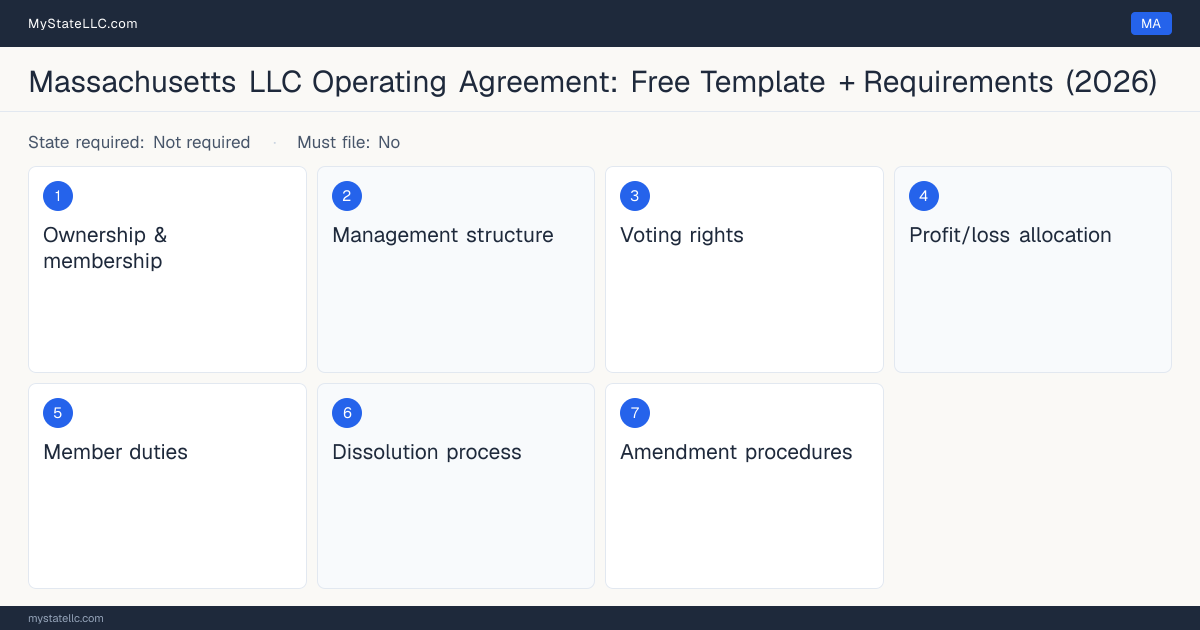
Massachusetts does not legally require an LLC operating agreement, but having one protects your limited liability status and sets the rules for ownership and profits. See exactly what to include below.
Edmond Hui is a software engineer and serial entrepreneur based in New York who has founded multiple online businesses across e-commerce, media, and information publishing. Before transitioning into tech, he spent years as a commercial real estate professional closing deals totaling over 100,000 square feet, giving him firsthand experience with business formation and entity structuring. He built MyStateLLC to provide the free, state-specific LLC guidance he wished existed when forming his own companies.
Affiliate disclosure: We may earn a commission at no extra cost to you.
Document each member's ownership percentage, capital contributions, and membership interests. This section establishes who owns what portion of your Massachusetts LLC and forms the foundation for all other provisions.
Management structure
Define whether your LLC is member-managed or manager-managed, and outline specific roles and responsibilities. Massachusetts allows flexible management structures, so clearly specify who has authority to make decisions and bind the company.
Voting rights
Establish voting procedures, required approval percentages for different decisions, and meeting requirements. Specify which decisions require unanimous consent versus simple majority approval to prevent future disputes.
Profit/loss allocation
Detail how profits and losses will be distributed among members, including timing of distributions and tax allocation methods. This section directly impacts each member's tax obligations and financial expectations.
Member duties
Outline each member's obligations, contributions, and restrictions on competing activities. Include non-compete clauses, confidentiality requirements, and consequences for failing to meet duties.
Dissolution process
Specify events that trigger dissolution, wind-up procedures, and asset distribution methods. Massachusetts law provides default dissolution rules, but your agreement should customize these processes for your specific situation.
Amendment procedures
Establish how the operating agreement can be modified, including required member approval and documentation requirements. Clear amendment procedures prevent conflicts when business circumstances change.
Frequently Asked Questions
No, Massachusetts does not legally require LLCs to have an operating agreement under Massachusetts General Laws Chapter 156C. However, creating one is highly recommended for critical practical reasons.
Without an operating agreement, your LLC is governed entirely by Massachusetts's default LLC statutes, which may not reflect your actual business intentions. For example, default rules dictate equal profit-sharing among all members regardless of capital contribution, automatic management by all members, and specific dissolution procedures. These provisions often conflict with founders' expectations.
More importantly, courts examine operating agreements when determining whether your LLC truly functions as a separate legal entity. Lacking one weakens your liability protection if a creditor or injured party sues—they may argue you treated the LLC as a personal extension rather than a legitimate business structure.
An operating agreement also clarifies member voting rights, profit distribution, management responsibilities, and buyout procedures, preventing costly disputes later. If you bring in investors or add members, you'll need one anyway.
Your next step: Draft an operating agreement using Massachusetts-specific templates and have each member sign and retain a copy before conducting any business transactions.
Yes, you can write your own Massachusetts LLC operating agreement, and Massachusetts doesn't legally require you to file it with the Secretary of the Commonwealth—it's an internal document. However, Massachusetts law requires your operating agreement to address specific provisions including member voting rights, profit distribution percentages, management structure, and dissolution procedures to be enforceable. Using a Massachusetts-specific template ensures compliance with state statutes under Massachusetts General Laws Chapter 156C. The practical reality is that a poorly drafted agreement creates liability exposure: if disputes arise between members, courts will interpret vague language against the LLC's interests, and the default statutory rules may not reflect your actual business arrangement. For single-member LLCs with straightforward ownership, a template suffices. For multi-member structures, significant capital contributions, or complex management arrangements, consulting a Massachusetts business attorney ($300–800 for agreement review) prevents costly litigation later. Your next step: download a Massachusetts template, draft your agreement addressing all required provisions, then have an attorney review it before members sign and retain copies in your LLC records.
No, Massachusetts does not require operating agreements to be notarized under Massachusetts General Laws Chapter 156C (the state's LLC statute). The agreement becomes legally binding once all members sign it, regardless of notarization status. However, notarization provides practical advantages for Massachusetts LLC owners. A notarized operating agreement carries stronger evidentiary weight in court disputes, making it harder for members to later claim they didn't sign the document or misunderstood its terms. This protection becomes especially valuable if your LLC involves multiple members, substantial capital contributions, or complex profit-sharing arrangements. Many Massachusetts banks and lenders also prefer notarized operating agreements when reviewing loan applications or LLC formation documentation. If you anticipate future disputes or need the agreement for banking purposes, obtain notarization from a Massachusetts notary public—typically costing $5–15 per signature. Contact your local courthouse or the Massachusetts Secretary of the Commonwealth's office for notary referrals in your area. For immediate protection, have all members sign before a notary even if it's not legally mandatory.
Without an operating agreement, your Massachusetts LLC will be governed by Massachusetts General Laws Chapter 156C, which applies rigid default rules that may not align with your business goals. Specifically, the state's default provisions dictate equal profit distribution among all members regardless of capital contributions, grant each member equal management authority, and require unanimous consent for major decisions like admitting new members or dissolving the LLC. These inflexible rules often create disputes over profit allocation, management authority, and exit strategies that could have been prevented with clear written terms. For example, if you and a co-member contributed capital unequally but the state defaults to 50/50 profit splits, you have no contractual recourse. Additionally, without an operating agreement on file with the Massachusetts Secretary of the Commonwealth, creditors may more easily pierce your LLC's liability protection during legal proceedings. The practical impact is significant: disagreements between members become costly litigation matters governed by statute rather than by terms you controlled. Your next step is to draft and execute a Massachusetts LLC Operating Agreement immediately—using the Secretary of the Commonwealth's guidance or an attorney—even if your LLC is already established, then maintain a signed copy with your Articles of Organization records.
Yes, you can amend your Massachusetts LLC operating agreement after formation by following the procedures specified in your original agreement. Most Massachusetts LLCs require unanimous member approval for amendments, though your agreement may permit modifications by majority vote depending on how it was drafted. All amendments must be documented in writing and signed by all members who consent to the changes. Unlike Articles of Organization modifications, operating agreement amendments don't require filing with the Massachusetts Secretary of the Commonwealth—they're internal documents. However, if your amendment affects member ownership percentages or profit distributions, you should retain signed copies for tax reporting purposes, as the IRS may request documentation during audits. The practical implication is that amending your agreement is straightforward and inexpensive, but failing to properly document amendments in writing can create disputes over whether changes were actually authorized. Review your current operating agreement's amendment clause immediately to confirm your specific approval requirements, then prepare a written amendment statement and circulate it to all members for execution before implementing any changes.