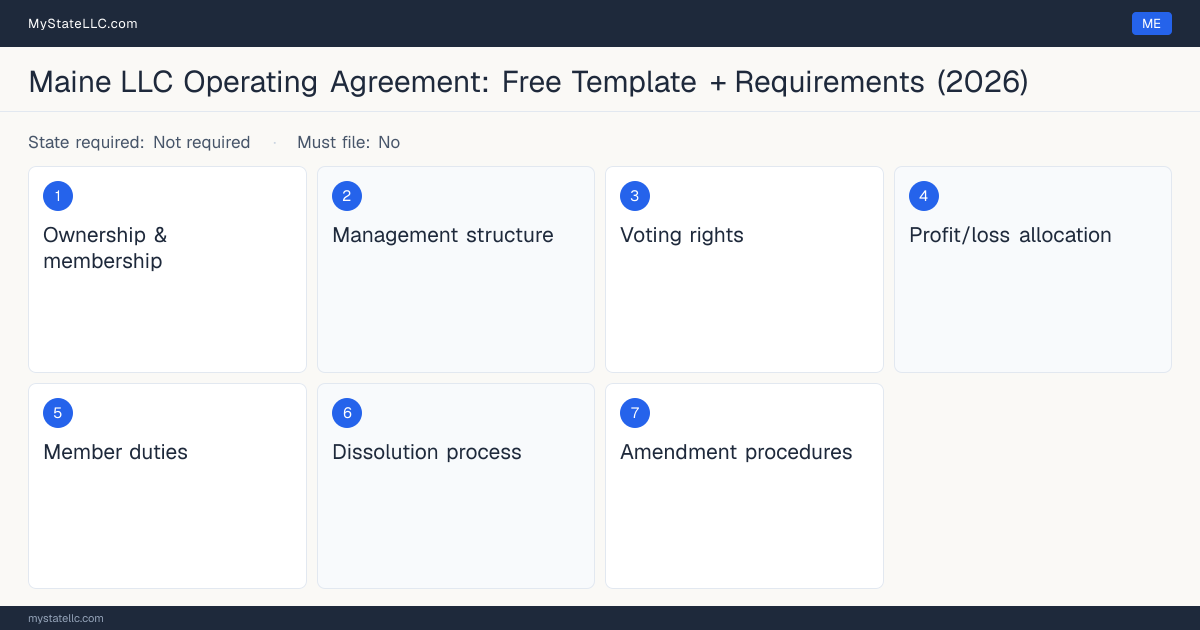
Maine does not legally require an LLC operating agreement, but having one protects your limited liability status and sets the rules for ownership and profits. See exactly what to include below.
Edmond Hui is a software engineer and serial entrepreneur based in New York who has founded multiple online businesses across e-commerce, media, and information publishing. Before transitioning into tech, he spent years as a commercial real estate professional closing deals totaling over 100,000 square feet, giving him firsthand experience with business formation and entity structuring. He built MyStateLLC to provide the free, state-specific LLC guidance he wished existed when forming his own companies.
Affiliate disclosure: We may earn a commission at no extra cost to you.
Define each member's ownership percentage and initial capital contributions. This section establishes who owns what portion of your Maine LLC and prevents future ownership disputes.
Management structure
Specify whether your LLC is member-managed or manager-managed and outline decision-making authority. Clear management roles prevent confusion and ensure smooth daily operations.
Voting rights
Establish how votes are allocated and what decisions require member approval. This protects minority members and ensures important business decisions follow proper procedures.
Profit/loss allocation
Detail how profits and losses are distributed among members and when distributions occur. Proper allocation prevents tax issues and member disputes over compensation.
Member duties
Outline each member's responsibilities, time commitments, and restrictions on competing activities. Clear duties ensure everyone understands their role and obligations to the LLC.
Dissolution process
Define when and how the LLC can be dissolved and how assets will be distributed. Having dissolution procedures in place protects all members if the business needs to close.
Amendment procedures
Specify how the operating agreement can be modified and what member approval is required. Amendment procedures ensure changes to the agreement follow proper authorization.
Frequently Asked Questions
No, Maine does not legally require LLCs to have a written operating agreement under Maine Revised Statutes Title 31, Chapter 311. However, this legal flexibility creates significant practical risks for LLC owners.
Without a documented operating agreement, your LLC defaults to Maine's statutory rules, which may not align with your business intentions regarding profit distribution, management authority, or member exit procedures. More critically, courts view operating agreements as evidence of intentional LLC formation; their absence can weaken your liability protection if a creditor argues the LLC wasn't properly established as a separate entity.
Creating an operating agreement costs $150–$300 through Maine's Secretary of State or a business attorney, but it protects your limited liability status, prevents costly member disputes, and clarifies voting rights and capital contributions upfront.
Next step: Draft an operating agreement using Maine's statutory framework (Title 31) or consult a Maine business attorney to ensure your agreement complies with state law while protecting your personal assets.
Yes, you can legally draft your own Maine LLC operating agreement using templates or DIY software—Maine law doesn't require attorney involvement for this document. However, Maine Revised Statutes Title 31, Section 608 requires your agreement to address member voting rights, profit distribution, and management structure to be enforceable. If your LLC involves multiple members, real estate holdings, or anticipated capital raises, working with a Maine business attorney (typically $500–$2,000 for agreement review) prevents costly disputes later. The practical benefit: a properly drafted agreement protects your personal assets from creditors and clarifies exit strategies when members leave. A vague or missing agreement defaults to Maine's statutory rules, which may not reflect your business intentions. Your next step: download the free Maine LLC operating agreement template from the Maine Secretary of State's website, customize it with your specific terms, then have a local attorney review it before members sign—the $1,500 investment now saves tens of thousands in litigation costs later.
No, Maine does not require notarization of LLC operating agreements under Maine Revised Statutes Title 31, Chapter 31. However, having all members sign the document creates a legally binding contract and demonstrates unanimous agreement to the terms, which is critical if disputes arise.
The practical implication is significant: while notarization isn't mandatory, the signatures themselves establish enforceability. Without documented signatures, a member could later claim they never agreed to specific provisions regarding profit distribution, management authority, or dissolution procedures. Maine courts rely on signed agreements to resolve LLC disputes, making your members' signatures far more valuable than the state's approval.
Additionally, if your operating agreement includes transfer restrictions or buyout provisions—common in multi-member LLCs—signed (though not notarized) documentation strengthens your ability to enforce these restrictions against departing members or their heirs.
Your next step: Have each member sign and date two copies of your operating agreement. Keep one original in your LLC records and distribute signed copies to each member. Consider a cover page stating the date of execution and listing all signatories for clarity during any future review.
Without an operating agreement, your Maine LLC defaults to Maine Revised Statutes Title 31, Chapter 31 (Maine LLC Act), which imposes rigid statutory rules that may not reflect your business intentions. Specifically, Maine law mandates equal profit and loss sharing among all members regardless of their capital contributions, meaning a member who invested $100,000 receives the same distributions as one who invested $1,000. Decision-making authority defaults to majority vote rather than allowing you to allocate control based on ownership percentages or management expertise. Additionally, if a member wants to leave or disputes arise, Maine's default dissolution provisions apply—potentially forcing asset liquidation and triggering tax complications you could have avoided with clear contractual terms.
For multi-member LLCs especially, these statutory defaults create serious conflicts. You lose the ability to designate managers, establish buyout procedures, or protect your operating procedures during member changes. The Maine Secretary of State's office does not require operating agreements for LLC formation, but operating without one leaves your business vulnerable to disputes and unintended tax consequences.
File your operating agreement with your registered agent and retain a copy in your LLC records immediately to override these defaults.
Yes, you can amend your Maine LLC operating agreement after formation, but you must follow the specific modification procedures outlined in your original agreement. Most Maine LLCs require unanimous or majority member approval, depending on the voting provisions you established. Amendments should be documented in writing and signed by the required members—there's no state filing requirement with the Maine Secretary of State for operating agreement changes, though you should maintain the amended document with your LLC records for at least seven years. This distinction is critical: while Articles of Organization amendments must be filed with the Maine Secretary of State using Form MLLC-3 (costing $125), operating agreement amendments remain internal documents. Failing to properly amend your agreement can create disputes if members disagree on changes. Review your original operating agreement's amendment clause to identify the exact voting threshold required, then distribute the written amendment to all members and obtain their signatures before implementing any changes.