How to Dissolve an LLC in West Virginia: Complete 2026 Guide
West Virginia charges a flat $25 state filing fee for Articles of Termination on Form LLD-9. No standard turnaround is published, so processing time varies.
By Edmond Hui · Last updated: September 2026
West Virginia's $25 LLC dissolution filing fee ranks #18 cheapest of the 50 states, tied with 6 other states
The fee is flat and mid-pack, so cost is rarely the deciding factor in West Virginia. What shapes the schedule instead is the order of operations: the state expects the LLC to be dissolved and wound up before the termination form is filed at all.
Source: MyStateLLC 50-state dissolution index, verified 2026-08-13
Dissolution at a Glance
| Filing Fee | $25 |
| Form Name | Articles of Termination of West Virginia Limited Liability Company (Form LLD-9) |
| Processing Time | varies |
| Creditor Notice Period | 120 days |
| Tax Clearance Required | No |
| Publication Required | No |
| File Online | SoS Dissolution Page → |
How to Form an LLC: Step-by-Step
- 1
Vote to Dissolve
West Virginia separates two events that owners often merge: the LLC first dissolves and winds up its business, and only then files to terminate. Start with the operating agreement, which normally sets the voting threshold, states who may call the vote, and says whether written consent can replace a meeting. If it does not address dissolution, the default rules in WV Code 31B-8-801 through 31B-8-812 supply the standard, so confirm what applies rather than assuming a majority carries. Record the outcome in writing with the date, the members who consented, the interests they hold, and a plain statement that dissolution was authorized. Single-member LLCs need the same record, because everything downstream rests on it.
Pro tip: Write the intended termination date into the consent. West Virginia lets you set an effective date up to 90 days after filing, and deciding that early keeps the wind-up schedule honest. - 2
File Articles of Termination (Form LLD-9) with the West Virginia Secretary of State
Termination is filed on Form LLD-9, Articles of Termination, under WV Code 31B-8-805, and it may be filed only after the LLC has been dissolved and its business wound up. The filing fee is flat at $25.00, and the LLD-9 form carries an expedite menu on top of it: $25.00 for next business day handling, $250.00 for 2-hour service, and $500.00 for 1-hour service. File online through the West Virginia One Stop Business Portal, reachable from https://sos.wv.gov/business/updates-and-changes/dissolveterminate-wv-business, or submit by mail, fax, or in person. The termination effective date may be the filing date or a date you choose that is no later than 90 days after filing. No standard processing turnaround is published, so treat the timing as variable.
Pro tip: Use the 90-day effective date window deliberately. Setting termination for the end of a quarter or a lease term is easier to reconcile in the final tax returns than a mid-month date chosen at random. - 3
Notify Creditors and Settle Debts
WV Code 31B-8-807 is permissive: a dissolved LLC may dispose of known claims by giving written notice, and a notice that does go out must set a claim deadline of not less than 120 days after it is received. If you reject a timely claim, that claim is barred unless the claimant files suit within 90 days of the rejection notice. If you use the procedure, send notice to every known creditor, describe the claim process plainly, and keep proof of what each recipient received and when. Pay or provide for each obligation before any assets move to members. Publication of a dissolution notice is permissive under West Virginia law, not mandatory, so no newspaper advertising cost belongs in your budget or your timeline. Because Form LLD-9 follows wind-up, the debt work comes before the filing.
Pro tip: Count the 120 days from when each creditor receives its own notice rather than from a single send date, and start a separate 90-day calendar entry for any claim you reject. - 4
Close West Virginia State Tax Accounts
This step carries a West Virginia twist worth understanding. No formal tax-clearance certificate has to be attached to Form LLD-9, so you are not waiting on a state agency to release you. What the form does require is that the signer certify that all responsibilities for filing with the Department of Tax and Revenue and any other state agencies have been completed. In practice that means doing the work first: file a final return for every West Virginia tax the LLC was registered for, mark each one final, use the correct short period, then close the underlying registrations. If you had employees, close the withholding and unemployment accounts too. Signing that certification with returns outstanding is a representation you do not want to make.
Pro tip: Work through your registration list one line at a time and save a confirmation for each closure. The certification on Form LLD-9 is easier to sign honestly when you can point to a folder of confirmations. - 5
Deactivate Your EIN with the IRS
The IRS cannot cancel an EIN, but it can deactivate it once any outstanding returns are filed and taxes owed are paid. See the FAQ below for the letter and mailing addresses. File the final federal return before or alongside the deactivation letter: Form 1065 for a multi-member LLC, Form 1120-S if you elected S corporation treatment or Form 1120 if you elected C corporation treatment, each with the final return box checked, or the appropriate schedule on a member's personal return for a single-member LLC. An LLC taxed as a corporation also files Form 966.
Pro tip: Send the deactivation letter certified and keep the receipt with your termination records. - 6
Distribute Remaining Assets to Members
Distribution is the last step for a reason. Creditors and other liabilities are paid or provided for first, including obligations you can reasonably foresee such as a contested invoice, a warranty claim, or a final professional fee. What remains goes to members, allocated as the operating agreement directs and by ownership percentage if it is silent. West Virginia's sequence makes this concrete: Form LLD-9 is filed after wind-up, so distributions made while a known creditor is unpaid are hard to defend later. Value non-cash property before you transfer it, log who received what on which date, and have each member sign for the distribution. Members report their own gain, and those records are what their accountants will ask for.
Pro tip: Hold a reserve until the rejected-claim window has run on any claim you turned down. Distributing everything while a creditor still has 90 days to sue puts members in the path of that suit. - 7
Confirm Dissolution is Complete
Look up your LLC in the Secretary of State's business search and confirm the record reflects the termination, keeping in mind that the effective date may be one you chose up to 90 days out rather than the date you filed. Until then the entity is still on the record. Order a certified copy of the filed Articles of Termination, since banks, landlords, insurers, and payment processors want state-issued proof rather than your own printout. Then assemble one permanent file with the member consent, the filed LLD-9 and certified copy, creditor notices with delivery proof, final federal and West Virginia returns, tax account closure confirmations, and the distribution records.
Pro tip: If you chose a future effective date, tell your bank and insurer that date rather than the filing date. Closing accounts early leaves the entity without coverage or a way to pay a final bill.
Winding-Up Checklist
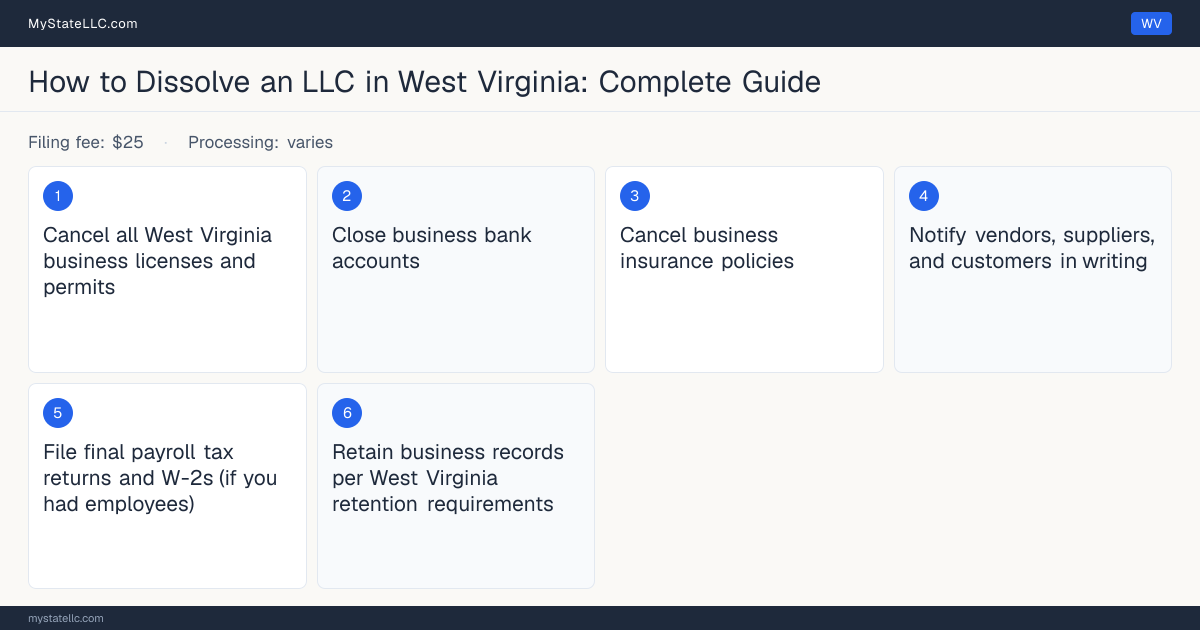
- Cancel all West Virginia business licenses and permits
State registrations, professional licenses, and municipal business licenses renew on their own cycles and keep billing after the termination is filed. Cancel each with the office that issued it and get written confirmation.
- Close business bank accounts
Close only after every check clears, card authorizations settle, and recurring debits are cancelled, and bring a copy of the filed Articles of Termination. An open account invites deposits into an entity that no longer exists.
- Cancel business insurance policies
Give the carrier a written effective date, matching the termination date you chose, and ask about unearned premium refunds. Ask specifically whether tail coverage is worth buying for claims reported after the policy ends.
- Notify vendors, suppliers, and customers in writing
A short notice with the effective date stops new orders, ends auto-renewing contracts, and tells customers where to direct final questions. Keep a copy of every notice with the wind-up file.
- File final payroll tax returns and W-2s (if you had employees)
File the final federal and West Virginia payroll returns, issue W-2s to employees and 1099s to contractors, and close the state withholding and unemployment insurance accounts. These are also the filings the Form LLD-9 certification covers.
- Retain business records per West Virginia retention requirements
Keep formation documents, the operating agreement, member consents, tax returns, and termination paperwork for at least seven years, which covers the usual federal and state audit windows. Store a second copy away from the office you are closing.
Frequently Asked Questions
Sources
Each entry below is a document recorded in our verified West Virginia sources, and each entry says what the document is. Some statutory text is read from an accurate mirror rather than from the state's own host, and those say so.
- sos.wv.gov/business/Pages/default.aspxWest Virginia Secretary of State: business entity filings
- sos.wv.gov/business/updates-and-changes/dissolveterminate-wv-businessWest Virginia Secretary of State: LLC dissolution
- sos.wv.gov/FormSearch/Business/Limited-Liability-Company/lld-9.pdfWest Virginia dissolution filing fee
- code.wvlegislature.gov/31B-8-807/West Virginia creditor notice period
- code.wvlegislature.gov/31B-8-808/West Virginia publication requirement on dissolution
- code.wvlegislature.gov/31B-8-811/West Virginia reinstatement after dissolution
Formation Services Compared
Forming an LLC in West Virginia?
See how Northwest Registered Agent, Bizee, ZenBusiness and LegalZoom, the formation services we partner with, compare on 3-year cost, BBB rating and Trustpilot score before you choose.

Edmond Hui · Founder, MyStateLLC
Edmond Hui is a software engineer and serial entrepreneur based in New York who has founded multiple online businesses across e-commerce, media, and information publishing. Before transitioning into tech, he spent years as a commercial real estate professional closing deals totaling over 100,000 square feet, giving him firsthand experience with business formation and entity structuring. He built MyStateLLC to provide the free, state-specific LLC guidance he wished existed when forming his own companies.