How to Dissolve an LLC in Ohio: Complete 2026 Guide
Close your Ohio LLC with one filing, Certificate of Dissolution Form 616, for a $50 fee and standard processing of 3 to 7 business days.
By Edmond Hui · Last updated: September 2026
Ohio's $50 LLC dissolution filing fee ranks #35 of 50 states, tied with 4 other states at the same price
Ohio sits on the pricier side of the middle for the filing itself, but it publishes a standard turnaround, which many states do not. Knowing when the filing lands is usually worth more to an owner than saving a few dollars on the fee.
Source: MyStateLLC 50-state dissolution index, verified 2026-08-13
Dissolution at a Glance
| Filing Fee | $50 |
| Form Name | Certificate of Dissolution (Form 616) for a Domestic Limited Liability Company |
| Processing Time | 3 to 7 business days |
| Creditor Notice Period | 90 days |
| Tax Clearance Required | No |
| Publication Required | No |
| File Online | SoS Dissolution Page → |
How to Form an LLC: Step-by-Step
- 1
Vote to Dissolve
Dissolution is an internal decision first and a filing second. Your operating agreement governs, so follow the approval standard it sets, whether that is a stated percentage of membership interests, a supermajority, or unanimous written consent. When the agreement is silent about dissolution, obtain unanimous written consent from all members. It costs nothing and eliminates any later dispute over who had authority to close the company. Capture the decision in a signed resolution stating the date members approved dissolution and the effective date you intend the dissolution to carry. Ohio does not ask you to file that resolution, but banks, landlords, insurers, and asset buyers regularly want to see it before they will act on your instructions.
Pro tip: Decide the effective date at the same meeting. A certificate of dissolution may specify a delayed effective date up to 90 days after the Secretary of State receives it, so the date is a real choice rather than an afterthought. - 2
File Certificate of Dissolution (Form 616) for a Domestic Limited Liability Company with the Ohio Secretary of State
Ohio domestic LLCs dissolve under Ohio Revised Code Chapter 1706, the Ohio Revised Limited Liability Company Act, by filing Certificate of Dissolution Form 616 with the Secretary of State. The filing fee is $50 and standard processing runs about 3 to 7 business days. File online through Ohio Business Central at bsportal.ohiosos.gov by choosing to update an existing business record and then selecting the certificate of dissolution for a limited liability company. Expedited service is optional and priced on top of the $50 base fee: Expedite 1 adds $100 for 2 business days, Expedite 2 adds $200, and Expedite 3 adds $300 for a walk-in filing handled in roughly four hours. The certificate may also specify a delayed effective date up to 90 days after the Secretary of State receives it. The state's overview lives at https://www.ohiosos.gov/business/ohio-business-roadmap/how-to-dissolve-a-business.
Pro tip: Only buy expedite if a closing date depends on it. Standard service already runs about 3 to 7 business days, and a delayed effective date on the certificate solves most scheduling problems for free. - 3
Notify Creditors and Settle Debts
Ohio makes creditor notice a claim-limiting option, not a prerequisite for filing Form 616. Under ORC 1706.473 a dissolved LLC may give written notice to its known creditors setting a claim deadline of not less than 90 days from the effective date of the notice, and claims that are not submitted or are rejected are barred. That 90 days is the notice period the statute names. Under ORC 1706.474 the LLC may publish notice of the dissolution on its own website and on the Secretary of State's website, after which claims are barred unless suit is commenced within two years of publication. Read that carefully, because it is where most guides go wrong. Ohio's publication mechanism is a website posting, not a newspaper advertisement, and no newspaper publication is required to dissolve an Ohio LLC.
Pro tip: If you use the website publication route under ORC 1706.474, screenshot both postings with visible dates before you take your site down. The bar period is worth nothing if you cannot show when publication happened. - 4
Close Ohio State Tax Accounts
File final returns for every Ohio tax the LLC is registered for and formally close those accounts, rather than simply stopping. For most small companies that means employer withholding if you ran payroll and sales tax if you collected it, plus any account tied to your particular industry. Mark each return final and confirm the registration is closed, because an open account keeps generating filing obligations and delinquency notices for a company that no longer exists. On the point that trips up most owners: Ohio does not require a tax clearance certificate to dissolve an LLC. Form 616 asks for no clearance certificate and no such requirement exists under ORC Chapter 1706. You still have to pay what you owe, and tax debt survives dissolution, but no clearance letter stands between you and a $50 filing that the state will accept.
Pro tip: Sequence the tax work before you close the bank account, not after. Paying a final assessment is trivial while the business account is open and genuinely awkward once it is not. - 5
Deactivate Your EIN with the IRS
The IRS cannot cancel an EIN, but it can deactivate it once any outstanding returns are filed and taxes owed are paid. See the FAQ below for the letter and mailing addresses. File the final federal return first or alongside the deactivation letter. A multi-member LLC taxed as a partnership files Form 1065 with the final return box checked and issues final K-1s. An LLC taxed as a corporation files Form 1120 or 1120-S the same way. A single-member LLC with no corporate election reports the closing year on the owner's own return.
Pro tip: Mail the deactivation letter certified and keep the receipt. - 6
Distribute Remaining Assets to Members
Creditors are paid before members, without exception. Settle or make provision for the company's debts and obligations, then distribute what remains under the operating agreement, which usually ties distributions to ownership percentages or to capital account balances. When a member takes equipment, a vehicle, or other property instead of cash, value it before the transfer, because the distribution is measured at fair market value and both the member and the company need a number they can defend on a return. Record every distribution with a signed receipt showing the recipient, the date, what was transferred, and the value assigned. Where a warranty, a contingent claim, or an unexpired lease is still live, hold a reserve back rather than distributing the account to zero.
Pro tip: Do one distribution after debts are settled rather than several along the way. Money drawn out mid-winding-up is what members end up returning when a late claim arrives. - 7
Confirm Dissolution is Complete
Standard processing runs about 3 to 7 business days, so check the Secretary of State's business search shortly after that window and confirm the record shows the dissolution and the effective date you selected. If you filed through Ohio Business Central, save the portal confirmation too. Then build one closing file: the accepted Form 616, the members' resolution, copies of any creditor notices and any website publication screenshots, final federal and Ohio returns, the EIN deactivation letter with its certified mail receipt, and the signed distribution receipts. Keep everything in one place. The questions that arrive two years from now come from tax agencies, former members, and occasionally a creditor, and every one of them is answered with a document rather than a recollection.
Pro tip: Download the filed certificate from the entity record and store the file yourself. A bookmark to a state page is not a record, and portals get reorganized.
Winding-Up Checklist
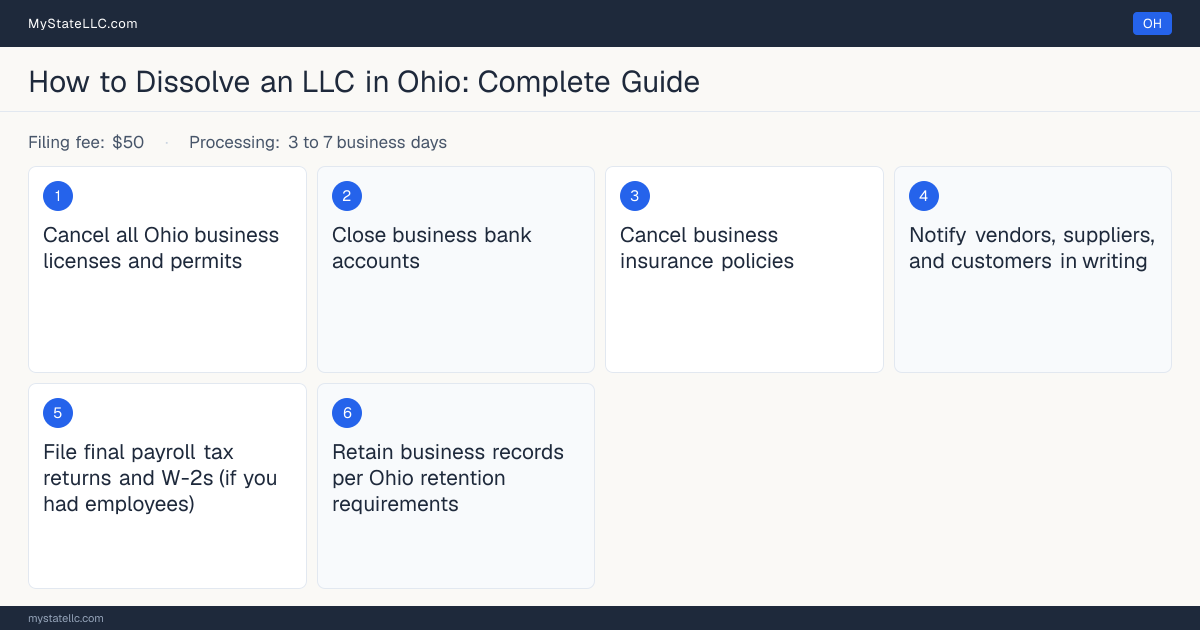
- Cancel all Ohio business licenses and permits
Work through them agency by agency: municipal and county permits, food service or alcohol licenses, contractor registrations, and any professional license held in the company name. Filing Form 616 tells those agencies nothing, and an unrenewed permit can still generate fees against you.
- Close business bank accounts
Keep the account open until the last checks clear, final tax payments settle, and any card processor reserve is released, then close it in writing and keep the closing statement. Closing early strands refunds and chargebacks with nowhere to go.
- Cancel business insurance policies
Cancel liability, property, auto, and workers compensation coverage effective on or after the day you stop operating, and ask each carrier about prorated refunds. For claims-made policies such as professional liability, price tail coverage before canceling, since claims can arrive well after closing.
- Notify vendors, suppliers, and customers in writing
Send a short written notice giving the closing date, a deadline for final invoices, and a contact who will still be reading mail afterward. That written record is what keeps an auto-renewing contract from quietly rolling into another term.
- File final payroll tax returns and W-2s (if you had employees)
File final federal and Ohio payroll returns marked final, deposit the last withholding, and deliver W-2s by the normal January deadline for the year the wages were paid. Trust fund payroll taxes are the category where responsible individuals can be pursued personally, so clear them first.
- Retain business records per Ohio retention requirements
Keep the filed Form 616, the resolution, final returns, creditor correspondence, and distribution receipts well past the closing date. The data verified for this page does not set an Ohio retention period for dissolved LLCs, so follow IRS record retention guidance and your accountant's advice rather than a rule of thumb.
Frequently Asked Questions
Sources
Each entry below is a document recorded in our verified Ohio sources, and each entry says what the document is. Some statutory text is read from an accurate mirror rather than from the state's own host, and those say so.
- ohiosos.gov/businesses/Ohio Secretary of State: business entity filings
- ohiosos.gov/business/ohio-business-roadmap/how-to-dissolve-a-businessOhio Secretary of State: LLC dissolution
- ohiosos.gov/assets/616.pdfOhio dissolution filing fee
- ohiosos.gov/globalassets/business/forms/616_instructions.pdfOhio Articles of Dissolution form
- codes.ohio.gov/ohio-revised-code/section-1706.473Ohio creditor notice period
- codes.ohio.gov/ohio-revised-code/section-1706.474Ohio publication requirement on dissolution
- bsportal.ohiosos.govOhio online dissolution filing
Formation Services Compared
Forming an LLC in Ohio?
See how Northwest Registered Agent, Bizee, ZenBusiness and LegalZoom, the formation services we partner with, compare on 3-year cost, BBB rating and Trustpilot score before you choose.

Edmond Hui · Founder, MyStateLLC
Edmond Hui is a software engineer and serial entrepreneur based in New York who has founded multiple online businesses across e-commerce, media, and information publishing. Before transitioning into tech, he spent years as a commercial real estate professional closing deals totaling over 100,000 square feet, giving him firsthand experience with business formation and entity structuring. He built MyStateLLC to provide the free, state-specific LLC guidance he wished existed when forming his own companies.