Illinois S-Corporation Election
By Edmond Hui · Facts verified July 29, 2026 against primary state sources
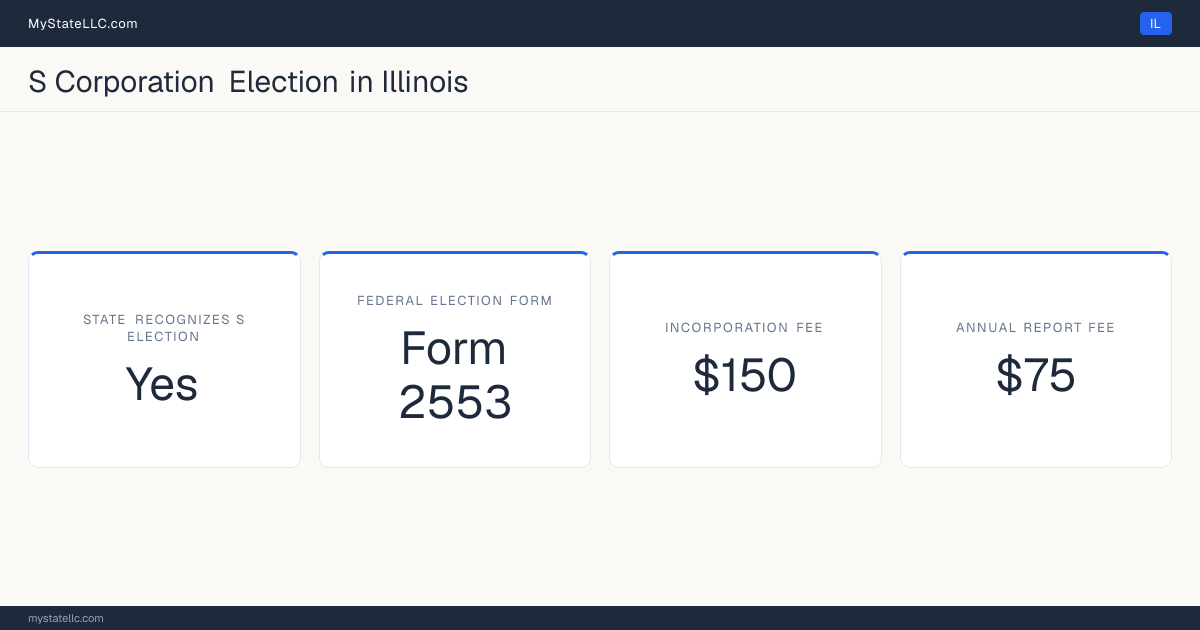
Does Illinois recognize the federal S election?
State treatment of the S election
| Follows the federal election | Yes |
| Separate state election form | None required |
| State return | Form IL-1120-ST (Small Business Corporation Replacement Tax Return) |
No separate state election to file: the federal election on IRS Form 2553 carries over. That is the election only, the corporation still files Form IL-1120-ST. Of the 50 states, 42 follow the federal election with no state form of their own, and 1 more, New York, recognizes S status but requires an election of its own as well.
What an S corporation still owes Illinois
Illinois S corporations pay the 1.5% Personal Property Replacement Tax (PPRT) at the entity level on Illinois net income (filed on IL-1120-ST); remaining income passes through to shareholders taxed at the 4.95% individual rate. A corporation with an S election still owes the SOS franchise tax. Illinois also offers an elective pass-through entity (PTE) tax of 4.95%.
Franchise or gross-receipts tax
Illinois corporate franchise tax REMAINS in effect (administered by the Secretary of State). The scheduled 2019 full phase-out (P.A. 101-9) was repealed by P.A. 102-16 (2021); the first $1,000 of a corporation's total annual franchise-tax liability is exempt. Rate is 0.1% of paid-in capital allocated to Illinois; initial minimum $25. Applies to corporations only, NOT to LLCs.
Illinois corporation vs Illinois LLC
State filing charges only. Corporate income tax and franchise tax are excluded because both depend on income or net worth, so no flat figure exists for either entity.
| Corporation | LLC | |
|---|---|---|
| Formation filing fee | $150 | $150 |
| Report cadence | Every year | Every year |
| Report fee | $75 | $75 |
| Entity-level tax on the LLC side | N/A | Personal Property Replacement Tax |
Both entities cost $150 to file in Illinois, so the filing fee is not a reason to pick one over the other.
Full Illinois LLC cost breakdown · LLC vs C-corp explained · LLC vs S-corp explained
How Illinois compares
| State treatment of the federal S election | States |
|---|---|
| Follows the federal election, no state form needed | 42 |
| No corporate income tax, so no state election exists | 5 |
| Has a corporate income tax and does not follow the election. The corporation is taxed like a C corporation | 2 |
| Follow the election but still impose some entity-level tax on the S corporation, California, Illinois, New York, Massachusetts and Delaware among them | N/A |
| Require a separate state election form as well | 1 |
Compare all 50 states · LLC vs S-corp · S-corp salary and savings calculator
Frequently Asked Questions
Where these numbers come from
This page covers how Illinois treats the federal S-corporation election and what an S corporation still owes the state. Every figure was checked against Illinois's own published sources on July 29, 2026, the state business filing agency's fee schedule, the governing statute, and where a state tax applies, the state Department of Revenue. Commercial formation-service pages were used as leads only and are never cited. Anything the review could not confirm from an official source is left blank on this page rather than filled with an estimate.
Corporate income tax and franchise tax are quoted as the state publishes them, as rate schedules and thresholds, and are excluded from every dollar total here. They depend on income or net worth, so there is no flat figure that would be true for every corporation.

Edmond Hui · Founder, MyStateLLC
Edmond Hui is a software engineer and serial entrepreneur based in New York who has founded multiple online businesses across e-commerce, media, and information publishing. Before transitioning into tech, he spent years as a commercial real estate professional closing deals totaling over 100,000 square feet, giving him firsthand experience with business formation and entity structuring. He built MyStateLLC to provide the free, state-specific LLC guidance he wished existed when forming his own companies.