In Tennessee, an LLC fits when your business profits are under $60,000 annually and self-employment tax savings don't justify S-Corp complexity; a S-corp fits when your business consistently generates $60,000+ in annual profits and you can justify a reasonable salary. Compare both structures in detail below.
Affiliate disclosure: We may earn a commission at no extra cost to you.
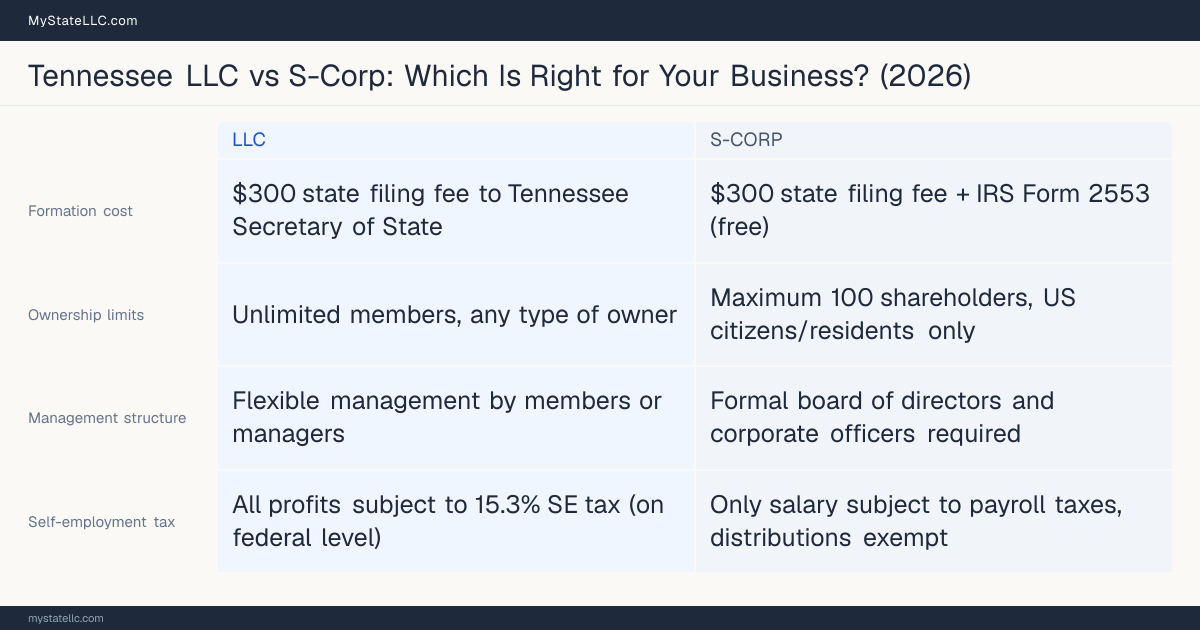
Side-by-side on the factors that decide the choice, for Tennessee. Source: Tennessee Secretary of State.
LLC vs S-Corp: Side-by-Side
Factor
LLC
S-Corp
Formation cost
$300 state filing fee to Tennessee Secretary of State
$300 state filing fee + IRS Form 2553 (free)
Ownership limits
Unlimited members, any type of owner
Maximum 100 shareholders, US citizens/residents only
Management structure
Flexible management by members or managers
Formal board of directors and corporate officers required
Self-employment tax
All profits subject to 15.3% SE tax (on federal level)
Only salary subject to payroll taxes, distributions exempt
Payroll required
No payroll requirements for owner-operators
Must run payroll for owner-employees with reasonable salary
State taxes in Tennessee
No state income tax; is subject to Tennessee franchise & excise tax (all corporations and LLCs doing business in TN owe it, regardless of revenue)
No state income tax; same franchise/excise tax rules apply
Complexity
Simple recordkeeping and minimal compliance requirements
Complex payroll, corporate resolutions, and formal meetings
Conversion path
Can elect S-Corp tax status anytime with Form 2553
Difficult to convert back to LLC without tax consequences
When an LLC Makes More Sense
Your business profits are under $60,000 annually and self-employment tax savings don't justify S-Corp complexity
You want maximum flexibility in ownership structure or have foreign investors
You prefer simple operations without payroll requirements and formal corporate procedures
You're unsure about long-term business structure and want to keep conversion options open
When an S-Corp Makes More Sense
Your business consistently generates $60,000+ in annual profits and you can justify a reasonable salary
You want to minimize self-employment taxes by splitting income between salary and distributions
You're comfortable with payroll processing, corporate formalities, and increased compliance requirements
You've a stable business with predictable income that can support regular salary payments
Tax Deep Dive
Llc Default Tax
Tennessee LLCs are taxed as pass-through entities by default, meaning all profits flow to your personal tax return and are subject to federal self-employment tax of 15.3%. Tennessee has no state income tax, but large LLCs may owe franchise and excise taxes.
S Corp Tax
S-Corps avoid self-employment tax on distributions by requiring owners to take reasonable salaries subject to payroll taxes, while remaining profits pass through as distributions. This salary-distribution split can generate significant tax savings for profitable businesses.
Breakeven Income
Most tax professionals suggest S-Corp election becomes beneficial around $60,000 in annual business profits in Tennessee, where payroll tax savings on distributions exceed the additional compliance costs and complexity.
Calculate Your Tax Savings in Tennessee
Enter your profit and filing status to compare estimated annual taxes for LLC, S-Corp, and C-Corp side by side, specific to Tennessee.
This guide is general information, not legal or tax advice, and reading it does not create an attorney-client relationship. It reports published tax rates and statutory attributes, with the sources this page cites. It cannot tell you which structure is better for you: that turns on your profit, the salary you could defend as reasonable compensation, every state you owe tax in, and plans for owners, investors and exit that no figure on this page measures. Confirm your own position with a CPA or tax attorney licensed in your state before you elect anything, because some elections are slow or costly to reverse.
Frequently Asked Questions
Choosing S-Corp election over standard LLC taxation in Tennessee can save $2,000 to $5,000 annually in self-employment taxes if your business generates $60,000 or more in profit. This works because S-Corps let you split income into reasonable W-2 wages (subject to payroll tax) and distributions (not subject to 15.3% self-employment tax). However, Tennessee requires you to file Form 2553 with the IRS and maintain payroll processing through the Tennessee Department of Labor and Workforce Development, adding $1,500 to $3,000 yearly in payroll service fees and additional accounting complexity. You'll also need a Tennessee Employer Identification Number if you weren't already running payroll. The net savings typically emerge only after offsetting these compliance costs, meaning businesses netting under $50,000 often break even or lose money. Before electing S-Corp status, calculate your specific tax obligation using IRS Publication 560 or consult a Tennessee CPA to model both scenarios with your actual profit margins and planned salary level.
To elect S-Corp tax status for your Tennessee LLC, file IRS Form 2553 (Election by a Small Business Corporation) with the IRS within 75 days of forming your LLC, or by March 15th if you're making a late election for the current tax year. Tennessee doesn't require a separate state-level election because the state automatically recognizes federal tax classifications for pass-through entities, once the IRS accepts your Form 2553, your LLC is treated as an S-Corp for both federal and Tennessee tax purposes. This election matters significantly for LLC owners because it changes how self-employment taxes are calculated. As an S-Corp, you'll split income between W-2 wages (subject to payroll taxes) and distributions (generally not subject to self-employment taxes), potentially saving 15.3% on a portion of your business income. However, you must also run payroll and file annual Form 1120-S returns. File Form 2553 with the IRS service center handling your federal tax return, and keep a copy for your records alongside your Tennessee LLC formation documents.
Yes, your Tennessee LLC can be taxed as an S-Corp by filing Form 2553 (Election by a Small Business Corporation) with the IRS, regardless of your state-level LLC structure. This election allows you to retain your LLC's liability protection and operational flexibility under Tennessee law while receiving federal S-Corp tax treatment, a significant advantage if your business generates substantial net income. The practical benefit is substantial: S-Corp taxation lets you split income between W-2 wages (subject to payroll taxes) and distributions (subject only to income tax), potentially saving 15.3% in self-employment taxes on your distributions. Tennessee levies a franchise and excise tax, 6.5% excise tax on Tennessee taxable income plus 0.25% franchise tax on net worth with a $100 franchise tax minimum, so the election does not leave you owing federal tax alone. File Form 2553 with the IRS within 60 days of your LLC's formation date or by March 15 of the tax year you want the election effective. File your completed form with the IRS Service Center serving your region. Consult a Tennessee tax professional to verify your LLC qualifies (fewer than 100 members, all U.S. citizens or residents) before filing.
Tennessee imposes no state income tax on either LLCs or S-Corps, making both structures equally attractive from a personal income perspective. Both entities must file a Franchise and Excise Tax return (Form FAE 170) with the Tennessee Department of Revenue; all corporations and LLCs doing business in Tennessee are subject, regardless of gross receipts. The franchise tax rate is $0.25 per $100 (0.25%) of net worth, with a $100 minimum. Tennessee automatically recognizes federal tax elections, so if you elect S-Corp taxation for your LLC at the IRS level using Form 2553, Tennessee will treat it identically. This means you won't face conflicting state and federal classifications that complicate compliance in other states. The practical benefit: you can optimize federal self-employment taxes through S-Corp election without navigating separate state requirements. File your federal election with the IRS and submit any required state notifications to the Tennessee Department of Revenue simultaneously to avoid processing delays.
You should elect S-Corp tax status when your Tennessee LLC consistently generates $60,000 or more in annual net profits, as this threshold typically justifies the administrative costs. File Form 2553 (Election by a Small Business Corporation) with the IRS. There's no state-specific form required in Tennessee, though you must maintain compliance with the Tennessee Secretary of State. The $60,000 benchmark matters because S-Corp election saves you 15.3% in self-employment taxes on distributions above your reasonable W-2 salary, offsetting the $800 to $1,200 annual accounting and payroll processing fees. This election becomes practical when your tax savings exceed these operational costs. As an LLC owner, you can elect S-Corp status without formal conversion, simply file Form 2553 with your federal tax return. The Tennessee Department of Revenue recognizes your election automatically once the IRS approves it. Your next step is consulting a Tennessee CPA to calculate your exact break-even point, then file Form 2553 by March 15 to make the election effective for the current tax year.
Yes, an S-Corp in Tennessee typically requires professional accounting support, while an LLC may not. S-Corps must file Form 1120S (U.S. Income Tax Return for S Corporation) with the IRS, establish formal payroll through the Tennessee Department of Labor and Workforce Development, and document a reasonable salary for owner-employees, a critical requirement the IRS audits frequently. An accountant ensures compliance with these payroll obligations and optimizes your salary-versus-distribution split to minimize self-employment taxes. Tennessee LLCs taxed as sole proprietorships or partnerships can often use affordable tax software like TurboTax Self-Employed, though more complex multi-member LLCs benefit from professional guidance. Budget $2,000 to $4,000 annually for S-Corp accounting in Tennessee, compared to $500 to $1,200 for basic LLC preparation. This professional support protects you from costly IRS penalties and audit exposure. Contact a Tennessee CPA or visit the Tennessee Society of CPAs website (tncpa.org) to find qualified professionals experienced with S-Corp structuring before making your final decision.
Sources
Each entry below is a document recorded in our verified Tennessee sources, and each entry says what the document is. Some statutory text is read from an accurate mirror rather than from the state's own host, and those say so.
See how Northwest Registered Agent, Bizee, ZenBusiness and LegalZoom, the formation services we partner with, compare on 3-year cost, BBB rating and Trustpilot score before you choose.
Edmond Hui is a software engineer and serial entrepreneur based in New York who has founded multiple online businesses across e-commerce, media, and information publishing. Before transitioning into tech, he spent years as a commercial real estate professional closing deals totaling over 100,000 square feet, giving him firsthand experience with business formation and entity structuring. He built MyStateLLC to provide the free, state-specific LLC guidance he wished existed when forming his own companies.