South Carolina LLC vs C-Corp: Choose the Right Business Structure in 2026
Understand the key differences between LLCs and C-Corporations in South Carolina to make the best choice for your business goals, taxes, and growth plans.
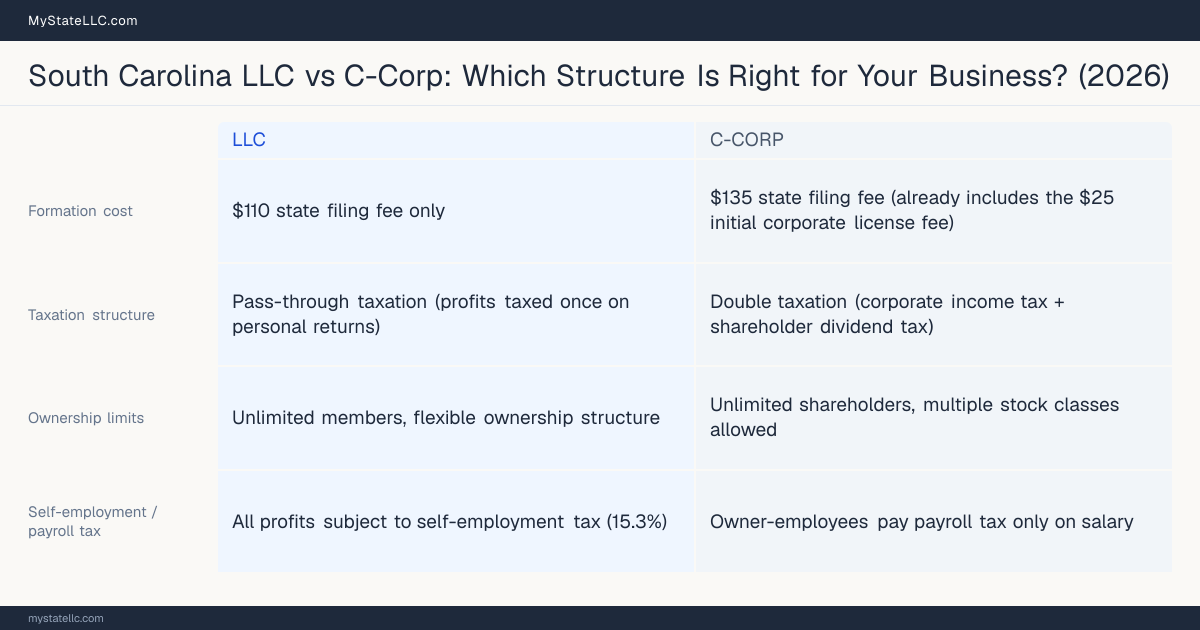
In South Carolina, an LLC fits when you want simple tax filing and pass-through taxation benefits; a C-corp fits when you plan to reinvest significant profits back into the business. Compare both structures in detail below.
Affiliate disclosure: We may earn a commission at no extra cost to you.
Dividends distributed proportional to stock ownership
When an LLC Makes More Sense
You want simple tax filing and pass-through taxation benefits
Your business has few owners who actively participate in operations
You prefer flexible profit sharing and minimal administrative requirements
You don't plan to seek venture capital funding or go public
When a C-Corp Makes More Sense
You plan to reinvest significant profits back into the business
You want to attract venture capital investors or plan an eventual IPO
You need to provide tax-deductible employee benefits like health insurance
Your business generates high profits and C-Corp tax rates would be lower
Tax Deep Dive
Llc Default Tax
South Carolina LLCs enjoy pass-through taxation by default, meaning business profits flow directly to members' personal tax returns and are taxed at individual rates ranging from 0% to 7%. This eliminates double taxation but subjects all profits to self-employment tax at the federal level.
C Corp Tax
C-Corporations in South Carolina face double taxation: the business pays 5% state corporate income tax plus 21% federal corporate tax, then shareholders pay additional taxes on any dividends received. This can result in a combined tax burden exceeding 40% on distributed profits.
When C Corp Wins
C-Corporations become tax-advantageous in South Carolina when retaining significant earnings for growth (avoiding dividend taxes), seeking venture capital (investors prefer C-Corps), or when the combined corporate tax rates are lower than the owner's individual tax bracket plus self-employment taxes. The 5% South Carolina corporate rate is competitive compared to the top 7% individual rate.
Calculate Your Tax Savings in South Carolina
Enter your profit and filing status to compare estimated annual taxes for LLC, S-Corp, and C-Corp side by side, specific to South Carolina.
This guide is general information, not legal or tax advice, and reading it does not create an attorney-client relationship. It reports published tax rates and statutory attributes, with the sources this page cites. It cannot tell you which structure is better for you: that turns on your profit, the salary you could defend as reasonable compensation, every state you owe tax in, and plans for owners, investors and exit that no figure on this page measures. Confirm your own position with a CPA or tax attorney licensed in your state before you elect anything, because some elections are slow or costly to reverse.
Frequently Asked Questions
Double taxation means C-Corporations pay corporate income tax on profits, then shareholders pay additional taxes when those profits are distributed as dividends. In South Carolina, your C-Corp first pays the state corporate income tax of 5% plus the federal rate of 21% on net profits. When you distribute remaining earnings as dividends to shareholders, those individuals then owe South Carolina individual income tax (ranging from 0% to 7% depending on tax bracket) plus federal dividend tax rates up to 20%. This stacking effect can result in combined tax rates exceeding 40% on distributed profits. For South Carolina LLC owners, this matters significantly: LLCs avoid double taxation through pass-through taxation, where profits are taxed only once at individual member tax rates. A $100,000 profit distributed by a C-Corp might leave shareholders with only $55,000 to $60,000 after taxes, whereas an LLC member would retain substantially more. To determine if your business should elect C-Corp taxation despite this disadvantage, consult a South Carolina CPA about your specific profit distribution plans and reinvestment strategy.
A C-Corp saves money in South Carolina when you retain profits inside the corporation rather than distributing them as dividends, since South Carolina's corporate income tax rate is 21% (flat rate for all brackets) compared to individual rates reaching 7%, and you avoid the 15.3% self-employment tax on retained earnings. The break-even point occurs when your personal income tax rate plus self-employment tax exceeds 21%, typically for business owners earning over $100,000 annually. Additionally, C-Corps can deduct 100% of health insurance premiums, retirement plan contributions, and other employee benefits through the South Carolina Department of Revenue (SCDOR), reducing taxable income dollar-for-dollar. File Form SC1120 (Corporate Income Tax Return) annually by the 15th day of the fourth month after year-end (April 15 for calendar-year filers) to maintain this tax advantage. However, you'll face double taxation when eventually distributing profits as dividends unless structured carefully. Consult a South Carolina CPA to compare your specific income level against the 21% corporate rate before electing C-Corp status with the SCDOR.
Yes, you can convert your South Carolina LLC to a C-Corporation, but the IRS treats this as a taxable event that may trigger immediate capital gains taxes on appreciated assets. You'll file Articles of Conversion with the South Carolina Secretary of State (filing fee: $125) and obtain a new EIN from the IRS. The conversion deadline doesn't exist. You can convert whenever needed, but delaying increases your tax liability exposure if your LLC has gained value. This means you could owe state and federal taxes on the difference between your asset basis and current fair market value, even though you haven't sold anything. You'll also need to dissolve the LLC formally, which requires filing a Certificate of Dissolution ($0 fee) with South Carolina. The practical implication: converting later is significantly more expensive than selecting the correct structure upfront, potentially costing thousands in unexpected tax bills. Your next step is consulting a South Carolina tax accountant to model conversion costs before deciding whether to restructure now or maintain your current LLC status.
Venture capital firms overwhelmingly prefer C-Corporations because they can issue multiple classes of preferred stock with liquidation preferences, anti-dilution protections, and dividend rights, structures impossible under South Carolina LLC law. Stock options for employees also receive favorable tax treatment under Section 422 of the Internal Revenue Code, making equity compensation more attractive to talent. Institutional investors actively avoid LLCs due to "unrelated business taxable income" (UBTI) complications that trigger unexpected tax liabilities for pension funds and endowments holding LLC interests. For South Carolina business owners seeking VC funding, this preference has immediate consequences: you'll face pressure to convert your LLC to a C-Corporation before closing any institutional investment round, triggering IRS Form 8832 entity classification elections and potential double taxation on conversion gains. **Next step:** If you anticipate raising venture capital within 3 to 5 years, consult a South Carolina business attorney about incorporating as a C-Corp initially rather than converting later, which costs significantly more and complicates cap table management.
South Carolina C-Corps pay a $135 filing fee to the Secretary of State compared to $110 for LLCs, a $25 difference. Beyond incorporation, C-Corps owe an annual franchise tax calculated by the South Carolina Department of Revenue based on your corporation's capital stock and paid-in capital, starting at a minimum of $25 annually but potentially reaching hundreds of dollars for well-capitalized businesses. You'll also pay South Carolina's 5% corporate income tax on net profits, whereas S-Corps and LLCs typically avoid entity-level taxation. C-Corps must file Form SC1120 (Corporate Income Tax Return) annually with the Department of Revenue, plus maintain more rigorous compliance records including board meeting minutes and formal resolutions. For LLC owners, this means C-Corp structures cost substantially more annually, easily $500 to $1,500+ depending on your capital structure, making C-Corps economically impractical unless you're reinvesting profits or attracting outside investors who specifically require the C-Corp structure. File your articles of incorporation with the South Carolina Secretary of State's Business Services Division and consult with a CPA about your state's current franchise tax brackets before deciding on your entity type.
Most small businesses in South Carolina should choose an LLC structure because of pass-through taxation, operational simplicity, and lower filing fees. South Carolina LLC formation costs $110 with the Secretary of State (no additional initial license fee), compared to C-Corp incorporation at $135 total, which already includes the $25 CL-1 initial license fee. This means immediate annual savings on compliance costs. LLCs avoid double taxation, profits pass through to your personal tax return without entity-level taxation, reducing your overall tax burden unless you're in the highest federal brackets. You'll also skip the mandatory corporate formalities like annual shareholder meetings and detailed minutes that the South Carolina Secretary of State requires for C-Corps. Choose a C-Corp only if you're actively seeking venture capital funding, plan to retain profits indefinitely for reinvestment, or if South Carolina's corporate tax rate (5.75%) plus federal rates would genuinely cost less than self-employment taxes on LLC income. File your LLC Articles of Organization with the South Carolina Secretary of State's Business Filings Division today to establish pass-through tax treatment immediately.
Sources
Each entry below is a document recorded in our verified South Carolina sources, and each entry says what the document is. Some statutory text is read from an accurate mirror rather than from the state's own host, and those say so.
See how Northwest Registered Agent, Bizee, ZenBusiness and LegalZoom, the formation services we partner with, compare on 3-year cost, BBB rating and Trustpilot score before you choose.
Edmond Hui is a software engineer and serial entrepreneur based in New York who has founded multiple online businesses across e-commerce, media, and information publishing. Before transitioning into tech, he spent years as a commercial real estate professional closing deals totaling over 100,000 square feet, giving him firsthand experience with business formation and entity structuring. He built MyStateLLC to provide the free, state-specific LLC guidance he wished existed when forming his own companies.