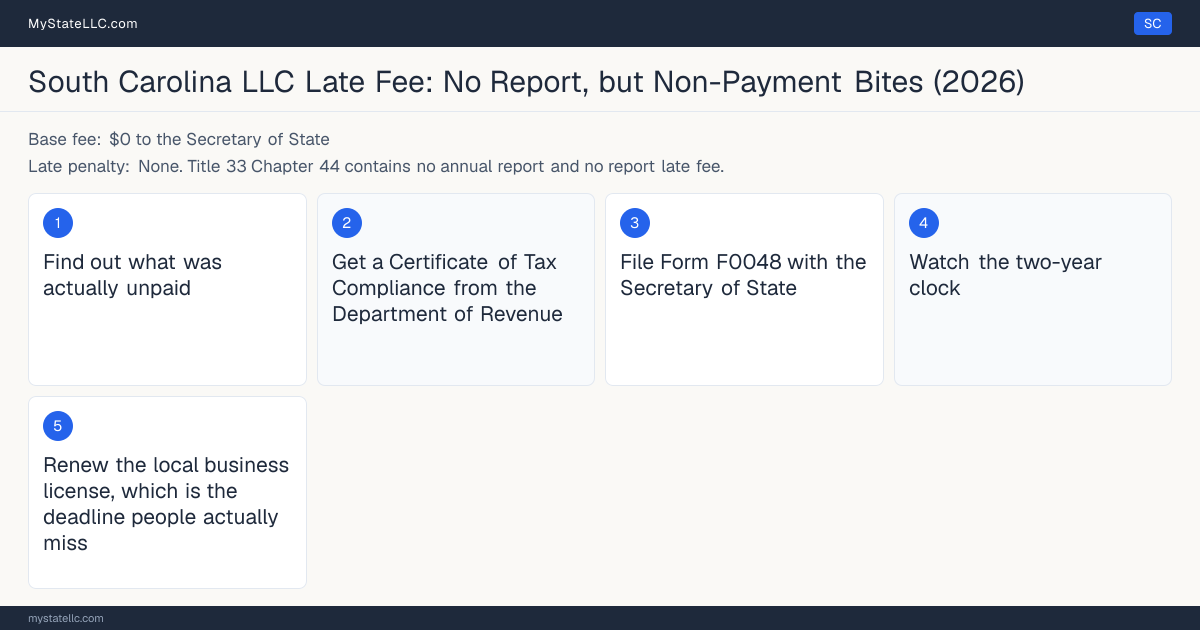
South Carolina LLC Late Fees: There Is No Report to File Late
No annual report goes to the Secretary of State, so no report late fee exists. What can dissolve a South Carolina LLC is not paying a fee or tax, and the window to reinstate is a hard two years.
South Carolina LLCs have no annual report deadline, so there is no annual report late fee. See details below.
South Carolina requires no LLC annual report. What the state charges when the filing it does require is missed, and how to cure it. Source: South Carolina Secretary of State.
Ready to file your annual report?
Go directly to the South Carolina Secretary of State portal.
None. Title 33 Chapter 44 contains no annual report and no report late fee.
⏱
grace period
Not applicable
🚨
dissolution timeline
Administrative dissolution follows non-payment of a fee, tax or penalty for 60 days, plus a further 60 days after the Secretary of State serves notice (SC Code 33-44-809, 33-44-810)
What Happens If You Miss the Deadline
Stage 1
Missing an annual report deadline
Nothing, because there is none. Title 33 Chapter 44 contains no annual report section, and SC Code 33-44-1204 lists every LLC filing fee without any recurring one. Any page quoting a South Carolina LLC annual report fee, an April 15 deadline or a report late penalty is describing a filing that does not exist.
✓ Fix:There is nothing to fix.
Stage 2
Not paying a fee, tax or penalty for 60 days
This is the only statutory trigger. SC Code 33-44-809 lets the Secretary of State begin dissolution "if the company does not pay a fee, tax, or penalty imposed by this chapter or other law within sixty days after it is due." The phrase "or other law" is what makes it bite: an LLC that elected corporate taxation and stops paying its Department of Revenue License Fee is squarely within it.
✓ Fix:Yes. SC Code 33-44-810 gives 60 days after the Secretary of State serves its determination to correct the ground or show it never existed, before the certificate of dissolution issues.
Stage 3
After administrative dissolution
The LLC "continues its existence but may carry on only business necessary to wind up" under SC Code 33-44-810, and the dissolution "does not terminate the authority of its agent for service of process". You can still be sued.
✓ Fix:Yes, for two years. SC Code 33-44-811(a) sets a hard two-year window from the effective date of dissolution, and unlike a South Carolina business corporation, an LLC cannot reinstate after it.
Stage 4
Letting the registered agent lapse
Not a ground for dissolution in South Carolina, despite what is often written. SC Code 33-44-809 lists non-payment only. What actually happens is SC Code 33-44-111(b): the Secretary of State becomes your agent for service of process, so a lawsuit can be served on the state rather than on someone who will tell you about it.
✓ Fix:Yes. File a change of agent; SC Code 33-44-1204(a)(9) sets the fee at $10.
How to Fix It: Step-by-Step
1
Find out what was actually unpaid
Dissolution follows money, not paperwork. If your LLC is taxed as a corporation, start with the Department of Revenue License Fee, which is 0.1% of capital stock and paid-in surplus plus $15, with a $25 minimum. If your LLC is taxed as a partnership or disregarded, the Department of Revenue's own guidance excludes it from both the annual report and the License Fee, so the unpaid item is something else.
2
Get a Certificate of Tax Compliance from the Department of Revenue
This is mandatory and is the part most guides omit. SC Code 33-44-811(a)(4) requires the reinstatement application to "contain a certificate from the Department of Revenue reciting that all taxes owed by the company have been paid." You request it on Form C-268 with a $60 non-refundable fee, and the Department notifies you of any delinquency with 30 days to comply.
3
File Form F0048 with the Secretary of State
The form is the "Application for Reinstatement by a Limited Liability Company Dissolved by Administration" under SC Code 33-44-811, filed with a $25 fee set by SC Code 33-44-1204(a)(11). Note the form number: F0048. There is no South Carolina form LLC-12, which is a California Statement of Information, and no form LLCREIN.
4
Watch the two-year clock
SC Code 33-44-811(a) allows reinstatement only "within two years after the effective date of dissolution". South Carolina business corporations may reinstate at any time; LLCs may not. If the application is denied, SC Code 33-44-812 gives 30 days to appeal to the circuit court.
5
Renew the local business license, which is the deadline people actually miss
South Carolina business licenses are issued by counties and cities, not the state. SC Code 6-1-400(B)(1) fixes a license year running May 1 to April 30 and requires renewal before May 1, with the tax computed on the previous calendar year's gross income at a rate each jurisdiction sets. This is annual, not biennial.
🚨 Reinstatement After Dissolution
Reinstatement Possible?
Yes, within two years
How Long Allowed
Two years from the effective date of dissolution, under SC Code 33-44-811(a). This is a hard limit for LLCs, unlike South Carolina business corporations, which may reinstate at any time.
Reinstatement Fee
$25 to the Secretary of State on Form F0048 (SC Code 33-44-1204(a)(11)), plus a $60 non-refundable Department of Revenue fee for the Certificate of Tax Compliance on Form C-268, plus whatever fee or tax was actually unpaid
What You Lose During Dissolution
Less than is usually claimed, and only temporarily. A dissolved LLC continues to exist for winding up and its agent's authority survives (SC Code 33-44-810). More importantly, SC Code 33-44-811(c) makes reinstatement retroactive: it "relates back to and takes effect as of the effective date of the administrative dissolution, and the company may resume its business as if the administrative dissolution had never occurred."
This guide is general information, not legal or tax advice, and reading it does not create an attorney-client relationship. It reports what each state publishes about filing deadlines, fees, and the consequences of missing them, with the sources this page cites. It cannot tell you what your own company owes: the date turns on when and where you formed, states change these rules between our reviews, and in several states an entity-level tax falls due in a year when no report does. Confirm your own dates with the filing office named on this page before you rely on one here, because the penalty for missing a deadline can be administrative dissolution of the company.
Frequently Asked Questions
There is none, because South Carolina LLCs file no annual report with the Secretary of State. Title 33 Chapter 44 contains no annual report section at all, and SC Code 33-44-1204, which lists every LLC filing fee, includes no recurring one.
The $25 figure often quoted as a report fee is the reinstatement filing fee under SC Code 33-44-1204(a)(11). It is what you pay to undo an administrative dissolution, not an annual charge.
South Carolina corporations do file an annual report, but not with the Secretary of State either. SC Code 33-16-220 routes it through Title 12, and SC Code 12-20-130 combines it with the income tax return, so it appears as a schedule on the SC1120. That is the regime most wrong answers about South Carolina are borrowed from.
Yes, and this is the one real exception.
SC Code 12-2-25(A)(3) defines "corporation" for Title 12 purposes to include "a limited liability company... taxed for South Carolina income tax purposes as a corporation". That pulls a corporate-taxed LLC into the annual report duty in SC Code 12-20-20 and the corporate License Fee in SC Code 12-20-50.
So an LLC taxed as a C corp or S corp files the annual report as part of its SC1120 or SC1120S and pays a License Fee of 0.1% of capital stock and paid-in surplus plus $15, with a statutory minimum of $25 a year. It also files a one-time CL-1, the Initial Annual Report of Corporations, with $25, within 60 days of commencing business in the state.
An LLC taxed as a partnership or disregarded owes none of it. The Department of Revenue's own guidance lists "a Limited Liability Company (LLC) not taxed as a corporation" among the entities not subject to the annual report or the License Fee.
Not paying something. SC Code 33-44-809 gives the Secretary of State one ground: the company "does not pay a fee, tax, or penalty imposed by this chapter or other law within sixty days after it is due".
That is the entire list. There is no report to miss, and, contrary to what is often written, letting your registered agent lapse is not a ground either. SC Code 33-44-111(b) handles that differently: the Secretary of State becomes your agent for service of process, which means a suit can be served without anyone telling you.
Before dissolution issues, SC Code 33-44-810 requires the Secretary of State to serve a record of its determination, giving you 60 days to correct the ground or show it did not exist.
For an LLC taxed as a corporation, the practical trigger is an unpaid Department of Revenue License Fee, which is a "tax... imposed by... other law".
No. Two provisions work against that reading.
SC Code 33-44-810 provides that an administratively dissolved LLC "continues its existence but may carry on only business necessary to wind up", and that the dissolution "does not terminate the authority of its agent for service of process". The entity does not vanish.
And SC Code 33-44-811(c) makes a successful reinstatement retroactive: it "relates back to and takes effect as of the effective date of the administrative dissolution, and the company may resume its business as if the administrative dissolution had never occurred". The gap closes rather than leaving a period of exposure behind it.
What does put a South Carolina LLC's shield at risk is the ordinary judicial doctrine: commingling funds, ignoring the entity's separateness, or using it as an alter ego. No filing prevents that, and no missed filing causes it.
Search your entity through the Secretary of State's business filings system at sos.sc.gov. Because an LLC has no periodic filing, an active LLC generally stays active unless it dissolves voluntarily or is administratively dissolved for non-payment.
If the record shows administrative dissolution and the cause is a Department of Revenue matter, the Secretary of State's own guidance directs you to contact the Department first, because the Certificate of Tax Compliance is a prerequisite to reinstatement.
For documentary proof of standing, order a Certificate of Existence. SC Code 33-44-1204(a)(13) sets the fee at $10, and the Secretary of State publishes an anti-scam notice making the same point, because third-party services resell it at a markup.
The filing fees are statutory and not negotiable: $25 for the reinstatement application under SC Code 33-44-1204(a)(11), $10 for a certificate of existence under 33-44-1204(a)(13), $60 for the Department of Revenue's Certificate of Tax Compliance on Form C-268.
The underlying tax or fee that caused the dissolution is a different matter, and if you believe it was assessed wrongly that is a dispute to raise with the Department of Revenue rather than a request for relief.
What is worth doing instead is watching the two-year clock in SC Code 33-44-811(a), because it is the one thing here that cannot be cured with money once it runs out.
This page is general information about South Carolina's statutes and filing requirements, not legal or tax advice.
Sources
Each entry below is a document recorded in our verified South Carolina sources, and each entry says what the document is. Some statutory text is read from an accurate mirror rather than from the state's own host, and those say so.
See how Northwest Registered Agent, Bizee, ZenBusiness and LegalZoom, the formation services we partner with, compare on 3-year cost, BBB rating and Trustpilot score before you choose.
Edmond Hui is a software engineer and serial entrepreneur based in New York who has founded multiple online businesses across e-commerce, media, and information publishing. Before transitioning into tech, he spent years as a commercial real estate professional closing deals totaling over 100,000 square feet, giving him firsthand experience with business formation and entity structuring. He built MyStateLLC to provide the free, state-specific LLC guidance he wished existed when forming his own companies.