Rhode Island does not legally require an LLC operating agreement, but having one protects your limited liability status and sets the rules for ownership and profits. See exactly what to include below.
Edmond Hui is a software engineer and serial entrepreneur based in New York who has founded multiple online businesses across e-commerce, media, and information publishing. Before transitioning into tech, he spent years as a commercial real estate professional closing deals totaling over 100,000 square feet, giving him firsthand experience with business formation and entity structuring. He built MyStateLLC to provide the free, state-specific LLC guidance he wished existed when forming his own companies.
Affiliate disclosure: We may earn a commission at no extra cost to you.
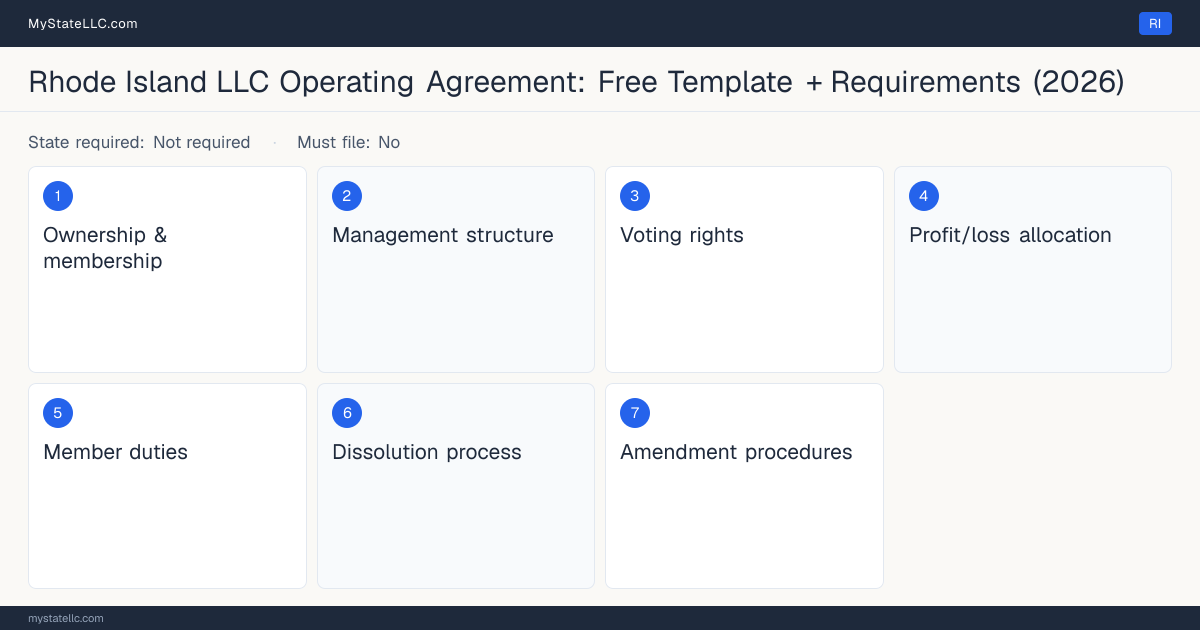
Define each member's ownership percentage, capital contributions, and membership interests. This section establishes who owns what portion of your Rhode Island LLC and prevents future disputes.
Management structure
Specify whether your LLC is member-managed or manager-managed and outline decision-making authority. Clear management roles prevent confusion and ensure smooth daily operations.
Voting rights
Establish voting procedures, required majorities for different decisions, and member voting power. This protects minority members and ensures important business decisions are made properly.
Profit/loss allocation
Detail how profits and losses will be distributed among members and the timing of distributions. Proper allocation rules ensure fair compensation and meet IRS requirements for tax purposes.
Member duties
Outline each member's responsibilities, time commitments, and fiduciary duties to the LLC. Clear expectations prevent misunderstandings and ensure all members contribute appropriately.
Dissolution process
Define circumstances that trigger dissolution and procedures for winding up business affairs. Having a clear exit strategy protects members' interests and ensures orderly business closure when needed.
Amendment procedures
Establish how the operating agreement can be modified, including required votes and documentation. This ensures your agreement can evolve with your business while maintaining proper approval processes.
Frequently Asked Questions
No, Rhode Island does not legally require LLCs to have a written operating agreement under Rhode Island General Laws Chapter 7-16. However, this absence of a legal mandate creates significant risk for your business. Without a formal operating agreement, Rhode Island's default LLC laws automatically apply to your company, which may not align with your ownership structure or decision-making preferences. Most critically, courts view operating agreements as essential evidence of your LLC's legitimacy; the absence of one can undermine your personal liability protection if a creditor challenges your corporate veil. An operating agreement also prevents costly member disputes by documenting profit-sharing percentages, voting rights, management responsibilities, and buyout procedures upfront. Additionally, many lenders and investors require operating agreements before approving loans or funding. You should draft or use a Rhode Island-specific operating agreement template immediately and have all members sign it, then store the original with your registered agent contact information.
Yes, you can draft your own Rhode Island LLC operating agreement—Rhode Island law doesn't require a written agreement or mandate any specific format. However, you'll need to address critical provisions yourself, including member contributions, profit distribution percentages, voting rights, and dissolution procedures outlined in Rhode Island General Laws Chapter 7-16-1 et seq.
For single-member LLCs with straightforward operations, a template or DIY approach works adequately. The practical advantage is cost savings—attorney fees typically run $500–$1,500 for custom drafting. However, Rhode Island's default statutory rules will govern any provisions you omit, which may not align with your intentions. For multi-member LLCs or those involving significant capital contributions, property transfers, or complex management structures, gaps in your agreement could trigger costly disputes later.
The critical implication: an incomplete agreement leaves you vulnerable to Rhode Island's statutory default provisions, which assume equal ownership and management rights regardless of capital contributions.
Start by downloading a Rhode Island-specific template from the Secretary of State's website (sos.ri.gov), then compare it against your specific operating structure to identify gaps before signing.
No, Rhode Island does not require LLC operating agreements to be notarized under Rhode Island General Laws Title 7, Chapter 16 (the Rhode Island Limited Liability Company Act). However, notarization is optional and can provide significant practical benefits for Rhode Island LLC owners.
While notarization isn't legally mandated, having your operating agreement notarized creates a certified record of execution and can strengthen the document's enforceability if disputes arise between members or if third parties challenge the agreement's validity. A notary public in Rhode Island charges typically between $5–$15 per signature to authenticate your document.
This distinction matters because unnotarized agreements may face scrutiny during litigation or when presented to banks, lenders, or business partners who want proof of legitimate formation. Many Rhode Island LLCs choose notarization as inexpensive insurance against future authentication questions.
To proceed, draft your operating agreement using Rhode Island's statutory requirements, then visit any licensed Rhode Island notary public (available at banks, law offices, and UPS stores) with a valid ID to have it notarized before filing with the Rhode Island Secretary of State.
Without an operating agreement, your Rhode Island LLC is governed entirely by Rhode Island General Laws Chapter 7-12-1 and the Secretary of State's default statutory rules. This means you lose control over critical decisions including management structure, profit distribution percentages, voting rights, and member buyout procedures—the state's one-member or multi-member default provisions apply instead.
Practically, this creates significant exposure: if disputes arise between members, you cannot point to written agreements to resolve them, leaving decisions to costly litigation based on Rhode Island statutes. You also forfeit liability protection customization and cannot establish clear operating procedures for meetings, amendments, or member removal. Additionally, absent a written agreement filed with the Rhode Island Secretary of State's Business Services Division, lenders and investors view your LLC as higher-risk, often refusing financing or partnership opportunities.
To protect your business immediately, draft or download a Rhode Island-specific operating agreement addressing member roles, capital contributions, and distribution schedules. File it with your LLC records and provide copies to all members within 30 days of formation.
Yes, you can amend your Rhode Island LLC operating agreement at any time after formation, but you must follow the specific procedures outlined in your original agreement. Most Rhode Island LLCs require unanimous member approval for fundamental changes—such as altering profit-sharing percentages, member withdrawal rights, or management structure—while less critical amendments may only require majority approval. The Rhode Island Secretary of State does not require you to file amended operating agreements; these remain internal documents. However, if your amendment affects information listed on your Certificate of Formation, you'll need to file a Certificate of Amendment with the Rhode Island Secretary of State (filing fee: $50 as of 2026) using Form 1030 within 30 days. This distinction matters significantly: failing to update your Certificate when required could create liability issues or jeopardize your LLC's legal standing. Before drafting amendments, review your current operating agreement's amendment clause carefully, document member votes, and keep signed copies for your records. Contact the Rhode Island Secretary of State's Business Services Division at (401) 222-3040 if your amendment affects formation details.