North Dakota LLC Operating Agreement Template & Guide
Protect your business with a comprehensive operating agreement. Get our free template plus expert guidance on North Dakota's requirements and best practices.
North Dakota does not legally require an LLC operating agreement, but having one protects your limited liability status and sets the rules for ownership and profits. See exactly what to include below.
Edmond Hui is a software engineer and serial entrepreneur based in New York who has founded multiple online businesses across e-commerce, media, and information publishing. Before transitioning into tech, he spent years as a commercial real estate professional closing deals totaling over 100,000 square feet, giving him firsthand experience with business formation and entity structuring. He built MyStateLLC to provide the free, state-specific LLC guidance he wished existed when forming his own companies.
Affiliate disclosure: We may earn a commission at no extra cost to you.
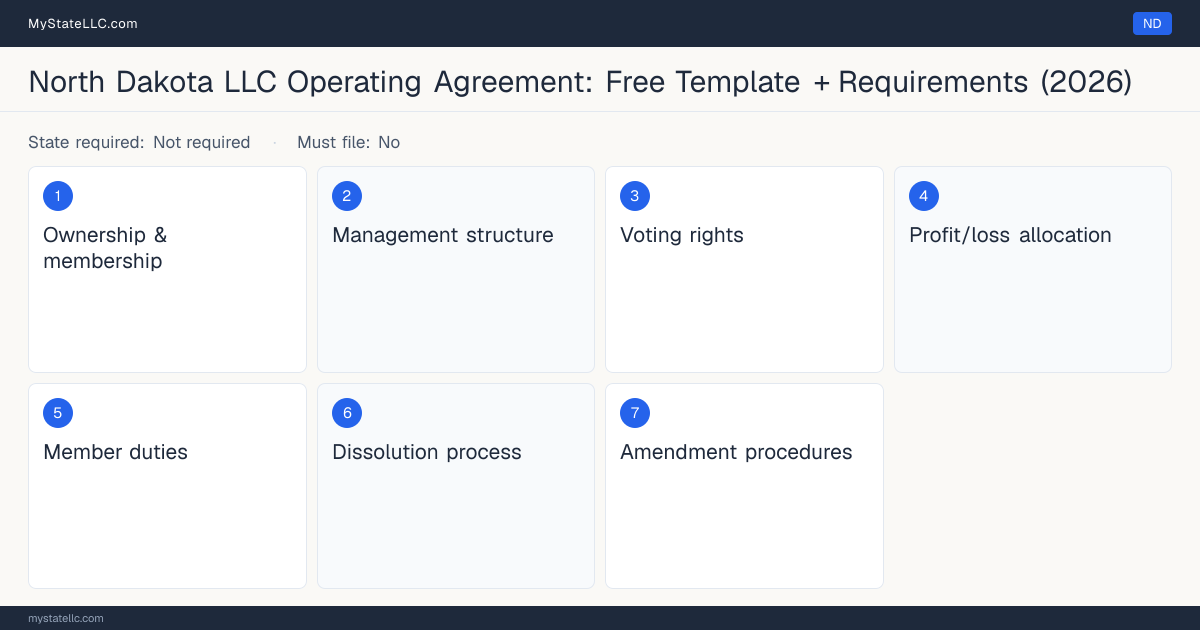
Define each member's ownership percentage, capital contributions, and membership interests. This section establishes the foundation of your LLC's ownership structure and prevents future disputes.
Management structure
Specify whether your LLC is member-managed or manager-managed, and outline the roles and responsibilities of managers or managing members. This clarifies who has authority to make business decisions.
Voting rights
Detail how voting power is distributed among members and what decisions require member approval. Include procedures for major decisions like admitting new members or dissolving the company.
Profit/loss allocation
Establish how profits and losses will be distributed among members, which may differ from ownership percentages. This section is crucial for tax planning and member expectations.
Member duties
Outline each member's obligations, contributions, and restrictions on competing activities. Clear expectations help maintain professional relationships and protect business interests.
Dissolution process
Define the circumstances that trigger dissolution and the procedures for winding up business affairs. This protects members' interests and provides an orderly exit strategy.
Amendment procedures
Specify how the operating agreement can be modified, including voting requirements and documentation procedures. This ensures changes are made properly and with appropriate member consent.
Frequently Asked Questions
No, North Dakota law doesn't require LLCs to have a written operating agreement under North Dakota Century Code § 10-32.1-23. However, this doesn't mean you should skip it—operating without one exposes your LLC to significant legal and financial risk.
Without a written operating agreement, your LLC defaults to North Dakota's statutory rules, which may not reflect your actual business intentions or member contributions. This creates practical problems: disputes over profit distribution, management authority, and membership changes become costly litigation rather than pre-planned solutions. Courts may also disregard your LLC's liability protection if you lack documented governance, potentially leaving your personal assets vulnerable.
An operating agreement establishes clear procedures for member decisions, capital contributions, profit allocation, and exit strategies. It demonstrates to the North Dakota Secretary of State and creditors that your LLC operates as a legitimate separate entity, not just a personal venture.
Draft your operating agreement before your first member meeting and keep it with your LLC records. If you're ready to formalize your structure, file your Articles of Organization with the North Dakota Secretary of State and implement your operating agreement simultaneously.
Yes, you can write your own North Dakota LLC operating agreement, and many single-member LLCs do so successfully using templates or legal software. However, North Dakota doesn't legally require a written operating agreement—only that you file Articles of Organization with the North Dakota Secretary of State (filing fee: $125). This creates a practical risk: without a documented agreement, your LLC defaults to North Dakota's statutory default rules under NDCC Chapter 10-32.1-1 et seq., which may not reflect your actual business intentions regarding profit distribution, management authority, or member buyout procedures. For multi-member LLCs or complex ownership structures—such as those with unequal profit-sharing, outside investors, or succession plans—courts will enforce your written agreement over default statutes, making a customized agreement essential. Consulting a North Dakota business attorney (typical cost: $500–$1,500) ensures your agreement complies with state law and addresses dissolution, dispute resolution, and tax classification. Your next step: download a state-specific North Dakota template, review it against your business structure, then have an attorney audit it before signing and retaining a copy with your LLC records.
No, North Dakota does not require LLC operating agreements to be notarized under North Dakota Century Code § 10-32.1-21. The state's Secretary of State does not mandate notarization as a condition of forming or maintaining an LLC.
However, notarization offers practical advantages worth considering. Many banks require a notarized operating agreement before opening business accounts or securing loans, even though it's not legally mandated. If your LLC plans to borrow money, establish credit lines, or conduct transactions with institutional lenders, notarization strengthens your document's credibility and demonstrates member commitment.
The cost is minimal—typically $10–25 per signature at North Dakota notary publics—compared to the potential complications of unnotarized documents during loan applications or legal disputes. Notarization also creates a dated record that's harder to challenge regarding member agreement authenticity.
To move forward, draft your operating agreement, then contact a local notary public through your bank or the North Dakota Secretary of State's office to have all member signatures notarized, even though it remains optional.
Without an operating agreement, your North Dakota LLC will be governed entirely by the default provisions in North Dakota Century Code Chapter 10-32.1, which limits your ability to customize ownership, management, and profit-sharing arrangements. Specifically, the state defaults assume equal ownership stakes among all members regardless of capital contributions, equal voting rights, and proportional profit distribution—even if this doesn't match your actual business arrangement. This inflexibility creates substantial practical problems: you lose the ability to designate a single manager, restrict member voting on specific decisions, or implement tiered profit distributions that reward investors differently. Without a written agreement documenting your operating procedures, the burden falls on you to prove your intended arrangement in any dispute, making litigation more expensive and uncertain. North Dakota does not require you to file an operating agreement with the Secretary of State, but failing to create one leaves your LLC vulnerable to member conflicts, creditor claims against personal assets, and IRS scrutiny of member classifications. Your immediate next step is to download a state-specific North Dakota LLC operating agreement template and customize it with your members' names, capital contributions, management roles, and profit-sharing percentages before conducting any business.
Yes, you can amend your North Dakota LLC operating agreement at any time after formation, but the process depends on your agreement's specific consent requirements. North Dakota law permits modifications as long as all members follow the procedures outlined in your original operating agreement—typically requiring either unanimous consent or a majority vote, whichever your agreement specifies. To officially amend, you'll need to prepare a written amendment document, obtain the required member signatures, and maintain the signed amendment with your LLC records. You do not need to file amendments with the North Dakota Secretary of State, though keeping detailed records protects you legally if disputes arise. The practical implication is that changing ownership percentages, profit distributions, member roles, or management structure requires careful documentation and member agreement—informal changes without proper documentation won't hold up legally. To proceed, review your current operating agreement's amendment clause, determine your consent threshold, draft the amendment using consistent language and formatting, and collect all required signatures with dates before implementing the changes.