North Carolina LLC Operating Agreement: Complete Guide + Free Template
Protect your business with a professional operating agreement. Get state-specific requirements, templates, and expert guidance for North Carolina LLCs.
North Carolina does not legally require an LLC operating agreement, but having one protects your limited liability status and sets the rules for ownership and profits. See exactly what to include below.
Edmond Hui is a software engineer and serial entrepreneur based in New York who has founded multiple online businesses across e-commerce, media, and information publishing. Before transitioning into tech, he spent years as a commercial real estate professional closing deals totaling over 100,000 square feet, giving him firsthand experience with business formation and entity structuring. He built MyStateLLC to provide the free, state-specific LLC guidance he wished existed when forming his own companies.
Affiliate disclosure: We may earn a commission at no extra cost to you.
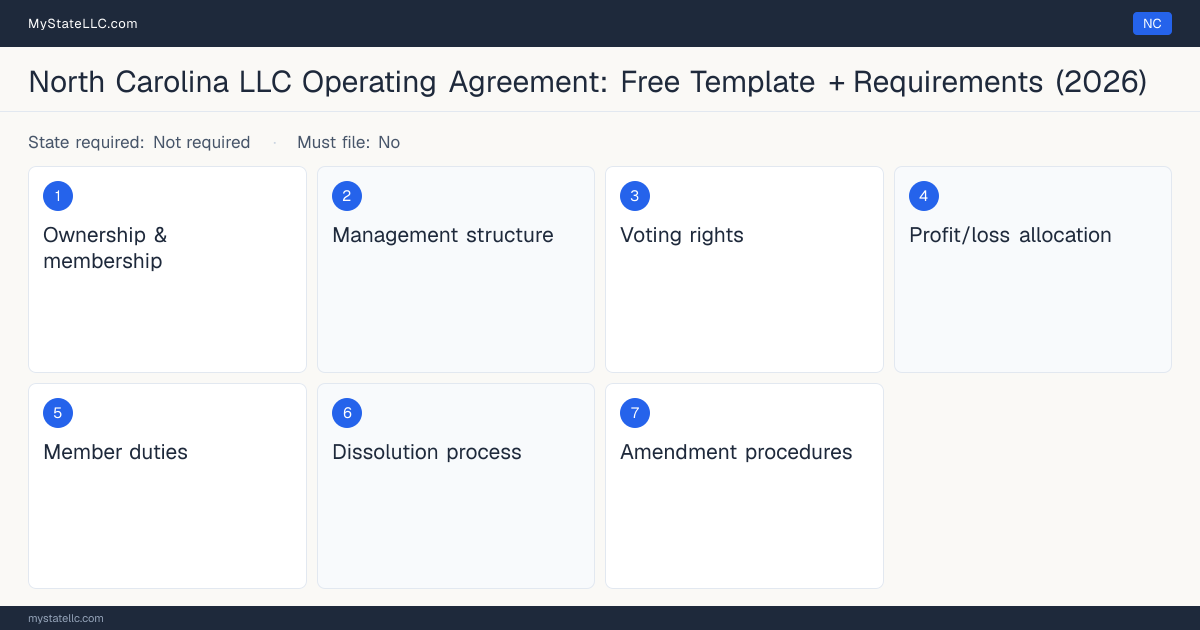
Define each member's ownership percentage, capital contributions, and membership interests. This establishes who owns what portion of the LLC and prevents future ownership disputes.
Management structure
Specify whether your LLC is member-managed or manager-managed, and outline the authority and responsibilities of each role. This clarifies who can make decisions and bind the company legally.
Voting rights
Detail how votes are allocated among members and what decisions require majority vs. unanimous consent. This prevents deadlocks and ensures important business decisions can be made efficiently.
Profit/loss allocation
Establish how profits and losses will be distributed among members, including timing and methods of distribution. This may differ from ownership percentages based on your business arrangement.
Member duties
Outline each member's responsibilities, time commitments, and restrictions on competing businesses. This sets clear expectations and prevents conflicts over member obligations.
Dissolution process
Define the circumstances that trigger LLC dissolution and the process for winding up business affairs. This provides a clear roadmap if the business needs to be dissolved or restructured.
Amendment procedures
Specify how the operating agreement can be modified, including required votes and documentation. This ensures changes to the agreement are made properly and with appropriate member consent.
Frequently Asked Questions
No, North Carolina law does not require LLCs to have a written operating agreement under N.C. Gen. Stat. § 57D-2-21. However, this legal flexibility creates significant practical risks for North Carolina LLC owners.
Without a documented operating agreement, your LLC defaults to North Carolina's statutory rules, which may not align with your business intentions regarding profit distribution, voting rights, or management structure. More critically, courts may view the absence of an operating agreement as evidence that your LLC lacks the formal business structure necessary to maintain liability protection—potentially exposing your personal assets if creditors challenge the LLC's legitimacy.
An operating agreement also serves as essential documentation for banks opening business accounts, lenders evaluating loans, and partners joining your venture. The North Carolina Secretary of State does not file operating agreements, so this document remains internal to your business.
Your next step: Draft and execute an operating agreement immediately, even though it's optional, to formalize your business structure and strengthen your liability protection shield.
Yes, you can write your own North Carolina LLC operating agreement without hiring an attorney, and North Carolina does not require you to file it with the Secretary of State. However, your agreement must address specific provisions mandated by North Carolina General Statute § 57D-1-20, including management structure, capital contributions, profit distribution, and member voting rights. Failing to document these terms in writing leaves your LLC governed by default state rules, which may not reflect your actual ownership intentions and could expose you to personal liability claims. Additionally, banks and lenders often require a certified copy of your operating agreement before approving business loans, making a detailed, professionally drafted document essential for financing. Rather than drafting from scratch, using a state-specific template ensures compliance with North Carolina requirements and protects your liability protections. Your next step is to download a North Carolina LLC operating agreement template, customize it with your specific member names, capital contributions, and management preferences, then have each member sign and date the agreement before opening a business bank account.
No, North Carolina does not require LLC operating agreements to be notarized to be legally valid. The North Carolina Secretary of State does not mandate notarization under the North Carolina Limited Liability Company Act (Chapter 57C). Your operating agreement becomes enforceable once all members sign it, regardless of notarization status.
However, notarization offers practical benefits worth considering. A notarized agreement provides stronger evidence of authenticity in future disputes, making it harder for a member to claim they didn't sign or didn't understand the terms. This becomes especially valuable if your LLC has multiple members or if you anticipate potential disagreements over governance or profit distribution.
If you choose notarization, expect to pay $5–$25 per signature at a local North Carolina notary public, plus any travel fees. Banks, law offices, and UPS stores typically offer notary services throughout the state.
To protect your LLC, have all members sign and date your operating agreement. If you want added protection, schedule a notary appointment before finalizing the document—this step takes 10–15 minutes per person.
Without an operating agreement, your North Carolina LLC will be governed by the state's default rules under the North Carolina Limited Liability Company Act (N.C. Gen. Stat. § 57C). This means the state's standardized ownership structure automatically applies, regardless of your actual business arrangements.
Specifically, North Carolina's default rules assume equal profit sharing among all members, equal voting rights, and predetermined rules for member withdrawal and buyouts that may contradict your intentions. If you have two members but want one to control management decisions, or if you've contributed different amounts of capital, the default framework ignores these arrangements entirely. This creates practical problems: disputes over profits become harder to resolve, member departures can trigger forced buyouts under state formulas, and tax classification for multi-member LLCs defaults to partnership taxation rather than S-corp election options you might prefer.
Without a documented agreement, creditors may more easily challenge your liability protection, and absent member death or incapacity provisions, your business faces operational gridlock. To protect your interests and clarify ownership terms, draft an operating agreement immediately—file it with the North Carolina Secretary of State, or retain it with your business records as required documentation for loan applications and member disputes.
Yes, you can amend your North Carolina LLC operating agreement at any time, but you must follow the specific procedures outlined in your original agreement. Most operating agreements require either unanimous consent from all members or approval by a majority vote—your agreement's terms determine which applies.
When amending, you'll need to prepare a written amendment document that clearly states the changes being made, then obtain the required member signatures. North Carolina doesn't mandate filing amendments with the Secretary of State unless the changes affect information in your Articles of Organization (such as registered agent or principal place of business). However, you should maintain signed amendment records with your LLC's documentation for legal protection.
The practical implication is significant: failing to properly amend your agreement can create disputes if members disagree about policy changes, and undocumented amendments may not be enforceable. Additionally, if your amendment affects tax classifications or member liability protections, you'll want written proof of approval.
Your next step is to review your current operating agreement's amendment section to determine your specific voting requirements, then draft the amendment language and distribute it to all members for execution.