New York LLC vs S-Corp: Choose the Right Business Structure
Compare formation costs, tax implications, and management flexibility to make the best decision for your New York business in 2026.
By Edmond Hui · Last updated: August 2026
Affiliate disclosure: We may earn a commission at no extra cost to you.
Start your LLC with ZenBusinessStart as an LLC, upgrade to S-Corp tax status any timeForm your LLC with Northwest ($39 + state fee)Includes a year of registered agent service. That enrolls you by default in annual report filing at $100 plus state fees, cancellable any time.Not sure which service is right? Compare formation services →
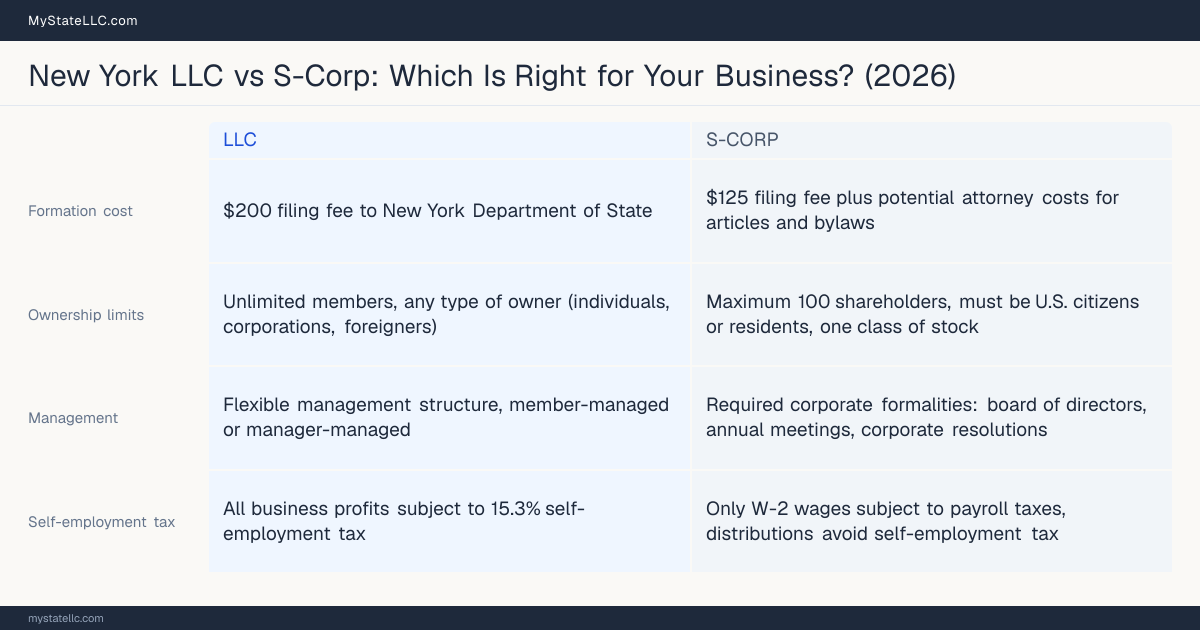
LLC vs S-Corp: Side-by-Side
| Factor | LLC | S-Corp |
|---|---|---|
| Formation cost | $200 filing fee to New York Department of State | $125 filing fee plus potential attorney costs for articles and bylaws |
| Ownership limits | Unlimited members, any type of owner (individuals, corporations, foreigners) | Maximum 100 shareholders, must be U.S. citizens or residents, one class of stock |
| Management | Flexible management structure, member-managed or manager-managed | Required corporate formalities: board of directors, annual meetings, corporate resolutions |
| Self-employment tax | All business profits subject to 15.3% self-employment tax | Only W-2 wages subject to payroll taxes, distributions avoid self-employment tax |
| Payroll required | No payroll requirements for owners | Owner-employees must receive reasonable salary through payroll |
| State taxes in New York | Annual LLC filing fee of $25 to $4,500 on New York source gross income; members pay on personal returns plus NYC UBT if applicable | Fixed dollar minimum franchise tax of $25 to $4,500 on New York receipts; shareholders pay on personal returns, same NYC treatment |
| Complexity | Simple ongoing compliance, annual biennial statement | Complex: payroll processing, corporate minutes, annual filings, tax elections |
| Conversion path | Can elect S-Corp tax status without changing legal entity | Can't convert to LLC without dissolving and reforming |
When an LLC Makes More Sense
- Your business profit is under $60,000 annually and self-employment tax savings don't justify payroll costs
- You want maximum flexibility in ownership structure or plan to have foreign investors
- You prefer simple management without corporate formalities like board meetings and resolutions
- You're a single-member business or partnership that values operational simplicity over tax optimization
When an S-Corp Makes More Sense
- Your business generates over $60,000 in annual profit and you can justify paying yourself a reasonable salary
- You want to minimize self-employment taxes by splitting income between wages and distributions
- You've U.S. citizen/resident owners only and don't need complex ownership structures
- You're willing to handle payroll processing and corporate compliance requirements for tax savings
Tax Deep Dive
Llc Default Tax
By default, New York LLCs are pass-through entities where all profits flow to members' personal tax returns. Members pay both income tax and 15.3% self-employment tax on their entire share of business profits, regardless of how much they actually withdraw from the business.
S Corp Tax
S-Corps require owner-employees to receive reasonable W-2 wages subject to payroll taxes (15.3% combined employer/employee). Remaining profits can be distributed to shareholders without self-employment tax, only subject to regular income tax rates.
Breakeven Income
In New York, S-Corp tax status typically becomes beneficial when business profits exceed $60,000 annually, as the self-employment tax savings on distributions outweigh the costs of payroll processing and additional compliance requirements.
Calculate Your Tax Savings in New York
Enter your profit and filing status to compare estimated annual taxes for LLC, S-Corp, and C-Corp side by side, specific to New York.
This guide is general information, not legal or tax advice, and reading it does not create an attorney-client relationship. It reports published tax rates and statutory attributes, with the sources this page cites. It cannot tell you which structure is better for you: that turns on your profit, the salary you could defend as reasonable compensation, every state you owe tax in, and plans for owners, investors and exit that no figure on this page measures. Confirm your own position with a CPA or tax attorney licensed in your state before you elect anything, because some elections are slow or costly to reverse.
Frequently Asked Questions
Sources
Each entry below is a document recorded in our verified New York sources, and each entry says what the document is. Some statutory text is read from an accurate mirror rather than from the state's own host, and those say so.
- dos.ny.gov/forming-limited-liability-company-new-yorkNew York Department of State, Division of Corporations: business entity filings
- dos.ny.gov/fee-schedulesNew York LLC filing fees
Formation Services Compared
Forming an LLC in New York?
See how Northwest Registered Agent, Bizee, ZenBusiness and LegalZoom, the formation services we partner with, compare on 3-year cost, BBB rating and Trustpilot score before you choose.
Ready to Form Your New York LLC?
Affiliate disclosure: We may earn a commission at no extra cost to you.
Start your LLC with ZenBusinessStart as an LLC, upgrade to S-Corp tax status any timeForm your LLC with Northwest ($39 + state fee)Includes a year of registered agent service. That enrolls you by default in annual report filing at $100 plus state fees, cancellable any time.Not sure which service is right? Compare formation services →

Edmond Hui · Founder, MyStateLLC
Edmond Hui is a software engineer and serial entrepreneur based in New York who has founded multiple online businesses across e-commerce, media, and information publishing. Before transitioning into tech, he spent years as a commercial real estate professional closing deals totaling over 100,000 square feet, giving him firsthand experience with business formation and entity structuring. He built MyStateLLC to provide the free, state-specific LLC guidance he wished existed when forming his own companies.