New Jersey does not legally require an LLC operating agreement, but having one protects your limited liability status and sets the rules for ownership and profits. See exactly what to include below.
Affiliate disclosure: We may earn a commission at no extra cost to you.
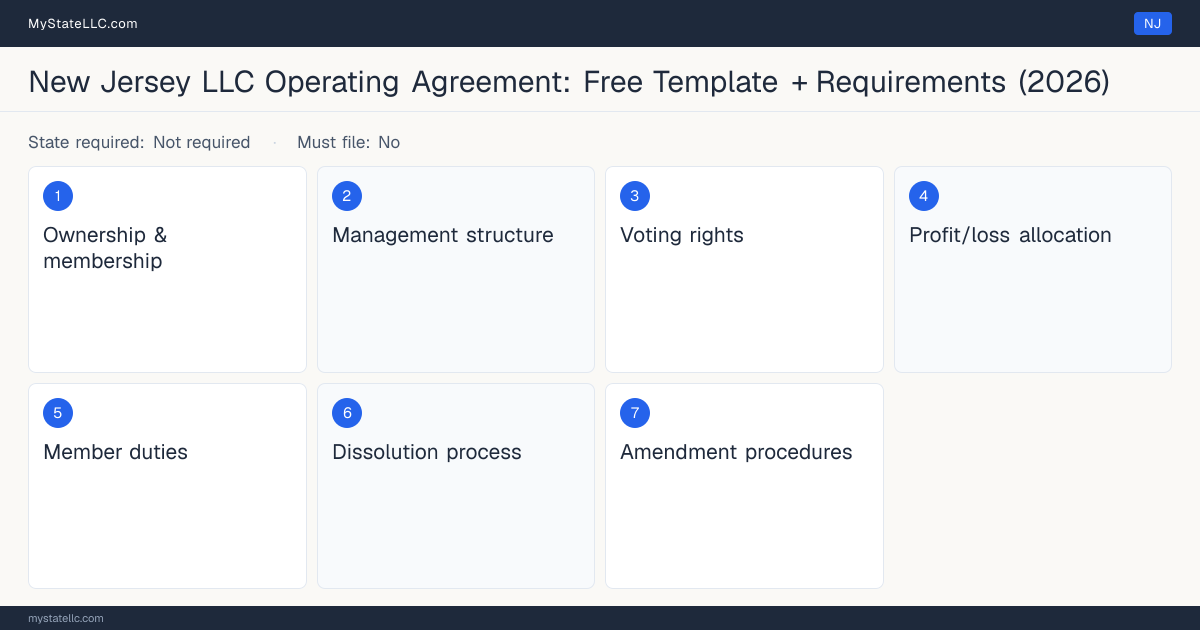
What a New Jersey operating agreement should contain, section by section. Source: New Jersey Division of Revenue and Enterprise Services.
State Requirements
Required By Law
no
Must Be Filed
no
Special Rules
None beyond standard requirements
What to Include in Your Operating Agreement
Ownership & membership
Define each member's ownership percentage and capital contributions. This prevents disputes about who owns what portion of your New Jersey LLC.
Management structure
Specify whether your LLC is member-managed or manager-managed. This determines who has authority to make business decisions and sign contracts.
Voting rights
Establish how decisions are made and what percentage of votes are needed for different types of business matters. Clear voting procedures prevent deadlock situations.
Profit/loss allocation
Detail how profits and losses are distributed among members. This doesn't have to match ownership percentages but should be clearly documented for tax purposes.
Member duties
Outline each member's responsibilities, time commitments, and restrictions on competing businesses. This sets clear expectations for everyone involved.
Dissolution process
Define the steps for closing the LLC, including how assets are distributed and debts are handled. Having this in writing prevents costly legal battles later.
Amendment procedures
Establish how the operating agreement can be changed in the future. Specify what vote percentage is needed and whether amendments must be in writing.
Frequently Asked Questions
No, New Jersey doesn't legally require LLCs to have an operating agreement, according to the New Jersey Limited Liability Company Act (N.J.S.A. 42:2B-1 et seq.). However, operating without one creates significant risks that can directly impact your liability protection and ownership rights.
Without a written operating agreement, your LLC will default to New Jersey's statutory rules, which may not reflect your actual business arrangement. This means the state's one-member LLC ownership structure and profit-sharing defaults apply automatically, potentially causing disputes if multiple members later join or if circumstances change.
More critically, courts have ruled that absent a documented operating agreement, the liability shield protecting your personal assets from business debts may be weakened. Creditors can more easily argue your LLC is merely an alter ego of the owner, piercing the corporate veil.
To protect your business interests and maintain ironclad liability protection, draft or download an operating agreement immediately after filing your Certificate of Formation with the New Jersey Division of Revenue and Enterprise Services. Include specific provisions addressing member contributions, profit distribution, voting rights, and dissolution procedures, customized to your actual business structure.
Yes, you can write your own LLC operating agreement in New Jersey. The state doesn't require a specific format or mandate attorney involvement. However, New Jersey's default LLC statutes (under the New Jersey Limited Liability Company Act) will govern your business if you don't create one, which may not align with your ownership structure or profit-sharing goals. If you use a template, ensure it addresses New Jersey-specific requirements like member voting rights, dissolution procedures, and how you'll handle the $125 annual filing fee due to the New Jersey Division of Revenue and Enterprise Services. The practical implication is significant: without a written agreement, disputes over membership percentages, management authority, or profit distribution become difficult and costly to resolve. For single-member LLCs with straightforward operations, a customized template works well. However, if you've multiple members, anticipate capital contributions, or plan future ownership changes, consult a New Jersey business attorney, the $300 to 500 investment now prevents thousands in litigation later. Your next step: download a state-specific template, customize it for your member agreement, and have it signed and dated by all members before conducting business.
No, New Jersey doesn't require operating agreements to be notarized. However, all members should sign the document, and you may want to have signatures witnessed for added legal protection.
While the New Jersey Division of Revenue and Enterprise Services doesn't mandate notarization for operating agreements, having signatures witnessed or notarized strengthens enforceability if disputes arise later. This is particularly important if your LLC has multiple members or if the agreement grants specific governance rights or profit distributions that members might later challenge.
Without notarization, you're relying solely on each member's acknowledgment that they signed voluntarily. If a member later claims they didn't authorize the agreement or disputes its terms, a notarized version provides a third-party verification of their identity and intent.
For practical protection, consider having a New Jersey notary public authenticate signatures. Most charge $2 to $5 per signature. This small investment prevents costly litigation over whether members genuinely consented to the operating agreement's provisions.
Next, ensure all LLC members sign and date the agreement, then schedule an appointment with a local notary to authenticate each signature.
Without an operating agreement, your New Jersey LLC automatically defaults to the statutory provisions outlined in the New Jersey Limited Liability Company Act (N.J.S.A. 42:2C). This means the state determines your management structure, profit distribution, voting rights, and member exit procedures, not you.
Practically, this creates significant vulnerabilities. If disputes arise between members, you lack documented agreements on decision-making authority, potentially requiring costly litigation to resolve disagreements. The default rules mandate equal profit-sharing regardless of capital contributions, which may not reflect your actual arrangement. Additionally, if a member leaves or dies, New Jersey law requires buyout procedures and valuations you didn't negotiate, often resulting in unexpected financial obligations or loss of business control.
For creditors and lenders, the absence of an operating agreement signals operational immaturity, making it harder to secure financing. Tax complications also arise. The IRS may challenge your intended tax classification without documented proof of member agreements.
Your next step: File a formal operating agreement with your members immediately, even retroactively, and maintain signed copies with your business records.
Yes, you can amend your New Jersey LLC operating agreement at any time, but the process depends on what your original agreement specifies. Most New Jersey LLCs require unanimous member approval for amendments, though your agreement can establish a lower threshold like a majority vote. To formally amend, you'll typically need to prepare a written amendment document signed by the required members and retain it with your LLC records. New Jersey doesn't require filing amendments with the Secretary of State's Division of Commercial Recording. However, if your amendment changes your registered agent, principal office location, or member information, you must file a revised Certificate of Formation with the state within the required timeframe. This distinction matters because failing to update your Certificate while changing your operating agreement creates a compliance gap that could complicate disputes or audits. Review your current operating agreement first to confirm your amendment procedure, then consult your co-members before drafting changes. Once approved, document the amendment with dated signatures and file any necessary state forms immediately.
Sources
Each entry below is a document recorded in our verified New Jersey sources, and each entry says what the document is. Some statutory text is read from an accurate mirror rather than from the state's own host, and those say so.
nj.gov/treasury/revenue/New Jersey Division of Revenue and Enterprise Services: business entity filings
See how Northwest Registered Agent, Bizee, ZenBusiness and LegalZoom, the formation services we partner with, compare on 3-year cost, BBB rating and Trustpilot score before you choose.
Edmond Hui is a software engineer and serial entrepreneur based in New York who has founded multiple online businesses across e-commerce, media, and information publishing. Before transitioning into tech, he spent years as a commercial real estate professional closing deals totaling over 100,000 square feet, giving him firsthand experience with business formation and entity structuring. He built MyStateLLC to provide the free, state-specific LLC guidance he wished existed when forming his own companies.