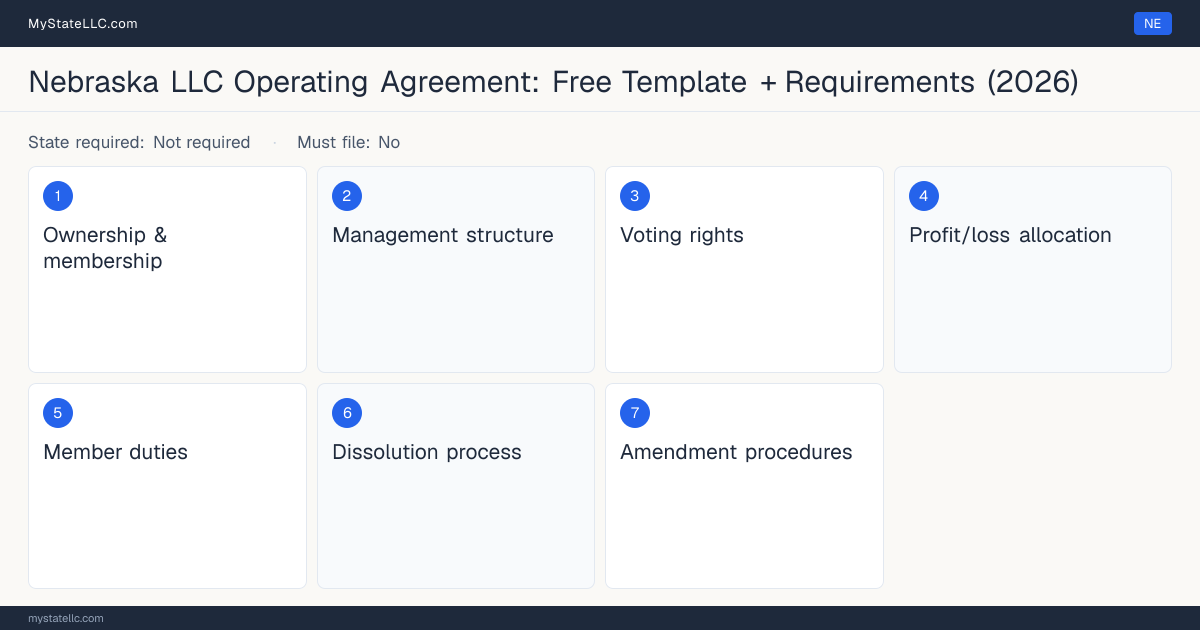
Nebraska does not legally require an LLC operating agreement, but having one protects your limited liability status and sets the rules for ownership and profits. See exactly what to include below.
Edmond Hui is a software engineer and serial entrepreneur based in New York who has founded multiple online businesses across e-commerce, media, and information publishing. Before transitioning into tech, he spent years as a commercial real estate professional closing deals totaling over 100,000 square feet, giving him firsthand experience with business formation and entity structuring. He built MyStateLLC to provide the free, state-specific LLC guidance he wished existed when forming his own companies.
Affiliate disclosure: We may earn a commission at no extra cost to you.
Define each member's ownership percentage and capital contributions. This section establishes who owns what portion of the LLC and prevents future ownership disputes.
Management structure
Specify whether your LLC is member-managed or manager-managed. This determines who has authority to make business decisions and sign contracts on behalf of the company.
Voting rights
Outline how decisions are made and what voting thresholds are required for different types of business matters. Clear voting procedures prevent deadlock situations.
Profit/loss allocation
Detail how profits and losses will be distributed among members. While this often follows ownership percentages, you can customize distributions based on your specific needs.
Member duties
Define each member's responsibilities, time commitments, and non-compete restrictions. This section helps prevent conflicts by setting clear expectations from the start.
Dissolution process
Establish procedures for winding down the LLC, including asset distribution and debt payment priorities. Planning for dissolution protects all members' interests.
Amendment procedures
Set requirements for changing the operating agreement, such as unanimous consent or majority vote. This ensures the agreement can evolve with your business needs.
Frequently Asked Questions
No, Nebraska law does not require LLCs to have a written operating agreement under the Nebraska Limited Liability Company Act (Neb. Rev. Stat. § 21-2601 et seq.). However, this legal flexibility creates significant practical risks for Nebraska LLC owners. Without a documented agreement, your LLC will be governed by Nebraska's default statutory provisions, which may not reflect your business intentions regarding profit distribution, voting rights, management structure, or member exit procedures. This absence of clarity frequently leads to costly disputes among co-members that require litigation to resolve. More critically, failing to maintain formal operating procedures—even informally agreed upon—can jeopardize your liability protection if a court determines your LLC wasn't adequately separated from personal affairs. Nebraska courts examine whether you respected corporate formalities when evaluating piercing-the-veil claims. To protect your limited liability status and establish enforceable member agreements, you should draft a customized operating agreement immediately after forming your LLC with the Nebraska Secretary of State. Templates are available, but consulting a Nebraska business attorney ensures your agreement addresses your specific ownership structure and complies with state law.
Yes, you can write your own Nebraska LLC operating agreement—Nebraska does not require you to file it with the Secretary of State or any state agency, giving you complete flexibility in its content and format. You can use templates, legal software, or draft from scratch, provided you address Nebraska's key statutory requirements under the Nebraska Limited Liability Company Act (Neb. Rev. Stat. § 21-2601 et seq.), including member voting rights, profit distribution, management structure, and dissolution procedures. However, if your LLC has multiple members, complex capital contributions, varying profit-sharing percentages, or specific governance needs, a Nebraska business attorney (typically costing $500–$1,500 for a custom agreement) can identify gaps that templates miss and prevent costly disputes later. Without a proper agreement, Nebraska's default rules apply, potentially overriding your intentions regarding member authority and liability protection. Your next step is to download a Nebraska-specific template from the Secretary of State's website or a reputable legal resource, review it against your business structure, then schedule a consultation with a Lincoln or Omaha business attorney if your situation involves multiple members or non-standard arrangements.
No, Nebraska does not require LLC operating agreements to be notarized or witnessed. According to Nebraska Revised Statutes § 21-113, the agreement is valid as long as it's signed by all members and properly executed according to its own terms.
This means you can execute your operating agreement without visiting a notary public or paying notarization fees, saving time and expense during formation. However, while notarization isn't legally required, many Nebraska LLCs choose to have their agreements notarized anyway for practical reasons: it creates a presumption of authenticity, strengthens the document's enforceability in disputes, and simplifies matters if a member later challenges the validity of their signature.
The Nebraska Secretary of State does not file or review operating agreements, so there's no state approval process regardless of notarization status. Your agreement becomes effective simply by being executed by all members according to its terms.
To finalize your LLC formation, file your Articles of Organization with the Nebraska Secretary of State (filing fee: $120 for online submission) once your operating agreement is complete and signed.
Without an operating agreement, your Nebraska LLC will be automatically governed by Nebraska Revised Statutes Chapter 21, Articles 101–145, which establishes default rules that may not align with your business needs. This means the Nebraska Department of State will effectively dictate your management structure, requiring member voting on all decisions and mandating equal profit distribution regardless of capital contributions or ownership percentages.
The practical implications are significant: you lose control over management authority (the default assumes member-managed structure), cannot customize voting rights, and cannot establish buyout terms or succession plans. If a dispute arises between members, Nebraska courts will apply statutory default rules rather than your documented intentions, often resulting in costly litigation to resolve governance questions that an operating agreement would have clarified upfront.
To protect your LLC, file a formal operating agreement with your records immediately—while Nebraska doesn't require filing with the Secretary of State, maintaining a signed copy demonstrates your intent to operate under custom terms rather than defaults.
Yes, Nebraska LLCs can amend their operating agreement after signing, provided the agreement itself specifies amendment procedures or all members unanimously consent to the changes. Nebraska Statutes § 21-2701 does not mandate specific amendment procedures, giving LLCs flexibility in establishing their own protocols within the operating agreement.
To amend your agreement, you must follow whatever amendment process your original operating agreement outlines—typically requiring member vote percentages (often 50% or higher) and written documentation. If your agreement lacks amendment language, you'll need unanimous written consent from all members to proceed. The practical implication is significant: failing to properly amend your operating agreement creates liability exposure, as outdated terms may conflict with actual business practices and member understandings.
Document all amendments on the original agreement form (such as "Amendment No. 1 to Operating Agreement"), have each member sign and date the amendment, and retain copies with your LLC records. File any amendments that affect your registered agent or principal place of business with the Nebraska Secretary of State using Form 4, though operating agreement changes typically don't require state filing unless they affect registered information.