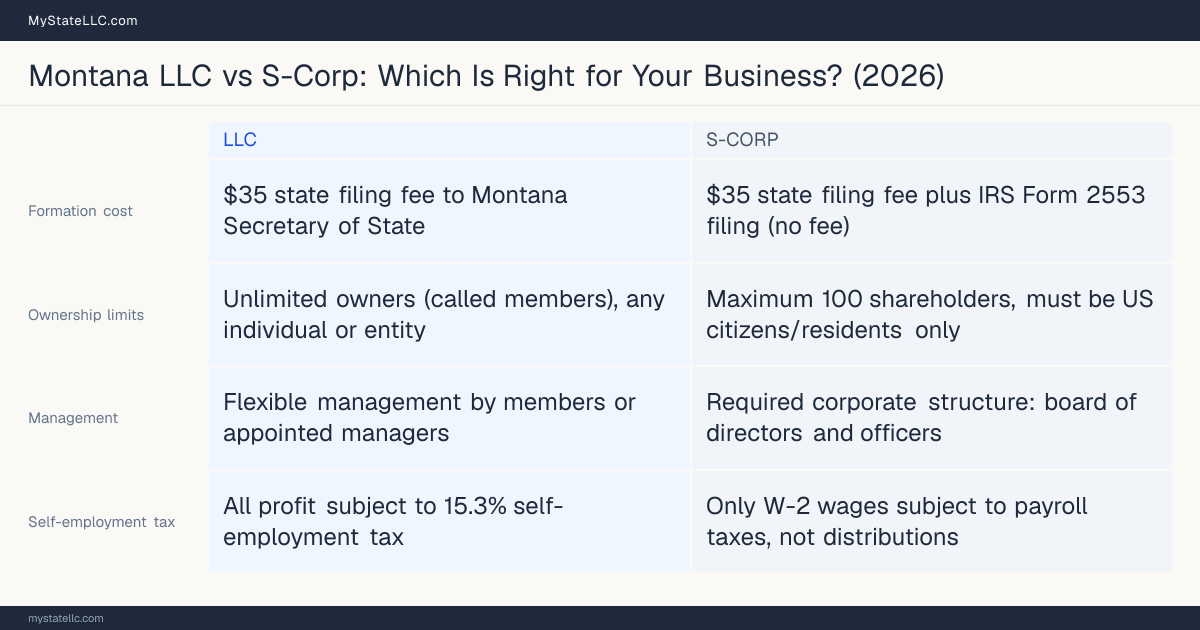
In Montana, an LLC fits when you want maximum flexibility in management structure and profit distribution; a S-corp fits when your business consistently generates over $60,000+ in annual profit. Compare both structures in detail below.
Affiliate disclosure: We may earn a commission at no extra cost to you.
Can elect S-Corp tax status anytime without changing entity
Complex conversion process to change to LLC structure
When an LLC Makes More Sense
You want maximum flexibility in management structure and profit distribution
Your business has multiple owners or you plan to bring in investors later
You prefer minimal ongoing paperwork and compliance requirements
Your annual profit is under $60,000 where self-employment tax savings are minimal
When an S-Corp Makes More Sense
Your business consistently generates over $60,000+ in annual profit
You want to minimize self-employment taxes through salary/distribution split
You've a single owner or small group of US citizen/resident owners
You're comfortable with formal corporate structure and payroll requirements
Tax Deep Dive
Llc Default Tax
By default, Montana LLCs are taxed as pass-through entities where all profits flow to members' personal tax returns. Members pay self-employment tax (15.3%) on their entire share of business profit, plus regular income tax rates.
S Corp Tax
S-Corps split income between W-2 wages (subject to payroll taxes) and distributions (not subject to self-employment tax). Owner-employees must take a reasonable salary, but remaining profits can be distributed tax-efficiently.
Breakeven Income
In Montana, S-Corp tax savings typically become worthwhile around $60,000-80,000 in annual profit, depending on reasonable salary requirements and payroll processing costs.
Calculate Your Tax Savings in Montana
Enter your profit and filing status to compare estimated annual taxes for LLC, S-Corp, and C-Corp side by side, specific to Montana.
This guide is general information, not legal or tax advice, and reading it does not create an attorney-client relationship. It reports published tax rates and statutory attributes, with the sources this page cites. It cannot tell you which structure is better for you: that turns on your profit, the salary you could defend as reasonable compensation, every state you owe tax in, and plans for owners, investors and exit that no figure on this page measures. Confirm your own position with a CPA or tax attorney licensed in your state before you elect anything, because some elections are slow or costly to reverse.
Frequently Asked Questions
An S-Corp election can save a Montana LLC earning $100,000 approximately $3,000 to 5,000 annually in self-employment taxes by allowing you to split income between W-2 wages and distributions, which avoids the 15.3% self-employment tax on the distribution portion. However, this savings applies only after you pay reasonable compensation as a W-2 employee through Montana's Department of Labor & Industry payroll system, which requires quarterly filings and tax deposits. For businesses under $60,000 net income, the administrative burden of Montana employer withholding filings and federal Form 2553 (S-Corp election) often exceeds potential savings. The Montana Department of Revenue imposes no additional state-level S-Corp tax, but you'll owe federal self-employment taxes on your reasonable salary regardless. Your actual savings depend entirely on what salary the IRS considers reasonable for your role, the agency actively audits disproportionately low salaries paired with high distributions. File Form 2553 with the IRS within 2 months and 15 days of your tax year start to ensure timely election. Consult a Montana CPA to calculate your specific breakeven point, as accounting costs typically run $1,500 to 3,000 annually for S-Corp compliance.
To elect S-Corp tax status for your Montana LLC, file IRS Form 2553 (Election by a Small Business Corporation) with the IRS. That one form is enough, because the election also treats your LLC as a corporation, so Form 8832 (Entity Classification Election) is not required. You must submit Form 2553 within 2 months and 15 days of the start of the tax year you want the election effective, or at any time during the year before it. Montana doesn't impose a separate state-level S-Corp election fee, and there's no annual franchise or net-worth license tax on LLCs (the annual report is free if filed by April 15). File the form with the IRS, not the Montana Secretary of State. This election allows you to avoid double taxation while maintaining LLC liability protection, potentially saving 15.3% on self-employment taxes for net profits above reasonable officer salary. Submit Form 2553 to the IRS office listed on the form instructions before the deadline; missing this deadline requires filing Form 2553 with a late-election request and reasonable-cause statement under Rev. Proc. 2013-30.
Yes, your Montana LLC can elect S-Corp tax treatment by filing Form 2553 with the IRS without changing your legal entity status with the Montana Secretary of State. This election allows your LLC to be taxed as an S-Corporation for federal income tax purposes while maintaining your LLC's operational structure under Montana law. The practical benefit is significant: you'll potentially reduce self-employment taxes on distributions while preserving LLC flexibility in management and ownership transfers. Montana does recognize S corporations: under MCA 15-30-3302 the entity is not taxed at the state level and files Form PTE, the Montana Pass-Through Entity Tax Return. You'll continue filing annual reports with the Montana Secretary of State as an LLC while your federal tax classification changes. File Form 2553 (Election by a Small Business Corporation) with the IRS within 2 months and 15 days after your LLC's tax year begins for the election to be effective that year. You may also need to make Montana corporate estimated tax payments under Form CIT. Consult a Montana tax professional to ensure your LLC meets S-Corp eligibility requirements. You're limited to 100 U.S. shareholders and one class of stock.
No, Montana doesn't impose entity-level taxes on either LLCs or S-Corps. Both structures are pass-through entities for state tax purposes, with income taxed only at the individual owner level. S-Corps operating in Montana don't pay this specific fee. Additionally, both entities must file an annual report with the Montana Secretary of State (free if filed by April 15; $35 if late) by April 15 annually. This means an LLC generating $100,000 in revenue could owe $50-$100 in Montana License Tax, while an S-Corp with identical revenue pays nothing extra at the state level. This difference can impact your total tax burden depending on your business income level. Contact the Montana Department of Revenue at (406) 444-6900 or visit revenue.mt.gov to calculate your exact License Tax liability before deciding between structures.
Consider electing S-Corp tax treatment when your Montana LLC consistently generates $60,000 or more in annual profit. At this threshold, the self-employment tax savings typically exceed the additional administrative costs and complexity required to maintain S-Corp status. Here's the practical impact: By electing S-Corp taxation with the IRS using Form 2553, you can split your business income into reasonable W-2 wages and distributions. This strategy allows you to avoid self-employment taxes on the distribution portion, potentially saving 15.3% on that income. For a Montana LLC owner earning $80,000 annually, this could mean $3,000+ in tax savings. However, this election requires you to register with Montana's Department of Labor & Industry for payroll tax purposes, file quarterly payroll tax returns with the Montana Department of Revenue, and maintain detailed payroll records. The filing fee for Montana business registration is $35. Your next step: Calculate your 2025 projected profit, then consult a Montana CPA to determine if S-Corp election makes financial sense for your specific situation before the December 31 deadline.
While Montana doesn't legally require an accountant for S-Corp tax filing, the Montana Department of Revenue strongly recommends hiring one due to federal Form 1120-S complexity and Montana-specific payroll obligations. S-Corp owners must file quarterly estimated tax payments (Form 1040-ES) with the IRS and an annual Montana Pass-Through Entity Tax Return (Form PTE) by March 15th. You'll also need to manage payroll withholding, quarterly Form 941 federal payroll tax returns, and Montana Department of Labor & Industry filings. Mistakes trigger penalties and interest charges. Montana imposes a 6.84% corporate tax rate on net income, making accurate filing critical for tax liability calculations. Most Montana S-Corp owners budget $2,500 to $4,500 annually for combined tax preparation and payroll processing services. The practical benefit: an accountant identifies deductions you'd miss, ensuring you don't overpay Montana's corporate tax while maintaining compliance. Contact a Montana CPA experienced with S-Corps to review your specific situation and obtain an engagement letter outlining their fees before your tax year begins.
Sources
Each entry below is a document recorded in our verified Montana sources, and each entry says what the document is. Some statutory text is read from an accurate mirror rather than from the state's own host, and those say so.
See how Northwest Registered Agent, Bizee, ZenBusiness and LegalZoom, the formation services we partner with, compare on 3-year cost, BBB rating and Trustpilot score before you choose.
Edmond Hui is a software engineer and serial entrepreneur based in New York who has founded multiple online businesses across e-commerce, media, and information publishing. Before transitioning into tech, he spent years as a commercial real estate professional closing deals totaling over 100,000 square feet, giving him firsthand experience with business formation and entity structuring. He built MyStateLLC to provide the free, state-specific LLC guidance he wished existed when forming his own companies.