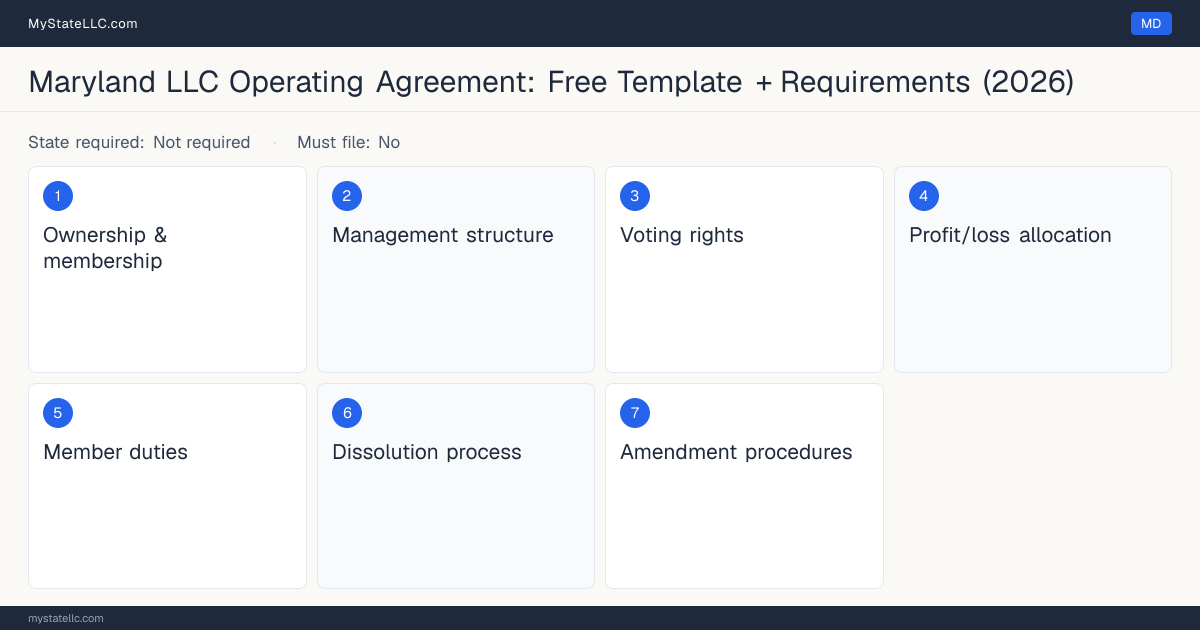
Maryland does not legally require an LLC operating agreement, but having one protects your limited liability status and sets the rules for ownership and profits. See exactly what to include below.
Edmond Hui is a software engineer and serial entrepreneur based in New York who has founded multiple online businesses across e-commerce, media, and information publishing. Before transitioning into tech, he spent years as a commercial real estate professional closing deals totaling over 100,000 square feet, giving him firsthand experience with business formation and entity structuring. He built MyStateLLC to provide the free, state-specific LLC guidance he wished existed when forming his own companies.
Affiliate disclosure: We may earn a commission at no extra cost to you.
Define each member's ownership percentage and capital contributions. This section establishes who owns what portion of the LLC and their initial investment amounts.
Management structure
Specify whether your LLC is member-managed or manager-managed. This determines who has authority to make business decisions and bind the company in contracts.
Voting rights
Outline how decisions are made and what voting power each member has. Include requirements for major decisions like admitting new members or selling company assets.
Profit/loss allocation
Detail how profits and losses are distributed among members. This affects tax reporting and ensures fair compensation based on ownership or contribution agreements.
Member duties
Define each member's responsibilities, time commitments, and restrictions on competing businesses. This prevents conflicts and ensures everyone understands their role.
Dissolution process
Establish procedures for closing the business, including asset distribution and debt payment. Having this planned prevents disputes during stressful dissolution periods.
Amendment procedures
Set rules for changing the operating agreement as your business evolves. Include voting requirements and documentation procedures for any modifications.
Frequently Asked Questions
No, Maryland does not legally require LLCs to have an operating agreement under the Maryland Limited Liability Company Act (MLLCA). However, this absence of a legal mandate creates significant practical risks for LLC owners.
Without a written operating agreement, Maryland's default LLC statutes automatically govern your business structure, which may not align with your intentions. This means the state determines how profits are split, management decisions are made, voting rights are allocated, and member disputes are resolved—typically equal distribution among all members regardless of capital contributions or involvement.
Having an operating agreement is essential for protecting your personal liability protection, which is the primary reason most business owners form LLCs in the first place. Courts may disregard your LLC's liability shield if you cannot demonstrate operational legitimacy through proper documentation.
An operating agreement also prevents costly disputes by clarifying each member's rights, responsibilities, ownership percentages, and exit procedures upfront. Without one, disagreements often require expensive litigation through Maryland courts to resolve.
Create your operating agreement before accepting capital contributions or conducting business. Download Maryland's template and customize it to match your specific ownership structure and operational preferences immediately.
Yes, you can write your own LLC operating agreement in Maryland—the state doesn't require you to file it with the Maryland Department of Assessments and Taxation. However, Maryland law (under the Maryland Limited Liability Company Act, Maryland Code, Corporations and Associations § 4A-101 et seq.) establishes default rules that apply if your agreement is silent on key issues, which can create liability gaps for multi-member LLCs. For single-member LLCs with straightforward operations, a template may suffice, but multi-member arrangements need careful attention to profit-sharing percentages, voting rights, dissolution procedures, and member withdrawal provisions—areas where Maryland courts have ruled against ambiguous agreements. The practical consequence: failing to address these specifics means Maryland's default statutes govern disputes, potentially overriding your actual intentions and exposing you to unexpected tax liability or loss of management control. Before finalizing, have an attorney review your agreement for Maryland-specific compliance, particularly regarding indemnification clauses and manager appointment rules. This typically costs $300–500 and prevents costly litigation later. Start by downloading a state-specific Maryland LLC template, then schedule a brief consultation with a Maryland business attorney to review your completed draft.
No, Maryland does not require LLC operating agreements to be notarized under Maryland Code, Business & Regulation § 4A-201. However, having your operating agreement notarized by a Maryland notary public is highly advisable for practical reasons. A notarized agreement strengthens its enforceability in disputes and is often required by banks when opening business accounts, applying for business loans, or obtaining commercial lines of credit. Many Maryland lenders and financial institutions specifically request notarized documentation to verify that all members genuinely signed the agreement. Without notarization, you may face delays or rejection during these transactions, requiring costly re-execution. The cost is minimal—typically $5 to $15 per signature in Maryland—making it a worthwhile investment for credibility. To proceed, have each member sign the agreement in front of a Maryland-licensed notary public, who will affix their seal and signature. Visit the Maryland Secretary of State's website or contact your bank directly to confirm their specific notarization requirements before signing.
Without an operating agreement, your Maryland LLC automatically defaults to Maryland Code § 4A-401 through § 4A-603, which governs profit distribution, management structure, and dissolution procedures through state statute rather than your chosen terms. This creates three critical problems for owners. First, Maryland law mandates equal profit sharing regardless of capital contributions—so a member who invested $50,000 receives the same distributions as one who invested $5,000. Second, all members gain management rights and decision-making authority by default, exposing your business to unilateral actions you didn't authorize. Third, if dissolution occurs, Maryland's statutory procedures apply, potentially triggering unexpected tax consequences or asset liquidation timelines that conflict with your business plan.
The practical implication is that you lose complete control over your business structure and finances. To regain this control, draft and execute a written operating agreement before conducting any business operations, then maintain a signed copy with your formation documents and business records. This single document prevents costly disputes and ensures your LLC operates exactly as you intended.
Yes, you can amend your Maryland LLC operating agreement at any time by following the procedures your original document specifies. If your agreement lacks amendment procedures, Maryland law requires unanimous consent from all members to approve any changes. The Maryland Department of Assessments and Taxation (SDAT) doesn't require you to file amendments with the state—changes remain internal documents—but you must document amendments in writing and retain copies with your LLC records. This distinction matters significantly: while the state won't know about modifications, members could later dispute unapproved changes, potentially creating liability disputes or triggering dissolution complications. Common amendments include adding members, changing profit distributions, or modifying management structure. To protect your LLC, draft amendments using the same format as your original agreement, have all consenting members sign and date the amendment, and store it alongside your Articles of Organization. Your next step is reviewing your current operating agreement's amendment clause and scheduling a member meeting to discuss any necessary modifications before implementing changes.