How to Dissolve an LLC in Tennessee: Complete 2026 Guide
Tennessee closes an LLC in two filings of $20 each and does not publish a standard processing time. A certificate of tax clearance from the Department of Revenue is required before the entity can be terminated.
By Edmond Hui · Last updated: September 2026
Tennessee's $20 LLC dissolution filing fee ranks #15 of 50 states, and it ties with 2 other states at that price.
The headline fee sits comfortably in the cheaper half of the country, but Tennessee closes an LLC in two filings rather than one and each carries the same charge. What actually sets the schedule is the tax clearance the Department of Revenue has to issue before the second filing can go in.
Source: MyStateLLC 50-state dissolution index, verified 2026-08-13
Dissolution at a Glance
| Filing Fee | $20 |
| Form Name | Articles of Termination (Form SS-4245); preceded by Notice of Dissolution (Form SS-4246) |
| Processing Time | varies |
| Creditor Notice Period | 120 days |
| Tax Clearance Required | Yes |
| Publication Required | No |
| File Online | SoS Dissolution Page → |
How to Form an LLC: Step-by-Step
- 1
Vote to Dissolve
Closing a Tennessee LLC begins with a documented decision by the members. Your operating agreement controls, so read what it says about dissolution votes, required percentages and any notice members are owed before the vote. If the agreement does not deal with dissolution, take written consent from every member rather than relying on a conversation. Write it up as a signed consent naming the LLC, confirming the members approved dissolution, giving the effective date, and authorizing a specific person to sign both state filings, because Tennessee requires two of them and you do not want to redo the paperwork halfway through.
Pro tip: Grant signing authority for both filings in the same consent. The termination filing can come months after the dissolution filing, and by then the person who signed the first one may already have moved on. - 2
File Articles of Termination (Form SS-4245); preceded by Notice of Dissolution (Form SS-4246) with the Tennessee Secretary of State
Tennessee voluntary dissolution is a two-step filing with the Secretary of State. First comes the Notice of Dissolution (Form SS-4246), which costs $20 and starts the winding-up phase. The Articles of Termination (Form SS-4245) come afterwards, also $20, and that second filing is what actually ends the entity, which works out at about $40 in state filing charges across the pair. Both can be submitted online through the TNBEAR portal. Tennessee does not publish a standard processing time for either filing, so treat the counter turnaround as variable and plan around the steps between the two.
Pro tip: Do not file the Articles of Termination the same week as the Notice of Dissolution. Tax clearance and creditor notice both belong in the gap between them, and rushing the second filing is how they get skipped. - 3
Notify Creditors and Settle Debts
Under Tenn. Code Ann. 48-249-611, a known claim is barred if it is not received by a deadline that may not be fewer than four months, roughly 120 days, after the effective date of your written notice. Note where that period starts: Tennessee measures it from the effective date of the notice rather than from delivery, which is unusual and worth reading carefully when you draft it. Build the known-claimant list from company records, covering lenders, landlords, suppliers, contractors, and anyone holding a deposit or an unresolved warranty claim, then pay or reserve for what comes in.
Pro tip: Send the creditor notices right after the Notice of Dissolution is filed. The period runs alongside your tax clearance request instead of after it, which is the single easiest way to shorten the whole timeline. - 4
Close Tennessee State Tax Accounts
Tennessee requires tax clearance and there is no way around it. The Secretary of State's guidance is explicit that tax clearances are required to obtain a certificate of existence, to reinstate, and to terminate, cancel or withdraw an entity from Tennessee. So file your final Tennessee returns, pay any remaining balance, close the registrations the LLC holds, and then request a certificate of tax clearance from the Tennessee Department of Revenue. That certificate is what lets the Articles of Termination proceed. Start the request as early as the rest of your wind-up allows, since it depends on another agency's queue rather than yours.
Pro tip: Request clearance only after every final return is actually filed. The Department of Revenue is checking whether the account is clear, so an outstanding return turns the request into a rejection and you start over. - 5
Deactivate Your EIN with the IRS
The IRS cannot cancel an EIN, but it can deactivate it once any outstanding returns are filed and taxes owed are paid. See the FAQ below for the letter and mailing addresses. File the final federal return first: Form 1065 for a multi-member LLC, Form 1120-S if you elected S corporation treatment or Form 1120 if you elected C corporation treatment, each with the final return box checked, or the owner's return (Schedule C for most business activity) for a single-member LLC that never elected corporate treatment.
Pro tip: Send the deactivation letter after the final return, never before. - 6
Distribute Remaining Assets to Members
Assets go out in order. Creditors are paid or provided for first, including claims running under your Tenn. Code Ann. 48-249-611 notices and anything the Department of Revenue turns up while reviewing your clearance request. Only what survives that reaches the members. Follow the distribution provisions in your operating agreement, and where it is silent, distribute in proportion to the members' ownership interests. Record each distribution with a date, an amount, and a description of any property transferred in kind rather than sold, since those records support each member's basis calculation on their personal return.
Pro tip: Wait for the tax clearance certificate before distributing. Clearance is the gate on the termination filing, and a balance discovered after the money has gone out to members is the hardest kind to fix. - 7
Confirm Dissolution is Complete
The company is not closed until the Articles of Termination (Form SS-4245) have been filed with the $20 fee and processed. The earlier Notice of Dissolution only started the winding-up phase. Once the termination is through, look the LLC up in the Tennessee Secretary of State's business records and save a copy of the entry showing its terminated status. Keep a single file containing the signed member consent, both stamped filings, the certificate of tax clearance from the Department of Revenue, the written creditor notices, the final federal and state returns, and the schedule of member distributions.
Pro tip: Save a dated PDF of the state record rather than a phone screenshot. Banks, insurers and the IRS ask for proof of the termination date long after the business is out of mind.
Winding-Up Checklist
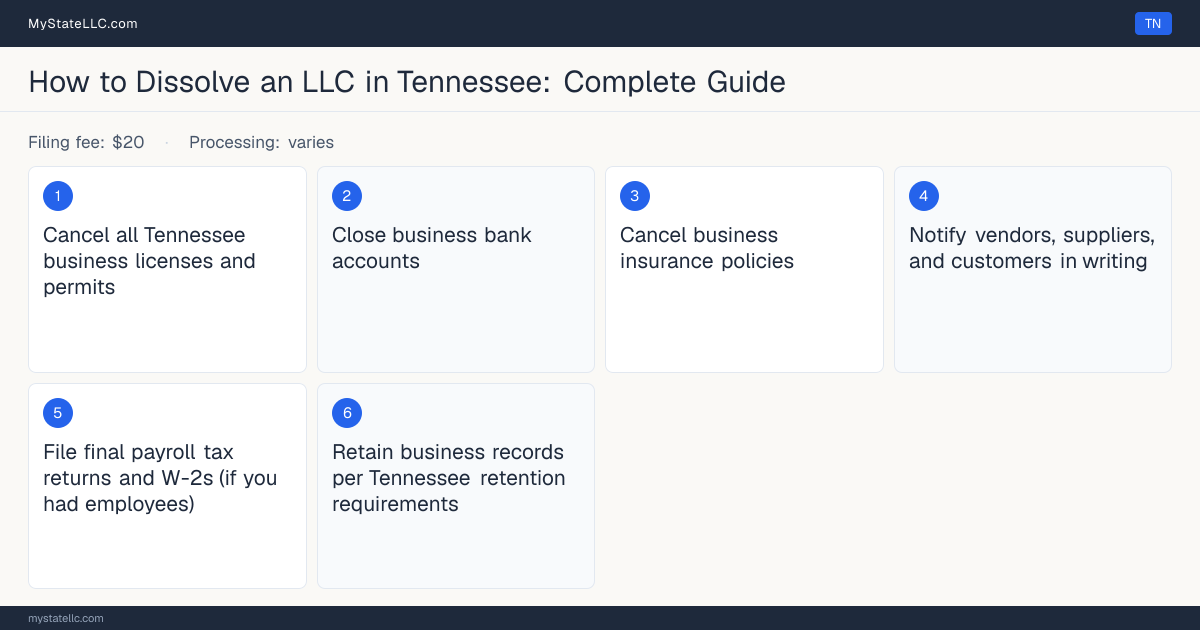
- Cancel all Tennessee business licenses and permits
State and county licenses outlive the company unless you cancel them. Contact each issuing office so renewal notices, inspection fees and late penalties stop arriving after the entity is gone.
- Close business bank accounts
Close accounts only after the last check clears, distributions are complete and refunds have landed. Cancel business credit cards in writing and keep the closing statements with your dissolution file.
- Cancel business insurance policies
Give each carrier the termination date and ask what happens to a claim reported after the policy ends. Tail or run-off coverage matters most for professional and product liability.
- Notify vendors, suppliers, and customers in writing
Set a final service date, settle open invoices in both directions, and cancel auto-renewing contracts and subscriptions so nothing keeps billing an entity that no longer exists.
- File final payroll tax returns and W-2s (if you had employees)
File the final federal and Tennessee employer returns, deposit the last withholding, and issue W-2s to employees and 1099-NEC forms to contractors. Outstanding payroll filings will block your tax clearance request.
- Retain business records per Tennessee retention requirements
The verified data behind this guide does not set a retention period for dissolved Tennessee LLC records, so do not guess at a cutoff. Keep both stamped filings, the tax clearance certificate and the final returns together.
Frequently Asked Questions
Sources
Each entry below is a document recorded in our verified Tennessee sources, and each entry says what the document is. Some statutory text is read from an accurate mirror rather than from the state's own host, and those say so. Where we hold the citation but no stable public link, the citation is printed on its own rather than pointed at a guessed address.
- sos.tn.gov/businessesTennessee Secretary of State: business entity filings
- sos.tn.gov/businesses/services/business-forms-feesTennessee Secretary of State: LLC dissolution
- Tennessee creditor notice period: Tenn. Code Ann. 48-249-611 (Tennessee Revised Limited Liability Company Act)
- sos.tn.gov/businesses/faqsTennessee tax clearance requirement
- tnbear.tn.gov/Common/DissolveInfo.aspxTennessee online dissolution filing
Formation Services Compared
Forming an LLC in Tennessee?
See how Northwest Registered Agent, Bizee, ZenBusiness and LegalZoom, the formation services we partner with, compare on 3-year cost, BBB rating and Trustpilot score before you choose.

Edmond Hui · Founder, MyStateLLC
Edmond Hui is a software engineer and serial entrepreneur based in New York who has founded multiple online businesses across e-commerce, media, and information publishing. Before transitioning into tech, he spent years as a commercial real estate professional closing deals totaling over 100,000 square feet, giving him firsthand experience with business formation and entity structuring. He built MyStateLLC to provide the free, state-specific LLC guidance he wished existed when forming his own companies.