How to Dissolve an LLC in New York: Complete 2026 Guide
Close your New York LLC for a $60 state filing fee. Processing time varies, since the Department of State publishes no standard turnaround for this filing.
By Edmond Hui · Last updated: September 2026
At $60, New York's LLC dissolution filing fee ranks 40th cheapest of the 50 states, and it ties with 1 other state at the same price.
New York sits in the more expensive third of the country on the filing fee alone, but the total cost of closing is lower than most owners expect because the two big add-ons are absent: no tax clearance is required for an LLC, and the newspaper publication that New York is famous for applies to formation, not to dissolution.
Source: MyStateLLC 50-state dissolution index, verified 2026-08-13
Dissolution at a Glance
| Filing Fee | $60 |
| Form Name | Articles of Dissolution (DOS-1366-f) |
| Processing Time | varies |
| Creditor Notice Period | None set by statute |
| Tax Clearance Required | No |
| Publication Required | No |
| File Online | SoS Dissolution Page → |
How to Form an LLC: Step-by-Step
- 1
Vote to Dissolve
New York's LLC Law treats dissolution and the filing that follows it as two different events, and this step is the first one. Under Article 7 of the LLC Law, a domestic New York LLC dissolves, then winds up, and only afterward files Articles of Dissolution. So begin with the operating agreement and follow whatever dissolution procedure the members wrote there, including the required vote and any notice the members owe each other. If the agreement is silent, get written consent signed by every member so no one can later question whether the decision carried. Record it as a dated resolution naming the company, stating that the members approved dissolution, and fixing the effective date. That date starts a real clock: LLC Law Section 705 requires the Articles of Dissolution to be filed within 90 days following dissolution and the commencement of winding up, or after any continuation period expires.
Pro tip: Diary the 90-day date the moment the resolution is signed. It is the one deadline in a New York dissolution that runs against you, and it starts at the dissolution rather than when the wind-up finishes. - 2
File Articles of Dissolution (DOS-1366-f) with the New York Department of State
The filing goes to the New York Department of State, Division of Corporations, on Articles of Dissolution, form DOS-1366-f. The state filing fee is $60, and cancellation of the articles of organization is effective upon filing rather than on some later approval date. Start from the Department's own page at https://dos.ny.gov/articles-dissolution-domestic-limited-liability-companies-0, which carries the form and the instructions. Online filing is available through the Department of State Business Express system, which returns an emailed filing acknowledgement. On timing, the Department does not publish a standard processing time for this filing on its primary page, so the honest answer is that it varies. If a specific date matters, expedited handling is sold per document on top of the $60 fee: an extra $25 for 24-hour handling, an extra $75 for same-day, and an extra $150 for 2-hour. Remember the 90-day window in LLC Law Section 705 when you schedule the submission.
Pro tip: Save the emailed filing acknowledgement the day it arrives. Because cancellation is effective upon filing, that acknowledgement is the document that proves the date your LLC's articles were cancelled. - 3
Notify Creditors and Settle Debts
New York sets no statutory creditor notice period for LLC dissolution. There is no waiting period to sit through and no state-prescribed claim form, so the sequence here is driven by good practice and by the 90-day filing window rather than by a creditor deadline. That absence is not permission to skip the work. Write to every creditor you know of, ask for a final statement of the balance, and pay or reserve for each one before members receive anything. Keep the correspondence, because with no statutory claims-bar procedure to rely on, your own records are what answer a stale invoice later. Do the same for anything contingent: an open lease, a disputed vendor charge, a warranty obligation. Where a number is not final, hold a reserve rather than estimating, and be careful not to let creditor work push you past the 90-day window for filing the Articles of Dissolution.
Pro tip: Ask each creditor for written confirmation that the balance is settled, not just a zero on your own ledger. Without a statutory claims bar, a payoff confirmation is the strongest evidence you will have. - 4
Close New York State Tax Accounts
File your final New York returns and close each state tax account the LLC actually holds with the New York State Department of Taxation and Finance. Depending on what the business did, that can include sales tax, employer withholding, and the LLC's own annual filing fee obligations. Mark the returns final rather than simply stopping, because an open account keeps producing filing duties and late penalties after the business has gone quiet. If you hold a Certificate of Authority for sales tax, surrender it as part of the same sweep. Now the point that saves New York owners the most wasted time: tax clearance is not required to dissolve an LLC. Consent from the state tax department is part of the separate track that business corporations follow before filing a Certificate of Dissolution, and neither LLC Law Section 705 nor the Department of State's LLC dissolution instructions impose a clearance prerequisite on an LLC. Closing your accounts is still correct. It is simply not a gate on the filing.
Pro tip: Close the tax accounts in the same stretch of work as the dissolution filing. Wait, and the next sales tax quarter opens, leaving you filing a zero return for a company that no longer exists. - 5
Deactivate Your EIN with the IRS
The IRS cannot cancel an EIN, but it can deactivate it once any outstanding returns are filed and taxes owed are paid. See the FAQ below for the letter and mailing addresses. File the final federal returns before the deactivation letter goes out. A multi-member LLC taxed as a partnership files a final Form 1065 with the final return box checked and issues final Schedules K-1; an LLC taxed as a corporation files Form 1120 or 1120-S, also with the final return box checked; a single-member LLC that never elected corporate treatment reports the activity on the owner's return. If the company had employees, the final employment tax returns come first.
Pro tip: Keep the deactivation letter and proof of mailing. - 6
Distribute Remaining Assets to Members
Members come last. Pay or reserve for creditors first, including any tax balances, then distribute what remains according to the operating agreement, which controls the percentages and any liquidation waterfall the members agreed. New York's structure makes the ordering especially clear: dissolution and winding up come first, and the Articles of Dissolution are filed after the wind-up has begun, so distributions belong inside that wind-up rather than after the paperwork is cleared. Because New York sets no statutory creditor claims-bar procedure for LLCs, a distribution made over an unresolved dispute has no statutory deadline protecting it, which is a good reason to hold a reserve. Record every distribution with the date, the amount, the recipient and the ownership percentage it reflects, and treat property the same as cash, since handing a member equipment or a vehicle is a distribution too.
Pro tip: Have each member sign a short receipt confirming what they received and that it was a liquidating distribution. It is the cheapest way to close off an argument about who got what. - 7
Confirm Dissolution is Complete
Cancellation of the articles of organization is effective upon filing, so what you are confirming is that the filing was accepted and recorded. Keep the emailed acknowledgement returned by the Business Express system and check the company's record in the Department of State's corporation and business entity database so you can see the change reflected there. Then keep one package together: the members' dissolution resolution, the filed Articles of Dissolution and its acknowledgement, creditor correspondence and payoff confirmations, the final federal and New York returns, the EIN deactivation letter, and the member distribution receipts. Retain it for at least seven years. New York provides no statutory claims-bar procedure for LLC dissolution, so a documented file is what answers a late claim rather than a deadline you can point to.
Pro tip: Save the acknowledgement as a PDF before you close the business bank account. Banks ask for proof that the LLC is dissolved, and retrieving a copy afterward is slower than saving one now.
Winding-Up Checklist
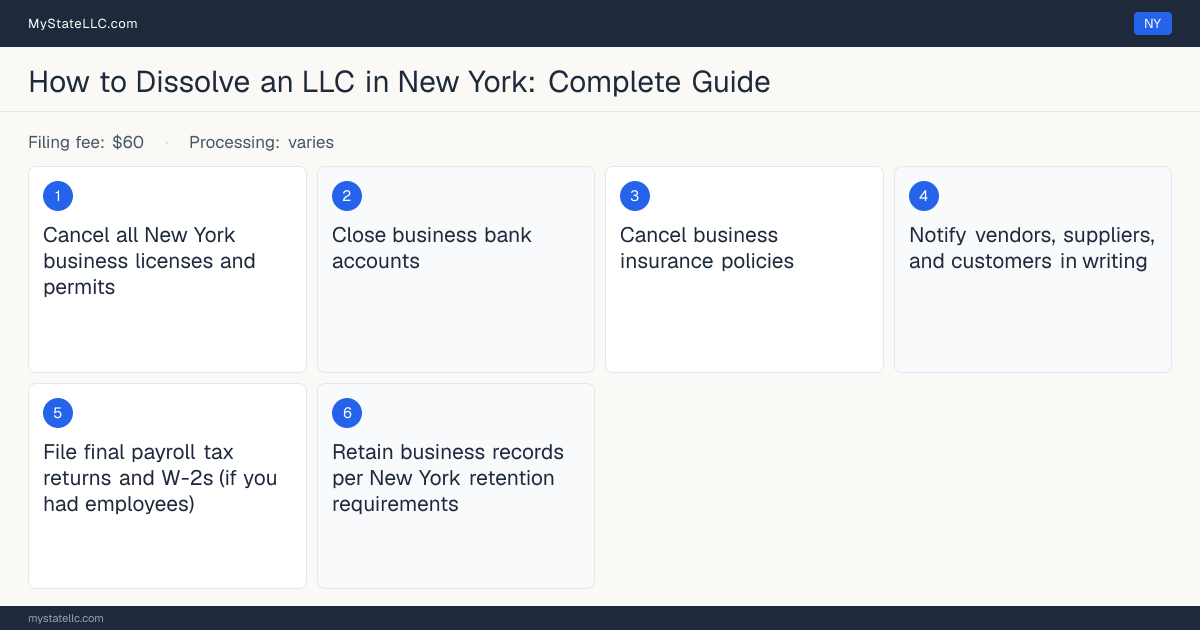
- Cancel all New York business licenses and permits
Cancel every state, city and industry license or permit the LLC held, with the body that issued each one. New York City permits are separate from state ones, and each renews on its own schedule, so anything left open keeps billing.
- Close business bank accounts
Close accounts only after creditors are paid and the final distributions have cleared. Download the complete statement history first and get written confirmation of closure, because access usually ends the day the account does.
- Cancel business insurance policies
Notify each carrier in writing with the dissolution date and ask about refunds of unearned premium. For professional liability, ask specifically whether tail coverage is worth buying, since claims can arrive after the policy period ends.
- Notify vendors, suppliers, and customers in writing
Send dated written notice stating that the company is dissolving, where to send a final invoice, and by when. With no statutory claims-bar procedure in New York, that dated letter is a large part of your protection against a late invoice.
- File final payroll tax returns and W-2s (if you had employees)
File the final federal employment tax returns, issue W-2s to every employee, and close the LLC's New York withholding and unemployment insurance accounts. An open payroll account keeps generating filing obligations even at zero wages.
- Retain business records per New York retention requirements
Keep the dissolution resolution, filed Articles of Dissolution and acknowledgement, creditor correspondence, tax returns and distribution records for at least seven years. New York sets no statutory claims bar for LLC dissolution, so the file is your evidence.
Frequently Asked Questions
Sources
Each entry below is a document recorded in our verified New York sources, and each entry says what the document is. Some statutory text is read from an accurate mirror rather than from the state's own host, and those say so.
- dos.ny.gov/forming-limited-liability-company-new-yorkNew York Department of State, Division of Corporations: business entity filings
- dos.ny.gov/articles-dissolution-domestic-limited-liability-companies-0New York Department of State, Division of Corporations: LLC dissolution
- nysenate.gov/legislation/laws/LLC/705New York tax clearance requirement
Formation Services Compared
Forming an LLC in New York?
See how Northwest Registered Agent, Bizee, ZenBusiness and LegalZoom, the formation services we partner with, compare on 3-year cost, BBB rating and Trustpilot score before you choose.

Edmond Hui · Founder, MyStateLLC
Edmond Hui is a software engineer and serial entrepreneur based in New York who has founded multiple online businesses across e-commerce, media, and information publishing. Before transitioning into tech, he spent years as a commercial real estate professional closing deals totaling over 100,000 square feet, giving him firsthand experience with business formation and entity structuring. He built MyStateLLC to provide the free, state-specific LLC guidance he wished existed when forming his own companies.