How to Dissolve an LLC in Missouri: Complete 2026 Guide
Missouri terminates an LLC in stages: a Notice of Winding Up (Form LLC-13) at $25, then Articles of Termination (Form LLC-5) at $25 once winding up is done. The Secretary of State does not publish a standard processing time, so the timeline varies.
By Edmond Hui · Last updated: September 2026
Missouri's $25 LLC dissolution filing fee ranks #18 of the 50 states counted from cheapest to most expensive, and it ties with 6 other states
Missouri sits in the cheaper half of the country per filing, but the ranking hides the structure. The state runs a voluntary termination through separate winding-up and termination filings, each carrying that same charge, so owners comparing headline fees across states are not comparing the same amount of paperwork.
Source: MyStateLLC 50-state dissolution index, verified 2026-08-13
Dissolution at a Glance
| Filing Fee | $25 |
| Form Name | Articles of Termination for Limited Liability Company (Form LLC-5); preceded by Notice of Winding Up for Limited Liability Company (Form LLC-13) |
| Processing Time | varies |
| Creditor Notice Period | 90 days |
| Tax Clearance Required | No |
| Publication Required | No |
| File Online | SoS Dissolution Page → |
How to Form an LLC: Step-by-Step
- 1
Vote to Dissolve
Missouri LLC voluntary termination runs under Chapter 347 of the Revised Statutes of Missouri, and it starts with the members authorizing dissolution. Read the operating agreement first, because it controls the approval threshold, whether a written consent can replace a meeting, and who is authorized to sign filings for the company. If the operating agreement does not address dissolution, follow the default rules in Chapter 347 rather than assuming a simple majority carries it. Capture the decision in a dated written consent or minutes that identify who approved it, what was approved, and which member or manager will sign the Notice of Winding Up and, later, the Articles of Termination. Both filings depend on that authorization, so it is worth getting the paperwork right before anything goes to the state.
Pro tip: Reconcile the member list against your transfer records before the vote. A dissolution approved by an ownership roster that no longer matches reality is a defect that only shows up when someone challenges it. - 2
File the Notice of Winding Up (Form LLC-13) and then the Articles of Termination (Form LLC-5) with the Missouri Secretary of State
Missouri splits voluntary termination into stages. Once the members have authorized dissolution, the LLC files a Notice of Winding Up, Form LLC-13, which discloses the dissolution on the public record. When winding up is actually complete, the LLC then files Articles of Termination, Form LLC-5. Each filing costs $25 under the Secretary of State schedule of fees, which lists winding up of a limited liability company at $25 and termination of a limited liability company at $25, so a complete voluntary termination costs $50 in state filing fees. Both forms are on the Secretary of State forms page at https://www.sos.mo.gov/business/corporations/forms. Missouri promotes an Online Business Services portal, though online availability specifically for Forms LLC-5 and LLC-13 is not confirmed on the primary forms page, so check the portal before you assume electronic filing. Note as well that the effective date of a filing may not be more than 90 days after the filing date.
Pro tip: The Notice of Winding Up is not the finish line. Until Articles of Termination are filed and processed, the LLC is still on the record as an entity in winding up, not a terminated one. - 3
Notify Creditors and Settle Debts
RSMo 347.141 governs disposition of claims. For known claimants, written notice must state a submission deadline of not fewer than 90 days from the effective date of the notice. That 90-day floor is the notice period the statute names, and it is the number to build your schedule around. For unknown and contingent claimants, Missouri offers an optional tool: publishing the notice of winding up bars claims not brought within three years after publication. Publication exists solely to trigger that three-year bar for claimants you cannot identify. Missouri does not require newspaper publication of a dissolution notice, it is not a condition of dissolving, and you should not buy advertising on the assumption that the state demands it. Work through your accounts payable, leases, loans, and contracts, and either pay each obligation or make adequate provision for it.
Pro tip: Send known-claimant notices with tracking and note the effective date on each one. The 90-day clock runs from that effective date, and you will need to prove it if a late claim appears. - 4
Close Missouri State Tax Accounts
File your final Missouri returns with the state tax agency, mark each as a final return, and give the dissolution date. Depending on how the LLC operated, that can include the state return matching your federal tax classification, sales and use tax if you were registered to collect it, and withholding if you had employees. Close each registration rather than simply stopping the filings, because an open account keeps generating obligations and automated notices after the business has wound down. What you do not need is a clearance certificate. No tax clearance is required for an LLC termination in Missouri, and tax clearance in the Chapter 347 context applies to corporate reinstatement rather than to voluntary LLC termination. Final returns and account closure are still the members' responsibility, they are simply not a gate on the filings.
Pro tip: Close the sales tax registration explicitly and keep the confirmation. A dormant sales tax account is the most common reason a terminated business keeps receiving state notices. - 5
Deactivate Your EIN with the IRS
The IRS cannot cancel an EIN, but it can deactivate it once any outstanding returns are filed and taxes owed are paid. See the FAQ below for the letter and mailing addresses. Do the federal filings first: a multi-member LLC taxed as a partnership files a final Form 1065 with the final return box checked, an LLC that elected S corporation treatment files a final Form 1120-S, an LLC that elected C corporation treatment files a final Form 1120, both also with the final return box checked, and a single-member LLC that never elected corporate treatment reports its last activity on the owner's return.
Pro tip: Send the deactivation letter by certified mail with return receipt and file the receipt with your termination records. - 6
Distribute Remaining Assets to Members
Creditors come before members. Pay or make adequate provision for the LLC's known debts and liabilities first, and hold back a reserve covering anything still inside the 90-day claim window from step 3. Only what remains after that is available to distribute. The operating agreement controls the division, and most agreements distribute according to membership interests or capital account balances. If the agreement is silent, follow the default distribution rules in Chapter 347 rather than negotiating a split in the moment. Value non-cash property at fair market value before you transfer it, record precisely who received what, and let members know that a distribution can create a tax consequence on their personal returns. Finish this before you file the Articles of Termination, since that filing is the statement that winding up is complete.
Pro tip: Fund the reserve before the first distribution goes out. Recovering money from members after a valid late claim lands is much harder than holding it back for a quarter. - 7
Confirm Dissolution is Complete
Search your LLC in the Missouri Secretary of State business entity search and confirm that the Articles of Termination have been processed, not just the Notice of Winding Up. Those are different states of the record, and only the termination signals that the entity is finished. Save the filed copies of both forms rather than the submission receipts, since banks, insurers, and buyers ask for the filed documents. Then build one file containing the member authorization from step 1, both filed forms, the creditor notices and any claim responses, the final federal and Missouri returns, and signed acknowledgments for each asset distribution. Keep the registered agent arrangement in place until the record shows the termination, so any late correspondence still reaches someone who understands it.
Pro tip: Save a dated PDF of the entity search result showing the terminated status. It costs nothing and it settles later arguments about exactly when the LLC ceased to exist.
Winding-Up Checklist
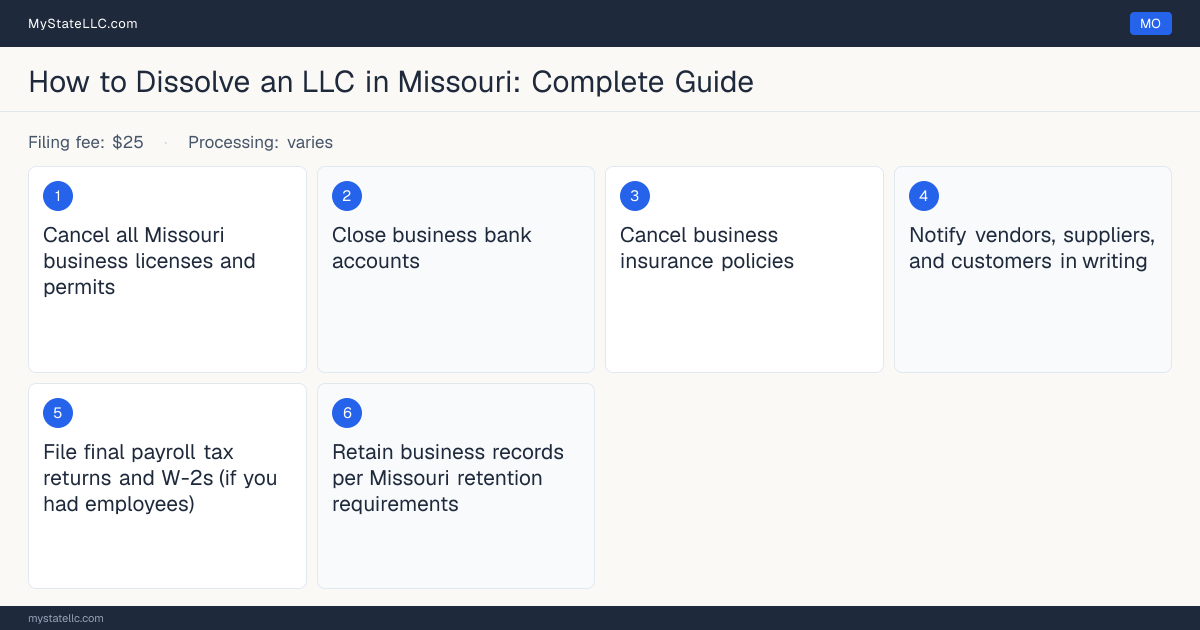
- Cancel all Missouri business licenses and permits
Return to every agency that issued a license, permit, or local business registration and cancel it in writing. Anything that renews automatically will keep generating fees and filing duties after the LLC stops trading.
- Close business bank accounts
Close the accounts only after every check has cleared, every card is cancelled, and every recurring debit is stopped. Keep the final statements, since they are the cleanest evidence of what was paid and what was distributed.
- Cancel business insurance policies
Give each carrier the dissolution date in writing and ask about a refund of unearned premium. If you carried a claims-made policy, ask specifically about tail coverage, because claims can arrive after the business is gone.
- Notify vendors, suppliers, and customers in writing
Send dated written notice so nobody ships goods, renews a contract, or invoices the LLC after the dissolution date. Keep those notices with the creditor correspondence from step 3.
- File final payroll tax returns and W-2s (if you had employees)
File the final federal employment tax returns and the final Missouri withholding returns, and issue W-2s to employees and 1099s to contractors on the usual schedule. Payroll obligations survive termination and can reach responsible individuals personally.
- Retain business records per Missouri retention requirements
Our verified data does not establish a specific Missouri retention period for a terminated LLC's records, so do not throw anything away on a guess. Keep both filed forms, the final returns, the creditor notices, and the distribution records for as long as your tax advisor recommends.
Frequently Asked Questions
Sources
Each entry below is a document recorded in our verified Missouri sources, and each entry says what the document is. Some statutory text is read from an accurate mirror rather than from the state's own host, and those say so.
- sos.mo.gov/business/corporationsMissouri Secretary of State: business entity filings
- sos.mo.gov/business/corporations/formsMissouri Secretary of State: LLC dissolution
- sos.mo.gov/CMSImages/Business/fees.pdfMissouri dissolution filing fee
- sos.mo.gov/CMSImages/Business/llc5.pdfMissouri Articles of Dissolution form
- revisor.mo.gov/main/OneSection.aspx?section=347.141Missouri creditor notice period
- sos.mo.gov/business/corporations/generalInfoMissouri tax clearance requirement
Formation Services Compared
Forming an LLC in Missouri?
See how Northwest Registered Agent, Bizee, ZenBusiness and LegalZoom, the formation services we partner with, compare on 3-year cost, BBB rating and Trustpilot score before you choose.

Edmond Hui · Founder, MyStateLLC
Edmond Hui is a software engineer and serial entrepreneur based in New York who has founded multiple online businesses across e-commerce, media, and information publishing. Before transitioning into tech, he spent years as a commercial real estate professional closing deals totaling over 100,000 square feet, giving him firsthand experience with business formation and entity structuring. He built MyStateLLC to provide the free, state-specific LLC guidance he wished existed when forming his own companies.