How to Dissolve an LLC in Kentucky: Complete 2026 Guide
Closing a Kentucky LLC means mailing Articles of Dissolution (form LLD) to the Kentucky Secretary of State with a $40 filing fee. Kentucky does not publish a standard turnaround, so processing time varies.
By Edmond Hui · Last updated: September 2026
Kentucky charges $40 to dissolve an LLC, which ranks #33 of 50 states from cheapest to most expensive, and it ties with 1 other states at that price.
The fee sits in the upper half of the national range but is still small enough to be a rounding error next to the wind-up itself. What actually shapes a Kentucky closure is that dissolution cannot be filed online, so the paperwork travels by mail or in person.
Source: MyStateLLC 50-state dissolution index, verified 2026-08-13
Dissolution at a Glance
| Filing Fee | $40 |
| Form Name | Articles of Dissolution (Limited Liability Company) - form LLD |
| Processing Time | varies |
| Creditor Notice Period | 120 days |
| Tax Clearance Required | No |
| Publication Required | No |
| File Online | SoS Dissolution Page → |
How to Form an LLC: Step-by-Step
- 1
Vote to Dissolve
Your operating agreement is the starting point. It sets who must approve a dissolution, what share of membership interests that takes, and whether the decision can be made by written consent instead of at a meeting. Follow it to the letter, because a filing made without the approval the agreement requires is a dispute waiting to happen. If your agreement says nothing about dissolution, the safest practice is unanimous written consent signed and dated by every member. Record the outcome as a short resolution naming the LLC, the date the members agreed to dissolve, and who is authorized to sign filings and wind the business up. A domestic Kentucky LLC dissolves and begins winding up under KRS 275.285, so this decision is what starts the wind-up, and the Articles of Dissolution come afterwards.
Pro tip: Name a single member or manager in the resolution as the authorized signer. The Kentucky form must be signed by a member or manager, and banks, insurers and the IRS all want to see who holds that authority. - 2
File Articles of Dissolution (Limited Liability Company) - form LLD with the Kentucky Secretary of State
Kentucky closes a domestic LLC with Articles of Dissolution (Limited Liability Company), form code LLD, filed with the Kentucky Secretary of State under KRS 275.315. The same form covers an LLC, a nonprofit LLC and a professional service LLC. The filing fee is $40.00, and the form must be signed by a member or manager. A check is made payable to the Kentucky State Treasurer, and the fee schedule also accepts cash, a prepaid account or a card. Two dates on this form do different jobs, and confusing them gets the filing rejected. The dissolution date in Article III is the date the event of dissolution actually occurred, and the form states that a dissolution date in the future will not be accepted for filing. The filing's effective date is the separate one: it has to be a date certain, and under KRS 14A.2-070(2) a delayed effective date cannot be later than the 90th day after filing. Dissolution is not one of the filings Kentucky accepts online: the Secretary of State's FastTrack system handles filings such as annual reports, assumed-name renewals, registered agent or office changes and new business formations, so the dissolution goes by mail to PO Box 718, Frankfort, KY 40602-0718 or in person at 1025 Capital Center Drive, Suite 201, Frankfort, KY 40601. Details and current forms are at https://www.sos.ky.gov/bus/business-filings/Pages/Dissolution.aspx. Kentucky does not require a tax clearance certificate to file, and it does not require you to publish a dissolution notice in a newspaper, though KRS 275.325 offers an optional publication route that buys something worth understanding before you skip it (see step 3).
Pro tip: Download the form fresh from web.sos.ky.gov the day you file rather than reusing a saved copy. The current LLD revision is (7/25), and the revision code is printed on the form, so check it before you mail the form with your payment. - 3
Notify Creditors and Settle Debts
Kentucky gives a dissolved LLC an optional tool for cutting off known claims. Under KRS 275.320 the company may bar a known claim by sending the claimant written notice that sets a deadline for submitting the claim, and that deadline may be no fewer than 120 days after the later of the date of the notice or the filing of the articles of dissolution. If the company then rejects a claim, the claimant has 90 days after the rejection notice to file suit. That 120-day figure is the notice period Kentucky's statute names, and using the procedure is the LLC's choice rather than a precondition of filing. Whether or not you use it, the substance is the same: write to every known creditor, lender, landlord and vendor, tell them the LLC is winding up, ask for final invoices, and pay or reserve for what is owed before any member takes a distribution. Winding up itself is governed by KRS 275.300. Kentucky also has an optional publication route under KRS 275.325 that no statute requires you to use. Publishing bars claims from claimants you never notified, and contingent claims, after two years from the later of the publication or the KRS 275.315 filing, or after five years for a professional LLC. Skipping publication is a legitimate choice and costs you nothing at the filing office, but understand what you are declining: without it that bar never arises.
Pro tip: If you use the KRS 275.320 notice procedure, send it by certified mail and diary the deadline you set. The 120-day count runs from the later of the notice date or the dissolution filing, so the two dates need to be in the same file. - 4
Close Kentucky State Tax Accounts
File a final return for every Kentucky tax account the LLC holds and close each account instead of leaving it open. That typically covers the limited liability entity and income tax filings, sales and use tax if you collected it, and withholding if you had payroll. Mark each return final and pay any balance. The Secretary of State recommends contacting the IRS, the Kentucky Department of Revenue, the state unemployment insurance office and your county clerk as part of closing down, and that list is a good checklist for accounts and registrations that outlive the business if nobody closes them. Kentucky does not require a tax clearance certificate to file Articles of Dissolution, and the Secretary of State does not ask for one, so do not treat a clearance as a gate on your filing.
Pro tip: Close the county-level registrations too. Local occupational license and net profits accounts are administered by county and city offices, not by the state, so a Frankfort filing does nothing to shut them off. - 5
Deactivate Your EIN with the IRS
The IRS cannot cancel an EIN, but it can deactivate it once any outstanding returns are filed and taxes owed are paid. See the FAQ below for the letter and mailing addresses. File the final federal return before or with the deactivation letter. A multi-member LLC taxed as a partnership files Form 1065 with the final return box checked and issues final Schedule K-1s to every member; an LLC taxed as a corporation files Form 1120 or 1120-S, also with the final return box checked. A single-member LLC that never elected corporate treatment reports the final year on the owner's return. An LLC that elected corporate treatment should also file Form 966.
Pro tip: Mail the deactivation letter by certified mail with return receipt and keep the receipt with your final return. - 6
Distribute Remaining Assets to Members
Creditors are paid before members are. Settle known debts and taxes, reserve for claims that exist but are not yet final, and only then distribute what remains. Follow the distribution provisions in your operating agreement; if it does not address the order, distribute according to ownership percentages and keep the arithmetic that shows how you got there. Turn assets into cash where you reasonably can, because distributing vehicles, equipment or receivables in kind creates valuation arguments and complicated tax reporting for the members who receive them. Log every distribution with its date, amount, recipient and purpose, and make sure the final Schedule K-1s match the ledger. Paying members ahead of creditors is the single mistake most likely to follow the owners personally after the LLC is gone.
Pro tip: Hold back a small reserve until the final Kentucky and federal returns are filed and accepted. Clawing money back from members to cover a late tax bill is far harder than distributing a small remainder later. - 7
Confirm Dissolution is Complete
Kentucky does not publish a standard processing time for Articles of Dissolution, and because the filing goes by mail or in person rather than through an online portal, you will not get an instant confirmation screen. Verify instead: look the LLC up in the Secretary of State's business organization search and confirm the record shows the dissolution and the effective date you specified. Keep the stamped copy the office returns and your cancelled check. Then assemble a closing file: the dissolution resolution, the filed Articles of Dissolution, any KRS 275.320 creditor notices and the responses, final federal and Kentucky returns, the EIN deactivation letter with its certified mail receipt, and the final accounting showing what each member received. Keep the file for at least seven years, because audit windows outlast the company.
Pro tip: Because the filing's effective date must be a date certain, check that the entity search shows the same date you put on the form. A mismatch is easiest to fix in the weeks right after filing, not a year later.
Winding-Up Checklist
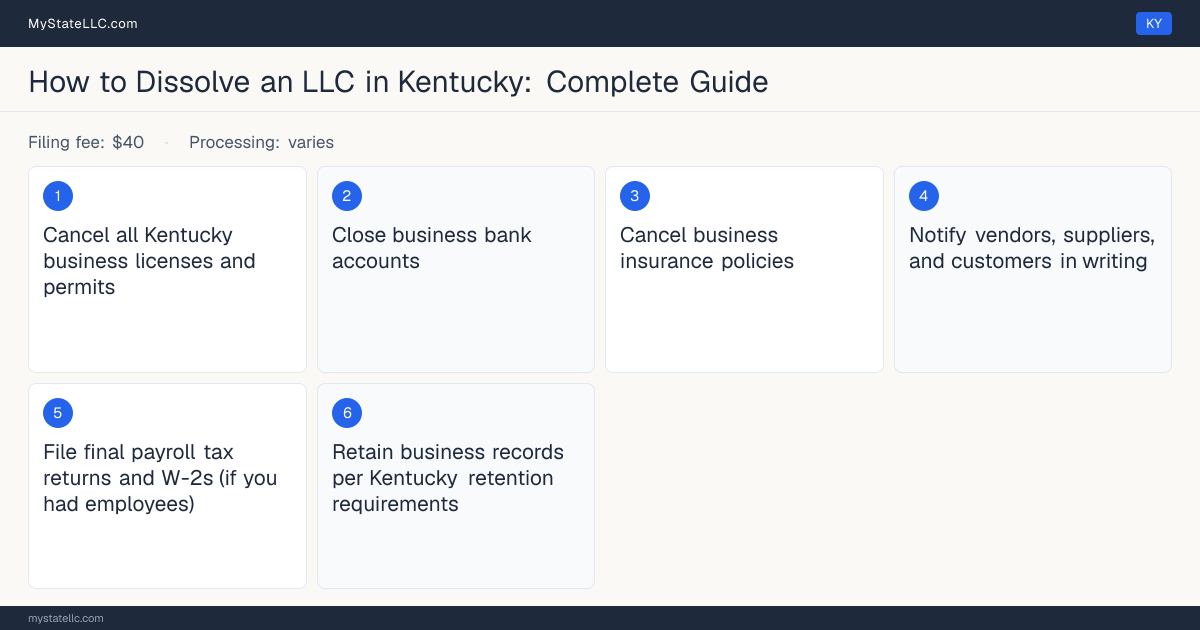
- Cancel all Kentucky business licenses and permits
Cancel every state license, professional registration and permit in writing, and do the same with your county clerk and city for local occupational licenses. Local registrations renew on their own schedule and will keep billing you if nobody closes them.
- Close business bank accounts
Wait until every check has cleared, the final tax payments have gone out and member distributions are complete, then close the operating account, any reserve account and all business cards. Download the full statement history first, because banks cut off access to closed accounts.
- Cancel business insurance policies
Tell your general liability, property, auto, workers compensation and professional liability carriers the wind-up date and ask about refunds of unearned premium. For claims-made policies, ask whether tail coverage is worth buying, since claims can arrive after the LLC is dissolved.
- Notify vendors, suppliers, and customers in writing
Send a dated written notice to every supplier, subscription vendor, landlord and active customer with the closing date and instructions for sending a final invoice. Cancel recurring charges directly with each vendor rather than assuming a closed card will stop them.
- File final payroll tax returns and W-2s (if you had employees)
File the final federal employment tax returns, make the last withholding deposit, and close the Kentucky withholding and unemployment insurance accounts. Issue W-2s to employees and 1099-NEC forms to contractors by the usual deadlines and mark the federal employment return as final.
- Retain business records per Kentucky retention requirements
Keep the articles of organization, operating agreement, dissolution resolution, filed Articles of Dissolution, ledgers, contracts and all tax returns for at least seven years. Store them somewhere a former member can actually retrieve them once the office is gone.
Frequently Asked Questions
Sources
Each entry below is a document recorded in our verified Kentucky sources, and each entry says what the document is. Some statutory text is read from an accurate mirror rather than from the state's own host, and those say so.
- sos.ky.gov/bus/business-filings/OnlineServices/Pages/default.aspxKentucky Secretary of State: business entity filings
- sos.ky.gov/bus/business-filings/Pages/Dissolution.aspxKentucky Secretary of State: LLC dissolution
- d2l2jhoszs7d12.cloudfront.net/state/Kentucky/Kentucky%20Secretary%20of%20State/sos.ky.gov/Business%20Filings%20Forms/Domestic%20Limited%20Liability%20Company%20Forms/ADLLC.PDFKentucky dissolution filing fee
- web.sos.ky.gov/forms/corp/LLD-Articles%20of%20Dissolution_Limited%20Liability%20Company.pdfKentucky Articles of Dissolution form
- apps.legislature.ky.gov/law/statutes/statute.aspx?id=13894Kentucky creditor notice period
Formation Services Compared
Forming an LLC in Kentucky?
See how Northwest Registered Agent, Bizee, ZenBusiness and LegalZoom, the formation services we partner with, compare on 3-year cost, BBB rating and Trustpilot score before you choose.

Edmond Hui · Founder, MyStateLLC
Edmond Hui is a software engineer and serial entrepreneur based in New York who has founded multiple online businesses across e-commerce, media, and information publishing. Before transitioning into tech, he spent years as a commercial real estate professional closing deals totaling over 100,000 square feet, giving him firsthand experience with business formation and entity structuring. He built MyStateLLC to provide the free, state-specific LLC guidance he wished existed when forming his own companies.