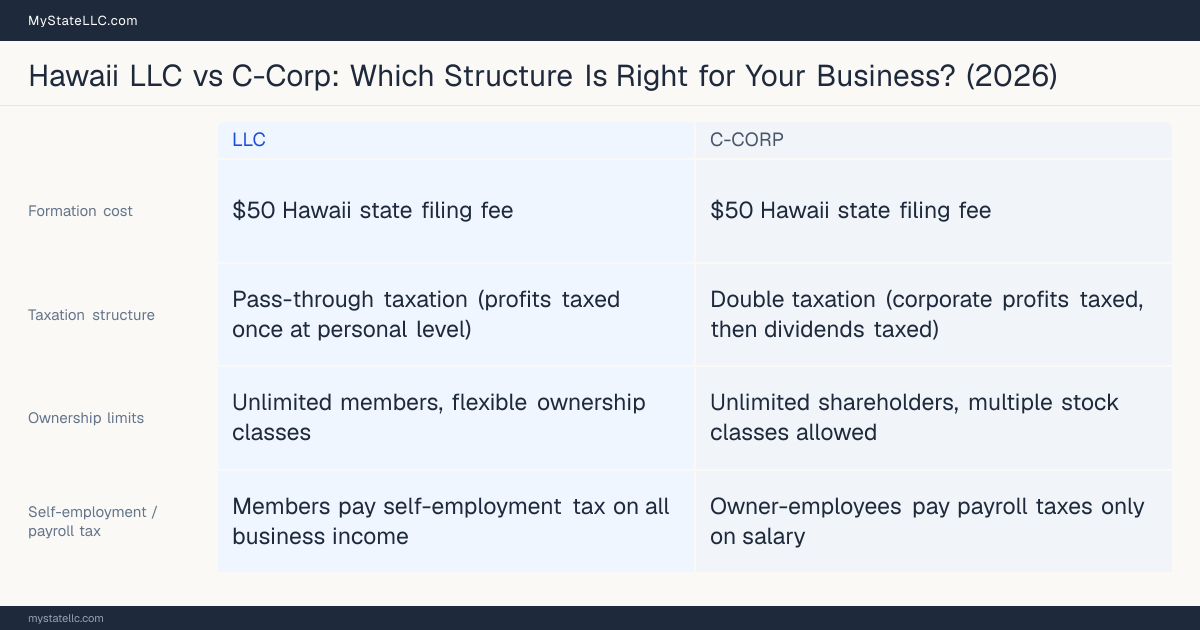
In Hawaii, an LLC fits when you're a small business owner prioritizing simplicity and tax pass-through benefits; a C-corp fits when you plan to seek venture capital investment or angel funding for business growth. Compare both structures in detail below.
Affiliate disclosure: We may earn a commission at no extra cost to you.
Side-by-side on the factors that decide the choice, for Hawaii. Source: Hawaii Department of Commerce and Consumer Affairs, Business Registration Division.
LLC vs C-Corp: Side-by-Side
Factor
LLC
C-Corp
Formation cost
$50 Hawaii state filing fee
$50 Hawaii state filing fee
Taxation structure
Pass-through taxation (profits taxed once at personal level)
Double taxation (corporate profits taxed, then dividends taxed)
Dividends distributed proportional to stock ownership
When an LLC Makes More Sense
You're a small business owner prioritizing simplicity and tax pass-through benefits
You want to avoid Hawaii's corporate income tax and double taxation issues
You prefer flexible management structure without board meetings and corporate formalities
You're not seeking venture capital funding or planning to go public
When a C-Corp Makes More Sense
You plan to seek venture capital investment or angel funding for business growth
You want to retain significant profits in the business for future expansion
You need to provide employee stock options or equity compensation plans
You're building a scalable business with plans for potential acquisition or IPO
Tax Deep Dive
Llc Default Tax
Hawaii LLCs enjoy pass-through taxation, meaning business profits flow directly to members' personal tax returns. Members pay Hawaii state income tax (1.4% to 11%) plus federal taxes on their share of LLC income, whether distributed or not.
C Corp Tax
C-Corps face double taxation in Hawaii: first at the corporate level (Hawaii corporate tax of 4.4% to 6.4% plus 21% federal), then shareholders pay personal income tax on dividends received. This creates a significant tax burden for smaller businesses.
When C Corp Wins
C-Corps become tax-advantageous when retaining substantial earnings (avoiding immediate distribution), seeking VC funding requiring corporate structure, or when owner-employees can optimize salary vs. dividend income. Hawaii's relatively moderate corporate tax rates make this structure viable for high-growth businesses planning significant reinvestment.
Calculate Your Tax Savings in Hawaii
Enter your profit and filing status to compare estimated annual taxes for LLC, S-Corp, and C-Corp side by side, specific to Hawaii.
This guide is general information, not legal or tax advice, and reading it does not create an attorney-client relationship. It reports published tax rates and statutory attributes, with the sources this page cites. It cannot tell you which structure is better for you: that turns on your profit, the salary you could defend as reasonable compensation, every state you owe tax in, and plans for owners, investors and exit that no figure on this page measures. Confirm your own position with a CPA or tax attorney licensed in your state before you elect anything, because some elections are slow or costly to reverse.
Frequently Asked Questions
Double taxation means C-Corp profits are taxed twice: first at the corporate level, then again when distributed as dividends to shareholders. In Hawaii, the Department of Taxation applies a corporate income tax rate of 4.4% to 6.4% on net profits, plus the federal rate of 21%, totaling 25.4% to 27.4% at the corporate level alone. When the corporation distributes remaining profits as dividends, Hawaii shareholders pay personal income tax at rates up to 8.75%, creating a combined effective tax rate potentially exceeding 35% on the same income. For a Hawaii LLC taxed as an S-Corp or partnership, profits pass through to owners without corporate-level taxation, preserving capital. This structural difference means a $100,000 profit distributed by a C-Corp could cost your business $35,000+ in combined taxes versus $8,750 in personal taxes for an LLC owner in Hawaii's top bracket. Review Form N-30 (Hawaii Corporation Income Tax Return) and Form N-35 (S Corporation Income Tax Return) requirements with a tax professional to determine which structure minimizes your actual tax liability.
A Hawaii C-Corp saves money on taxes when annual business income exceeds $100,000 and you reinvest profits instead of distributing them to owners. This works because C-Corps pay a flat 21% federal corporate tax rate, while Hawaii LLCs taxed as sole proprietorships or partnerships face self-employment tax (15.3%) plus income tax on all profits. The Hawaii Department of Taxation requires C-Corps to file Form N-30 (Corporation Income Tax Return), due the 20th day of the 4th month after the close of the tax year (April 20 for calendar-year filers). The real savings emerge when you're an owner-employee: you pay yourself a reasonable W-2 salary (subject to payroll tax deduction) and take remaining profits as dividends, which avoids the 15.3% self-employment tax on that dividend portion. However, the IRS scrutinizes unreasonably low salaries, so you must document market rates for your role. This strategy only works if you don't need all earnings immediately. Consult a Hawaii CPA to model your specific income scenario and ensure compliance with reasonable salary requirements before converting to C-Corp status.
Yes, Hawaii LLCs can convert to C-Corps through statutory conversion under Hawaii Revised Statutes Chapter 414D, or by forming a new corporation and transferring assets. This route preserves your entity's continuity and avoids immediate asset transfer complications. However, conversion may trigger tax consequences, including potential capital gains taxes on appreciated assets and loss of LLC pass-through taxation benefits. The IRS treats statutory conversions as taxable events in most cases. For LLC owners planning future growth or seeking corporate liability protection advantages, converting later is more efficient than dissolving a C-Corp to form an LLC. File your conversion documents with the DCCA's Business Registration Division at least 30 days before your intended conversion date to allow processing time. Consult a Hawaii tax professional before converting to model your specific tax impact.
Venture capitalists strongly prefer C-Corporations over LLCs because institutional investors, pension funds, endowments, and other funds managing the VC firm's capital, face tax complications with pass-through entities like LLCs. C-Corps provide a standardized structure that aligns with VC term sheets, which typically require conversion to C-Corp status before any institutional funding in Hawaii. C-Corps enable clean equity incentive plans through ISO and NSO stock options, critical for attracting talent without triggering immediate tax liability. They also facilitate predictable exit strategies: acquisition by another C-Corp or IPO registration with the SEC. With an LLC, these exits create murky tax consequences for multiple investor classes. For Hawaii business owners seeking VC funding, this means you'll likely need to convert your LLC to a C-Corp filing Articles of Incorporation with Hawaii's Department of Commerce and Consumer Affairs (DCCA) before approaching institutional investors. This conversion costs $150 in state filing fees, $100 for the Articles of Conversion (Form X-10) plus $50 for the Articles of Incorporation that Hawaii requires be filed with it, plus potential accounting costs for basis adjustments. Optional expedited review adds $75 and $25 respectively. Contact the Hawaii DCCA's Business Registration Division or consult a Hawaii-licensed tax attorney to initiate conversion before pitching to venture capital firms.
Hawaii C-Corps pay the same $50 initial filing fee as LLCs to the Hawaii Department of Commerce and Consumer Affairs (DCCA), but face significantly higher ongoing costs. C-Corps must pay Hawaii's corporate income tax, which ranges from 4.4% to 6.4% on net income depending on your tax bracket. Additionally, C-Corps file an annual report (Form D1) with the DCCA each year for a $15 fee, due during the calendar quarter that contains your incorporation anniversary. In contrast, LLCs avoid corporate-level taxation entirely, though members still pay Hawaii personal income tax (2% to 8.25%) on their business profits. This structural difference means a profitable C-Corp can face double taxation, once at the corporate rate and again when shareholders receive dividends. To determine your actual tax burden, calculate your projected net income and compare the combined C-Corp tax rate against your personal tax rate as an LLC member. Contact the DCCA's Business Registration Office at (808) 586-2744 to clarify your specific tax obligations before incorporating.
Most small Hawaii businesses should start as an LLC because Hawaii's pass-through taxation structure allows you to avoid the state's 4.4 to 6.4% corporate income tax, while still maintaining personal liability protection. Filing with Hawaii's Department of Commerce and Consumer Affairs costs $50 for both an LLC and a C-Corp, and each must file a simple annual report. This structure keeps administrative overhead minimal during your critical growth phase. However, if you're pursuing venture capital funding, planning to retain over $50,000 in annual profits, or building complex employee equity incentive plans, a C-Corp's separate tax entity status becomes advantageous despite higher compliance costs. To determine your ideal structure, first estimate your projected annual income and capital needs, then file your Articles of Organization with Hawaii DCCA using Form LLC-1. Your decision point should occur before your first operational year closes.
Sources
Each entry below is a document recorded in our verified Hawaii sources, and each entry says what the document is. Some statutory text is read from an accurate mirror rather than from the state's own host, and those say so.
See how Northwest Registered Agent, Bizee, ZenBusiness and LegalZoom, the formation services we partner with, compare on 3-year cost, BBB rating and Trustpilot score before you choose.
Edmond Hui is a software engineer and serial entrepreneur based in New York who has founded multiple online businesses across e-commerce, media, and information publishing. Before transitioning into tech, he spent years as a commercial real estate professional closing deals totaling over 100,000 square feet, giving him firsthand experience with business formation and entity structuring. He built MyStateLLC to provide the free, state-specific LLC guidance he wished existed when forming his own companies.