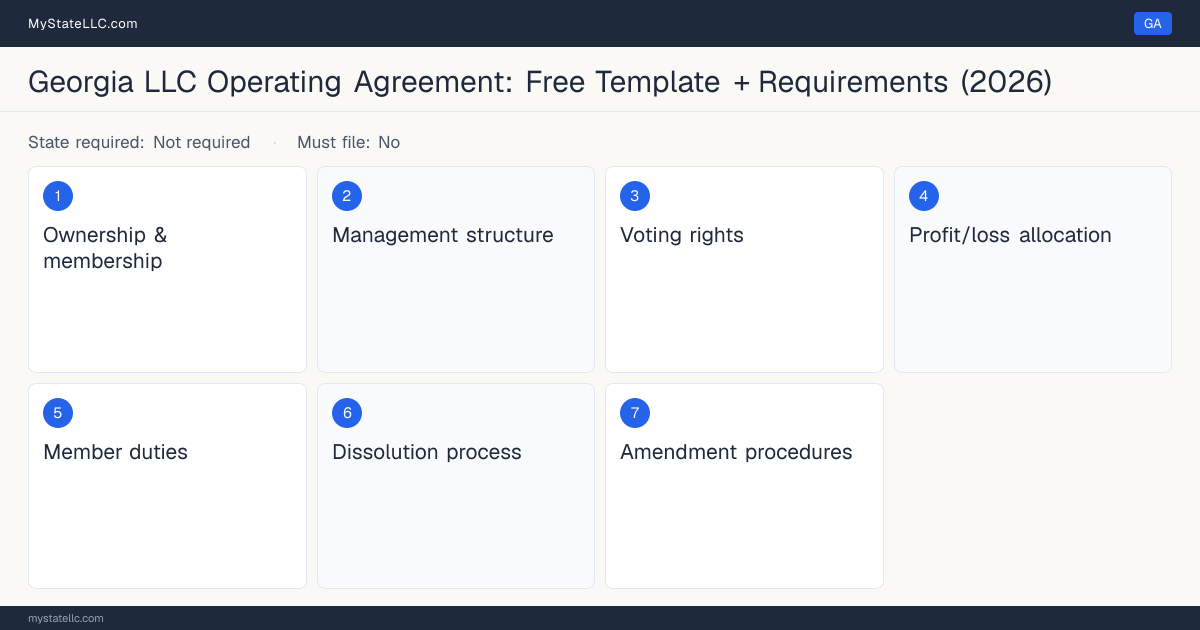
Georgia does not legally require an LLC operating agreement, but having one protects your limited liability status and sets the rules for ownership and profits. See exactly what to include below.
Edmond Hui is a software engineer and serial entrepreneur based in New York who has founded multiple online businesses across e-commerce, media, and information publishing. Before transitioning into tech, he spent years as a commercial real estate professional closing deals totaling over 100,000 square feet, giving him firsthand experience with business formation and entity structuring. He built MyStateLLC to provide the free, state-specific LLC guidance he wished existed when forming his own companies.
Affiliate disclosure: We may earn a commission at no extra cost to you.
Define each member's ownership percentage, capital contributions, and membership interests. This establishes clear ownership rights and prevents disputes over who owns what portion of the LLC.
Management structure
Specify whether your LLC is member-managed or manager-managed and outline decision-making authority. This clarifies who has the power to bind the company and make operational decisions.
Voting rights
Establish voting procedures, quorum requirements, and what decisions require member approval. Clear voting rules prevent deadlocks and ensure important business decisions can be made efficiently.
Profit/loss allocation
Detail how profits and losses are distributed among members and when distributions occur. This section ensures transparent financial arrangements and tax compliance.
Member duties
Outline each member's responsibilities, time commitments, and fiduciary duties to the LLC. This sets clear expectations and helps prevent conflicts over member obligations.
Dissolution process
Define the circumstances that trigger dissolution and the process for winding up the business. This protects members by establishing an orderly exit strategy if the business needs to close.
Amendment procedures
Specify how the operating agreement can be modified and what vote is required for changes. This ensures the agreement can evolve with your business while protecting minority members' interests.
Frequently Asked Questions
No, Georgia law does not require LLCs to have an operating agreement. However, having one is strongly recommended because it protects your limited liability status and prevents costly disputes between members. Without an operating agreement, your LLC defaults to Georgia's statutory rules under O.C.G.A. § 34-11-3-109, which may not align with your business structure or member intentions. For example, default rules require equal profit-sharing regardless of capital contributions, restrict member exit without penalty, and give the state authority over management decisions. An operating agreement lets you customize voting rights, profit distribution, management roles, and buyout procedures to match your actual business arrangement. Without one, you risk losing liability protection if a court deems your LLC insufficiently formalized, exposing your personal assets. Download Georgia's official LLC operating agreement template from the Secretary of State's website, customize it for your member count and business structure, and have all members sign it before conducting business operations.
Yes, you can write your own Georgia LLC operating agreement without hiring an attorney. Georgia law does not require a written operating agreement—the state's default rules under O.C.G.A. § 34-11-1-101 et seq. will govern if you don't create one. However, this default framework may not protect your personal liability or align with your specific ownership structure, profit distributions, or management preferences.
If you're a single-member LLC with straightforward operations, a template may suffice. For multi-member LLCs or arrangements involving capital contributions, buy-sell provisions, or management disputes, skipping legal review creates significant risk. Georgia courts will enforce an ambiguous agreement according to the Uniform Limited Liability Company Act, potentially overriding your intent.
A Georgia-licensed attorney typically charges $300–$800 to review a custom agreement, far less than resolving disputes later. Download a Georgia LLC operating agreement template from the Secretary of State's website, customize it for your business structure, then have an attorney verify it complies with current Georgia law before signing.
No, Georgia does not require LLC operating agreements to be notarized under Georgia Code § 34-11-102. However, having your signatures notarized by a Georgia notary public is highly recommended, even though it's optional. Notarization creates a presumption of authenticity and can significantly strengthen your agreement if disputes arise in court or during dissolution proceedings.
Without notarization, members may later dispute whether signatures are genuine, potentially undermining the agreement's enforceability. With notarization, you gain a certified third-party witness to the signing, which courts heavily favor when validating member intent and authority.
All members must sign the operating agreement. If you have multiple members signing at different times or locations, have each person's signature notarized by a Georgia notary public to ensure uniform credibility across all signatures.
Store the original notarized agreement in your LLC's official records book, which the Georgia Secretary of State may request during compliance audits.
Next step: Visit your local bank, law library, or UPS store to locate a Georgia notary public, and schedule notarization before finalizing your operating agreement.
Without an operating agreement, your Georgia LLC will be governed by Georgia's default Limited Liability Company Act provisions, which treat your business as if it operates under a one-size-fits-all template that may directly contradict your intentions.
Specifically, Georgia law defaults to equal profit and voting rights among all members, regardless of capital contributions. If you invested 70% of startup funds while another member invested 30%, you'd still split profits equally without a written agreement—a costly oversight that courts won't remedy.
Default rules also prevent you from establishing custom management structures. Georgia automatically assumes member-managed operation, meaning every LLC member can bind the company to contracts and incur debt without consent from others. For multi-member LLCs, this creates significant liability exposure and operational chaos.
Additionally, without documented buyout provisions, if a member dies or wants to leave, Georgia's default succession rules could force an involuntary dissolution or allow the departing member's heirs to claim ownership stakes.
**Next step:** Draft or download a Georgia LLC Operating Agreement before your Secretary of State filing becomes official, then have all members sign and retain copies in your company records.
Yes, Georgia LLC operating agreements can be amended, and the process is straightforward under Georgia law. The amendment procedure must follow the terms specified in your original operating agreement—most commonly requiring unanimous consent from all members, though some agreements permit amendments with a majority vote (typically 50% or higher). All amendments must be documented in writing and signed by the required parties as defined in your agreement. Georgia does not mandate filing amendments with the Secretary of State unless your agreement specifically requires it or the amendment affects provisions that impact your Articles of Organization. The practical benefit is flexibility: you can modify profit-sharing percentages, management structure, member roles, or withdrawal procedures without dissolving your LLC. Keep signed amendment copies in your LLC records for tax and legal compliance purposes. For your next step, review your current operating agreement's amendment clause to confirm the required voting threshold, then draft your amendment using consistent language and formatting before circulating it for signatures.