Colorado does not legally require an LLC operating agreement, but having one protects your limited liability status and sets the rules for ownership and profits. See exactly what to include below.
Edmond Hui is a software engineer and serial entrepreneur based in New York who has founded multiple online businesses across e-commerce, media, and information publishing. Before transitioning into tech, he spent years as a commercial real estate professional closing deals totaling over 100,000 square feet, giving him firsthand experience with business formation and entity structuring. He built MyStateLLC to provide the free, state-specific LLC guidance he wished existed when forming his own companies.
Affiliate disclosure: We may earn a commission at no extra cost to you.
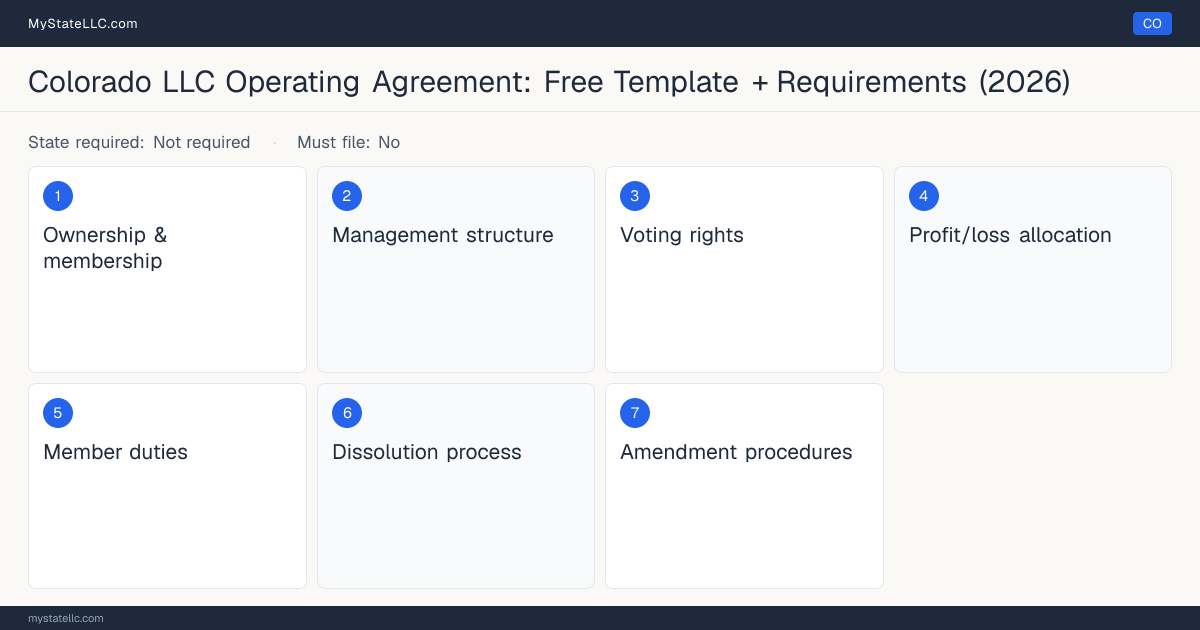
Define each member's ownership percentage and capital contributions. This section establishes who owns what portion of your Colorado LLC and prevents future disputes.
Management structure
Specify whether your LLC is member-managed or manager-managed and outline decision-making authority. Colorado law allows flexibility in how you structure management roles.
Voting rights
Detail how votes are allocated among members and what matters require unanimous consent versus majority approval. Clear voting procedures prevent deadlocks and disputes.
Profit/loss allocation
Establish how profits and losses are distributed among members, which may differ from ownership percentages. This affects both cash distributions and tax reporting.
Member duties
Define each member's responsibilities, time commitments, and any restrictions on competing businesses. This section protects the LLC's interests and clarifies expectations.
Dissolution process
Outline the steps for dissolving the LLC, including triggering events and asset distribution procedures. Colorado requires proper dissolution filing with the Secretary of State.
Amendment procedures
Specify how the operating agreement can be modified, typically requiring written consent from a certain percentage of members. This ensures changes are made deliberately and fairly.
Frequently Asked Questions
No, Colorado does not legally require LLCs to have a written operating agreement under the Colorado Limited Liability Company Act (C.R.S. § 7-80-101 et seq.). However, this lack of a legal mandate creates significant risk for LLC owners who operate without one.
Without an operating agreement, your LLC defaults to Colorado's statutory rules, which may not align with your business structure or member intentions. More critically, courts may view your LLC as a less formal entity, potentially piercing the corporate veil and exposing your personal assets to liability—the primary reason most entrepreneurs form LLCs in the first place.
An operating agreement establishes clear governance terms, defines member capital contributions and profit distribution, specifies decision-making authority, and demonstrates to courts and creditors that your LLC is a legitimate business entity with intentional structure. This documentation is essential if you have multiple members, plan to raise capital, or anticipate disputes.
File your Articles of Organization with the Colorado Secretary of State's Business Division, then draft your operating agreement immediately after formation—even though it's not mandated, treating it as mandatory protects your liability shield.
Yes, you can write your own Colorado LLC operating agreement—the Colorado Secretary of State doesn't require you to file it or use a specific form. Many Colorado entrepreneurs use templates or online services to create their agreements at minimal cost, making this approach cost-effective for single-member LLCs with straightforward structures.
However, Colorado's default LLC laws (outlined in the Colorado Limited Liability Company Act, C.R.S. § 7-80-101 et seq.) will govern your LLC if your operating agreement doesn't address certain issues. This means multi-member LLCs or those with complex profit-sharing arrangements, capital contribution terms, or management structures risk disputes if key provisions aren't clearly defined in writing.
An attorney review typically costs $300–$800 and is worthwhile if your LLC involves multiple members, significant capital investment, or non-standard operating arrangements. Without proper documentation, you could face unexpected liability issues or disagreements about voting rights and profit distribution.
Your next step: draft your agreement using a Colorado-specific template, then have an attorney review it if your LLC structure is more complex than a basic single-member operation.
No, Colorado does not require operating agreements to be notarized under Colorado Revised Statutes § 7-80-101 et seq. However, having members sign the agreement before a notary public can provide significant practical benefits. A notarized signature creates a certified record that courts recognize as authentic, which becomes crucial if members later dispute whether someone actually agreed to specific provisions regarding profit distribution, voting rights, or management duties. This notarization is particularly valuable if your LLC has multiple members or outside investors who may not have direct contact with each other. While Colorado's Secretary of State does not mandate notarization, the cost—typically $5–15 per signature at banks or notary services—is minimal compared to potential litigation expenses. To protect your LLC, have each member sign the operating agreement in front of a Colorado notary public and retain the notarized copy with your business records, separate from the copy filed with the Secretary of State.
Without an operating agreement, your Colorado LLC will be governed by Colorado Revised Statutes § 7-80-101 et seq. (the Colorado Limited Liability Company Act), which imposes default rules that may conflict with your actual business intentions. Specifically, Colorado's default provisions dictate equal profit and loss distribution regardless of capital contributions, default voting rights that may not reflect member involvement, and automatic transfer restrictions that could lock up your ownership stake. These statutory defaults become particularly problematic during member disputes or unexpected departures, potentially forcing expensive litigation to resolve governance questions that an agreement would have clarified upfront. For multi-member LLCs, this creates substantial risk: the state assumes equal management authority unless your operating agreement specifies otherwise, meaning any member can theoretically bind the entire company to contracts without consent. Your practical next step is to draft or download a Colorado-compliant operating agreement immediately, then have all members sign and retain copies—this single document prevents costly disputes and ensures your LLC operates exactly as you intended.
Yes, you can amend your Colorado LLC operating agreement at any time, but the process depends entirely on what your original agreement specifies. Colorado law doesn't mandate a particular amendment procedure—your operating agreement controls whether amendments require unanimous written consent from all members or just a majority vote. This flexibility is critical: if your agreement requires unanimity and you only obtain majority approval, the amendment may be unenforceable. Most Colorado LLCs require written consent from all members for substantive changes like profit-sharing or management structure, while procedural changes might need only majority approval. You don't need to file amendments with the Colorado Secretary of State, but you should document all changes in writing and retain signed copies with your LLC records. The practical implication is that amending requires coordination and agreement—disagreements among members can block necessary changes. Your next step: review your current operating agreement's amendment clause, then draft a written amendment specifying exactly what's changing, circulate it to all members, and collect signatures before implementing any changes.