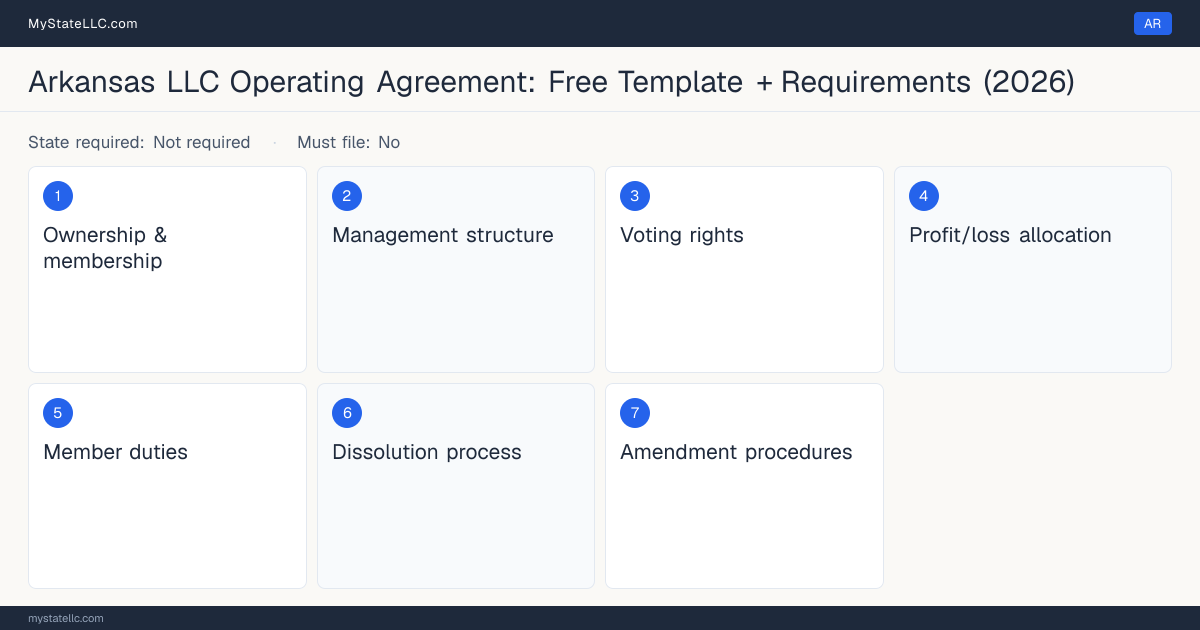
Arkansas does not legally require an LLC operating agreement, but having one protects your limited liability status and sets the rules for ownership and profits. See exactly what to include below.
Edmond Hui is a software engineer and serial entrepreneur based in New York who has founded multiple online businesses across e-commerce, media, and information publishing. Before transitioning into tech, he spent years as a commercial real estate professional closing deals totaling over 100,000 square feet, giving him firsthand experience with business formation and entity structuring. He built MyStateLLC to provide the free, state-specific LLC guidance he wished existed when forming his own companies.
Affiliate disclosure: We may earn a commission at no extra cost to you.
Define each member's ownership percentage and initial contributions. This establishes who owns what portion of the LLC and prevents future disputes over equity.
Management structure
Specify whether your Arkansas LLC is member-managed or manager-managed. This determines who has authority to make decisions and bind the company in contracts.
Voting rights
Outline how decisions are made and what voting thresholds are required for different types of business decisions. Include procedures for major decisions like adding members or selling assets.
Profit/loss allocation
Detail how profits and losses are distributed among members and when distributions occur. This is crucial for tax purposes and member expectations.
Member duties
Define each member's responsibilities, time commitments, and fiduciary duties to the LLC. Include non-compete clauses and confidentiality requirements if applicable.
Dissolution process
Establish procedures for dissolving the LLC, including triggering events, asset distribution, and member buyout provisions. This prevents costly disputes if the business ends.
Amendment procedures
Specify how the operating agreement can be modified in the future. Include voting requirements and documentation procedures for making changes.
Frequently Asked Questions
No, Arkansas law does not require LLCs to have a written operating agreement under Arkansas Code Annotated § 4-32-101 et seq. However, this legal permission to operate without one creates significant practical risk for Arkansas LLC owners.
Without an operating agreement, your LLC automatically defaults to Arkansas's statutory default rules, which may not align with your business structure, profit distribution, or management preferences. More critically, courts view operating agreements as evidence of deliberate LLC formation and member intent—without one, your personal liability protection becomes vulnerable if a creditor argues the LLC was merely an informal partnership.
The Arkansas Secretary of State does not require operating agreement filing, but your formation documents and initial LLC registration still need proper handling. Missing this opportunity to document management structure, capital contributions, and voting rights weakens your legal defensibility during disputes or litigation.
Your next step: Draft or obtain an operating agreement before admitting members or conducting business operations, then maintain signed copies with your LLC records at your Arkansas registered agent's address.
Yes, you can write your own Arkansas LLC operating agreement, and Arkansas does not legally require a written operating agreement—the Arkansas Limited Liability Company Act (Ark. Code Ann. § 4-32-101 et seq.) allows you to operate under default statutory rules if you choose. However, writing your own agreement gives you critical control over member voting rights, profit distribution, management structure, and buyout procedures that Arkansas's default rules may not address favorably for your situation. For single-member LLCs with straightforward operations, a template from the Arkansas Secretary of State's website or reputable legal software can suffice. For multi-member LLCs, partnerships with outside investors, or businesses with non-standard management structures, an Arkansas business attorney can ensure your agreement complies with state law, anticipates dissolution scenarios, and protects your personal liability shield—which costs $500–$1,500 but prevents costly disputes later. Start by downloading the Arkansas Secretary of State's free LLC formation guide, then assess whether your LLC's complexity justifies professional legal review before finalizing and having all members sign the agreement.
No, Arkansas does not require LLC operating agreements to be notarized under Arkansas Code Title 4, Chapter 32. Your operating agreement is legally valid as long as all members sign it. However, notarization is optional and can provide practical benefits: many banks require a notarized copy when opening a business account, and notarization strengthens the agreement's enforceability if disputes arise later. The cost is minimal—typically $5–$15 per signature at an Arkansas notary public. If you plan to use your operating agreement with financial institutions or want additional legal protection, have it notarized by a notary licensed in Arkansas even though it's not mandated. Contact your local bank before finalizing the document to confirm whether they require notarization, then visit your bank's notary, a local courthouse, or a title company to get signatures certified at no additional cost if you're already doing business there.
Without an operating agreement, your Arkansas LLC will automatically be governed by the default provisions in the Arkansas Small Business Entity Tax Pass Through Act (Ark. Code Ann. § 4-32-101 et seq.). These state-mandated default rules typically assume equal ownership stakes, equal voting rights, and proportional profit distribution among all members—even if this doesn't match your actual business arrangement.
This creates significant practical problems. If you have invested substantially more capital than other members or negotiated different roles, you have no documented protection. Disputes over management decisions, profit withdrawals, or member buyouts become costly litigation matters rather than contractual disputes. The state's default provisions also don't address LLC dissolution procedures, member removal processes, or transfer restrictions—leaving you vulnerable to unwanted ownership changes.
Additionally, without a written agreement, you lose flexibility in structuring management (member-managed versus manager-managed), capital contributions, and voting thresholds.
**Next step:** Draft an operating agreement using Arkansas's template requirements, then keep a signed copy with your registered agent and business records. File nothing with the Arkansas Secretary of State—operating agreements remain internal documents.
Yes, you can amend your Arkansas LLC operating agreement at any time after formation, though the process depends on your existing agreement's amendment clause. Most Arkansas operating agreements require either unanimous or majority member consent, as specified in your original document. To amend, draft written amendments detailing the specific changes, obtain signatures from the required members, and retain the signed document with your LLC records. The Arkansas Secretary of State does not require you to file operating agreement amendments, so this remains an internal matter. However, if your amendment affects the information in your Articles of Organization—such as registered agent changes or member names—you must file an amended Articles of Organization with the Secretary of State for a $50 filing fee. Failing to document amendments properly can create disputes if members disagree about operational changes later. Your next step is to review your current operating agreement's amendment procedures section, then prepare written amendments and circulate them for member signatures.