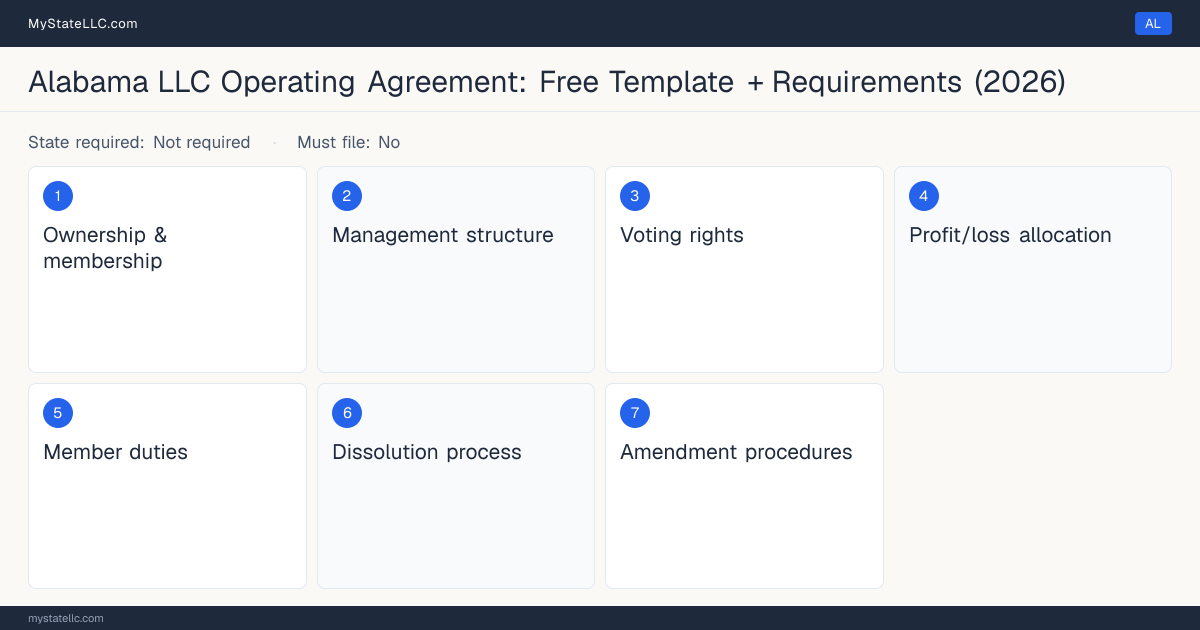
Alabama does not legally require an LLC operating agreement, but having one protects your limited liability status and sets the rules for ownership and profits. See exactly what to include below.
Edmond Hui is a software engineer and serial entrepreneur based in New York who has founded multiple online businesses across e-commerce, media, and information publishing. Before transitioning into tech, he spent years as a commercial real estate professional closing deals totaling over 100,000 square feet, giving him firsthand experience with business formation and entity structuring. He built MyStateLLC to provide the free, state-specific LLC guidance he wished existed when forming his own companies.
Affiliate disclosure: We may earn a commission at no extra cost to you.
Define each member's ownership percentage and initial capital contributions. This section establishes who owns what portion of your Alabama LLC and prevents future disputes over equity.
Management structure
Specify whether your LLC will be member-managed or manager-managed, and outline key responsibilities. Alabama law allows flexibility in how you structure your LLC's day-to-day operations.
Voting rights
Establish how major business decisions will be made and what voting thresholds are required. Clear voting procedures prevent deadlocks and ensure smooth operation of your Alabama LLC.
Profit/loss allocation
Detail how profits and losses will be distributed among members and when distributions occur. This section is crucial for tax planning and member expectations in your Alabama LLC.
Member duties
Outline each member's responsibilities, time commitments, and any restrictions on competing businesses. Setting clear expectations helps maintain professional relationships and protects your LLC's interests.
Dissolution process
Define the circumstances that would trigger LLC dissolution and the process for winding up affairs. Having a clear exit strategy protects all members and ensures orderly business closure if needed.
Amendment procedures
Specify how the operating agreement can be modified and what approval is required for changes. This flexibility allows your Alabama LLC to adapt to changing business needs while maintaining member protection.
Frequently Asked Questions
No, Alabama law does not require LLCs to have a written operating agreement under the Alabama Limited Liability Company Act (Ala. Code § 10-12A-1 et seq.). However, having one is strongly recommended because it protects your limited liability status—courts may pierce the corporate veil if you fail to maintain basic governance structures—and prevents costly disputes among members by clarifying ownership percentages, profit distribution, and voting rights upfront.
Without an operating agreement, your Alabama LLC defaults to state-mandated rules that may not align with your business goals. For example, Alabama law assumes equal ownership and profit-sharing among all members unless documented otherwise, which can create complications if you have unequal capital contributions or different roles.
An operating agreement also demonstrates to lenders and the IRS that your LLC is a legitimate, organized business entity, which may help with financing and tax classification decisions.
Download an Alabama LLC operating agreement template and customize it for your specific member structure, then have all members sign it. Keep the executed agreement in your LLC's records as protection against future governance disputes.
Yes, you can draft your own Alabama LLC operating agreement without legal assistance. Alabama law does not mandate a written operating agreement, and the state does not require you to file it with the Alabama Secretary of State. However, this flexibility comes with critical trade-offs. Without a formal agreement, your LLC defaults to Alabama's statutory provisions under the Alabama Limited Liability Company Act, which may not reflect your specific ownership structure, profit-sharing percentages, or decision-making authority. For single-member LLCs with straightforward operations, a basic self-drafted agreement often suffices. For multi-member LLCs or those with significant assets, complex ownership structures, or planned capital contributions, gaps in your agreement can create costly disputes over voting rights, member withdrawal procedures, or dissolution terms—potentially exposing your personal assets to liability. Alabama courts interpret ambiguous agreements strictly against the drafting party. Consider having an attorney review your agreement for $300–$500, particularly if multiple members are involved, to ensure it complies with Alabama law and protects your liability protection. Start by downloading a state-specific template and identifying your specific operational needs before finalizing any document.
No, Alabama does not require LLC operating agreements to be notarized or witnessed. The agreement is a private contract between members and does not need to be filed with the Alabama Secretary of State's Business Services Division or meet any specific formality requirements under Alabama Code Section 10-2A-102.
However, while notarization is optional, many Alabama LLC owners choose to have their operating agreement notarized anyway for practical reasons. A notarized agreement provides stronger evidence of member signatures and intent, making it more defensible if disputes arise or if you need to prove the agreement's authenticity in court or during loan applications. Banks and lenders often request notarized copies when LLC members apply for business financing.
Your next step is to draft your operating agreement using Alabama-compliant templates, have all members sign it, and decide whether notarization aligns with your business needs and lender requirements. Keep the original signed copy with your LLC records, separate from your Articles of Organization filed with the Secretary of State.
Without an operating agreement, your Alabama LLC will be governed by the default provisions in Alabama Code Title 10, Chapter 12A (the Alabama Limited Liability Company Act). This means the state's standard rules automatically control your business structure, removing your ability to customize profit splits, voting rights, and management authority among members.
Practically, this creates three serious problems for Alabama LLC owners. First, the state defaults to equal profit distribution regardless of capital contributions, which may not reflect your actual investment. Second, all members gain equal management rights and decision-making power unless your operating agreement specifies otherwise—potentially paralyzing operations if members disagree. Third, without documented liability protections outlined in an operating agreement, courts may be more likely to pierce your LLC's liability shield in disputes, exposing your personal assets.
Additionally, lenders and investors typically require proof of an operating agreement before providing financing or capital, so missing this document can block growth opportunities.
File your operating agreement with the Alabama Secretary of State's Business Division as part of your LLC formation, or create one immediately if your LLC already exists. Use Alabama's official LLC formation resources at sos.alabama.gov to access templates and filing requirements.
Yes, Alabama LLC operating agreements can be amended after formation, and the process is straightforward under Alabama's Limited Liability Company Act (Ala. Code § 10-12A-101 et seq.). The amendment procedure should be specified in your original agreement—most commonly requiring either unanimous consent from all members or majority consent, depending on your agreement's language. Any amendments must be documented in writing and retained in your LLC's official records, as the Alabama Secretary of State does not require filing of internal amendments. However, if your amendment changes information in your Articles of Organization (such as the registered agent or principal place of business), you must file an Amendment to Articles of Organization with the Alabama Secretary of State, which costs $25. This distinction is critical: internal governance changes don't require state filing, but structural or agent changes do. Document all amendments with the date, member signatures, and specific language being modified to maintain a clear amendment trail and protect your LLC's liability protection. Contact the Alabama Secretary of State's Business Services Division at (334) 242-5324 to clarify whether your specific amendment requires state filing.