How to Dissolve an LLC in Wisconsin: Complete 2026 Guide
Close your Wisconsin LLC the right way. The state filing fee is $35 on paper, and the Department of Financial Institutions does not publish a standard processing time, so turnaround varies.
By Edmond Hui · Last updated: September 2026
Wisconsin's $35 LLC dissolution filing fee ranks #28 of 50 states from cheapest, tied with 3 other states.
Wisconsin sits in the middle of the national pack on price, so the fee is rarely the reason a closure stalls. What actually decides your timeline is how quickly you settle claims and close tax accounts, not what the state charges to record the filing.
Source: MyStateLLC 50-state dissolution index, verified 2026-08-13
Dissolution at a Glance
| Filing Fee | $35 |
| Form Name | Form 510 - Limited Liability Company Statement of Dissolution or Termination |
| Processing Time | varies |
| Creditor Notice Period | 120 days |
| Tax Clearance Required | No |
| Publication Required | No |
| File Online | SoS Dissolution Page → |
How to Form an LLC: Step-by-Step
- 1
Vote to Dissolve
Start with your operating agreement. If it sets out how the members approve a dissolution, that procedure controls, and you follow it exactly as written. Wisconsin LLCs dissolve voluntarily under the 2023 revised Uniform Limited Liability Company Law at Wis. Stat. ch. 183, subch. VII. If your operating agreement is silent on the vote, the statute supplies the default rule, so read subch. VII or ask a Wisconsin business attorney before assuming a simple majority is enough. Record the outcome in a written consent or set of minutes that names the members who approved, the date of approval, and the effective date of dissolution.
Pro tip: Sign the written consent before you touch anything else. Every later step, from the state filing to closing the bank account, tends to ask for proof that the members actually authorized the closure. - 2
File Form 510, the Statement of Dissolution or Termination, with the Wisconsin Department of Financial Institutions
Wisconsin business filings go to the Department of Financial Institutions (DFI), Division of Corporate and Consumer Services. Unlike most states, Wisconsin does not route LLC filings through a Secretary of State office, so any guide telling you to file with one is describing a different state. Submit Form 510, the Limited Liability Company Statement of Dissolution or Termination, at https://apps.dfi.wi.gov/apps/gofr/Form/Index/48. The standard paper filing fee is $35. The same filing submitted through the DFI online filing system is $20, and if your LLC owes delinquent annual reports the DFI adds $25 for each delinquent year. DFI does not publish a standard processing time, so plan for the turnaround to vary.
Pro tip: Expedited service exists if you have a closing date to hit. DFI charges an extra $100 for next-day handling, $250 for 4-hour in-person service, and $500 for 1-hour in-person service. Those charges sit on top of the filing fee, not in place of it. - 3
Notify Creditors and Settle Debts
Wisconsin gives a dissolved LLC an optional tool for cutting off claims. Under Wis. Stat. 183.0704(2)(c), the company may notify a known claimant in writing and set a deadline for that claimant to submit its claim, and the deadline may not be less than 120 days after the notice is effective. That 120 day figure is the statutory floor for the deadline you set, and nothing more. Separately, Wis. Stat. 183.0705(1) is permissive: a dissolved LLC may publish notice of its dissolution as a class 1 notice under ch. 985, which bars unknown and other claims not commenced within about 2 years after publication. Publication is optional in Wisconsin and is not a condition of dissolving.
Pro tip: Build the creditor list from your bank statements and accounts payable ledger rather than from memory. Landlords, equipment lessors, and the corporate card issuer are the three that owners most often forget. - 4
Close Wisconsin State Tax Accounts
Wisconsin does not require a tax clearance certificate to dissolve an LLC. Neither Form 510 nor the DFI fee schedule imposes a clearance prerequisite, so nobody has to wait on a certificate before filing. You do still owe the tax work. File your final Wisconsin returns with the Wisconsin Department of Revenue, mark them as final, and close every state account the LLC holds, including sales and use tax and employer withholding. Settling those obligations is part of winding up, and leaving an account open invites notices addressed to an entity that no longer trades.
Pro tip: Ask the Department of Revenue for written confirmation that each account is closed and keep it with the dissolution file. An open withholding account can keep generating filing notices long after the last paycheck cleared. - 5
Deactivate Your EIN with the IRS
The IRS cannot cancel an EIN, but it can deactivate it once any outstanding returns are filed and taxes owed are paid. See the FAQ below for the letter and mailing addresses. File the final federal return as well: Form 1065 for a multi-member LLC taxed as a partnership, or a corporate return (Form 1120 or 1120-S) if the LLC elected corporate treatment, each with the final return box checked, or the owner's return for a single-member LLC that never elected corporate treatment.
Pro tip: Send the deactivation letter by certified mail with return receipt. - 6
Distribute Remaining Assets to Members
Distribution comes last, after the debts are paid or adequately provided for. Creditors are satisfied first, then whatever remains goes to the members in the proportions your operating agreement sets, or by ownership percentage if the agreement is silent. Distributing early is the mistake that undoes the liability shield: a member who takes cash out of an LLC that still owes creditors can be asked to give it back. Record every distribution with the date, the amount, the recipient, and the fair market value of anything paid in property rather than cash.
Pro tip: Hold back a reserve for the final tax preparation bill and any claim still inside its deadline. It is far easier to make a small second distribution later than to ask a member to return money already spent. - 7
Confirm Dissolution is Complete
Once DFI has processed the filing, look the LLC up in the DFI business records search and confirm the status shown matches what you filed. Because DFI does not publish a standard processing time, check back rather than assuming the record updated the day you submitted. Keep the filed Form 510 and its receipt, the members written consent, the creditor notices and any responses, the final federal and Wisconsin returns, the EIN deactivation letter with its certified mail receipt, and the schedule of member distributions.
Pro tip: Save the confirmation as a PDF the day you see it. Banks, payment processors, and insurers routinely ask for proof of dissolution months later, and a saved record beats searching the database again.
Winding-Up Checklist
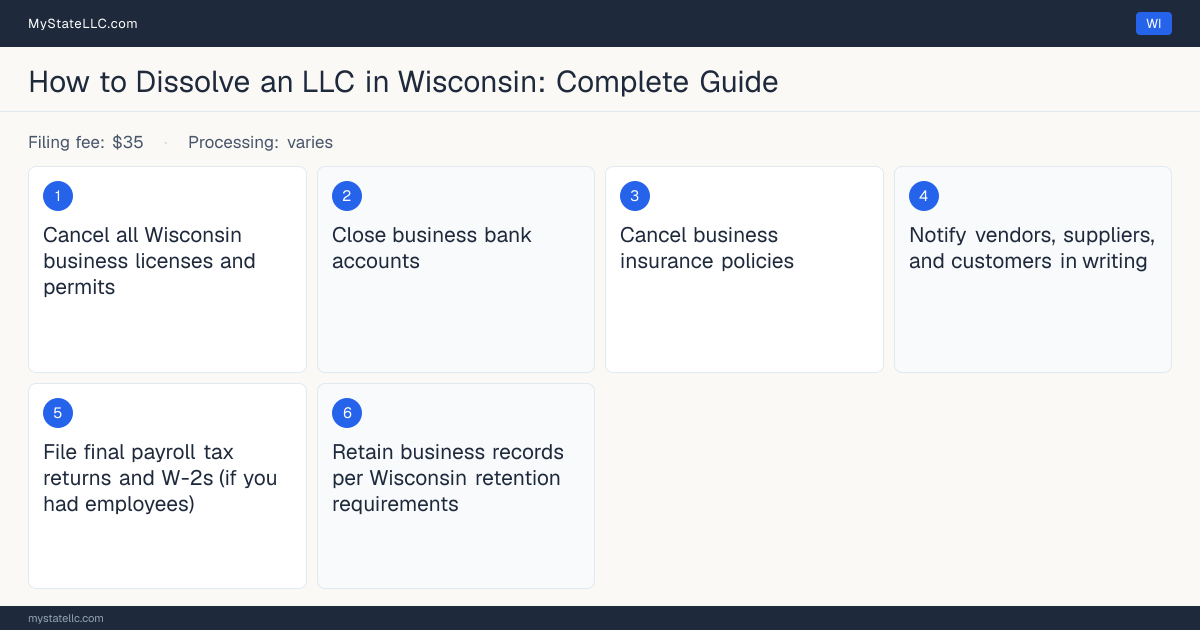
- Cancel all Wisconsin business licenses and permits
Contact each issuing authority, state or municipal, and formally surrender the license rather than letting it lapse. Lapsed permits can still generate renewal invoices and late penalties against a closed business.
- Close business bank accounts
Close the accounts only after the last check clears and the final distributions are made. Ask the bank for closing statements showing a zero balance and keep them with the dissolution records.
- Cancel business insurance policies
Give each carrier the dissolution date in writing and ask about unearned premium refunds. If you carried claims-made coverage, ask what tail coverage would cost before you cancel, since claims can arrive after the doors close.
- Notify vendors, suppliers, and customers in writing
Send a short written notice with your last day of business and the address for final invoices. Written notice also creates the paper trail you want if a vendor later claims it was never told.
- File final payroll tax returns and W-2s (if you had employees)
Issue W-2s, file the final federal and Wisconsin payroll returns, and close the withholding and unemployment insurance accounts. Payroll obligations are the ones most likely to follow the people who ran the business.
- Retain business records per Wisconsin retention requirements
Keep tax returns, financial statements, and the full dissolution file for at least seven years, which covers the usual federal audit exposure. Store them somewhere that survives the office closing, such as encrypted cloud storage.
Frequently Asked Questions
Sources
Each entry below is a document recorded in our verified Wisconsin sources, and each entry says what the document is. Some statutory text is read from an accurate mirror rather than from the state's own host, and those say so.
- dfi.wi.gov/Pages/BusinessServices/BusinessEntities/GeneralInformation.aspxWisconsin Department of Financial Institutions: business entity filings
- apps.dfi.wi.gov/apps/gofr/Form/Index/48Wisconsin Department of Financial Institutions: LLC dissolution
- dfi.wi.gov/Pages/BusinessServices/BusinessEntities/Fees.aspxWisconsin dissolution filing fee
- docs.legis.wisconsin.gov/document/statutes/183.0704Wisconsin creditor notice period
- docs.legis.wisconsin.gov/document/statutes/183.0705Wisconsin publication requirement on dissolution
Formation Services Compared
Forming an LLC in Wisconsin?
See how Northwest Registered Agent, Bizee, ZenBusiness and LegalZoom, the formation services we partner with, compare on 3-year cost, BBB rating and Trustpilot score before you choose.

Edmond Hui · Founder, MyStateLLC
Edmond Hui is a software engineer and serial entrepreneur based in New York who has founded multiple online businesses across e-commerce, media, and information publishing. Before transitioning into tech, he spent years as a commercial real estate professional closing deals totaling over 100,000 square feet, giving him firsthand experience with business formation and entity structuring. He built MyStateLLC to provide the free, state-specific LLC guidance he wished existed when forming his own companies.