How to Dissolve an LLC in North Carolina: Complete 2026 Guide
Close your North Carolina LLC the way the state actually requires. One $30 filing, Form L-07, and a processing time the Secretary of State does not publish, so plan for it to vary.
By Edmond Hui · Last updated: September 2026
North Carolina's $30 LLC dissolution filing fee ranks #25 of 50 states, tied with 2 other states at the same price
That puts North Carolina squarely in the middle of the national range, so the state fee is rarely what decides when an owner closes up. The cost that actually bites is the winding up work you skip, not the filing itself.
Source: MyStateLLC 50-state dissolution index, verified 2026-08-13
Dissolution at a Glance
| Filing Fee | $30 |
| Form Name | Articles of Dissolution of Limited Liability Company (Form L-07) |
| Processing Time | varies |
| Creditor Notice Period | 120 days |
| Tax Clearance Required | No |
| Publication Required | No |
| File Online | SoS Dissolution Page → |
How to Form an LLC: Step-by-Step
- 1
Vote to Dissolve
Dissolution begins as an internal decision, not a state filing. Your operating agreement is the controlling document, so follow whatever approval standard it sets, whether that is a majority of membership interests, a supermajority, or unanimous written consent. If the agreement is silent about dissolution, the safest course is unanimous written consent from every member, because that removes any later argument about who had authority to close the company. Record the decision in a signed written resolution naming the date the members approved dissolution and the effective date you intend to put on the state form. North Carolina does not ask you to file the resolution, but a bank, a landlord, or a buyer of your equipment may well ask to see it.
Pro tip: Settle the effective date before the vote, not after. Form L-07 takes a date-certain effective date, and it is far easier to name that date in the original resolution than to amend a signed resolution later. - 2
File Articles of Dissolution of Limited Liability Company (Form L-07) with the North Carolina Secretary of State
File the Articles of Dissolution of Limited Liability Company (Form L-07, revised 2017) with the North Carolina Secretary of State under N.C.G.S. 57D-6-09. The filing fee is $30, and that amount is printed on the form itself. The form is short by design. It asks for the LLC name, an optional SOSID number, and a date-certain effective date, and nothing else. You can submit it online through the Secretary of State's online services portal, which offers a File L-07 Online option, or send the paper form by mail. The Secretary of State does not publish a standard turnaround for this filing, so the honest answer on timing is that it varies. Start from the closing-business page at https://www.sosnc.gov/divisions/business_registration/closing_nc_business.
Pro tip: Do not pad the submission. Form L-07 does not ask for a tax clearance certificate, a creditor list, or a schedule of assets, and North Carolina does not require any of them to dissolve an LLC. - 3
Notify Creditors and Settle Debts
North Carolina treats creditor notice as optional rather than as a precondition to filing. Under N.C.G.S. 57D-6-10 a dissolved LLC may notify its known claimants in writing, and when it does, the notice sets a deadline of not fewer than 120 days for the claimant to submit a claim. That 120 days is the notice period the statute names. If you reject a claim that comes in, the claimant then has 90 days from receiving the rejection to start a proceeding. Under N.C.G.S. 57D-6-11 a dissolved LLC may also publish notice one time in a newspaper of general circulation in the county of its principal or last registered office, which bars covered claims unless a proceeding begins within five years of publication. Publication is a choice you make to shorten your own exposure. North Carolina does not require it, and you do not need it to dissolve.
Pro tip: Whether or not you send notices, pay or reserve for every known debt before any money moves to members. The notice statutes limit how long claims stay alive. They do not erase the claims. - 4
Close North Carolina State Tax Accounts
File final state returns and close every state tax account the LLC holds. For most small companies that means withholding if you had employees and sales and use tax if you collected it, plus anything industry specific. Mark each final return as final and formally close the account so the state stops expecting periodic filings from a company that no longer exists. One point deserves to be blunt, because it is the most common piece of bad advice about closing a North Carolina LLC. The state does not require a tax clearance certificate to dissolve. No clearance is referenced on Form L-07 or on the Secretary of State's closing-business page. Filing your final returns and paying what you owe is still the right thing to do, and unpaid state tax does not disappear at dissolution, but a clearance letter is not a gate you must pass before the $30 filing will be accepted.
Pro tip: Ask your accountant to confirm which state accounts are actually open under your EIN. Owners are regularly surprised to find a dormant withholding account still marked active years after the last paycheck. - 5
Deactivate Your EIN with the IRS
The IRS cannot cancel an EIN, but it can deactivate it once any outstanding returns are filed and taxes owed are paid. See the FAQ below for the letter and mailing addresses. File the final federal return first or at the same time. A multi-member LLC taxed as a partnership files Form 1065 with the final return box checked and issues final K-1s. An LLC taxed as a corporation files Form 1120 or 1120-S the same way. A single-member LLC with no corporate election reports the final year on the owner's own return.
Pro tip: Mail the deactivation letter certified and keep the receipt. - 6
Distribute Remaining Assets to Members
Distribution comes last. Pay or make provision for the company's debts and obligations first, then distribute what is left to the members. Follow the operating agreement, which usually keys distributions to ownership percentages or to capital account balances. If members are taking property rather than cash, have it valued before the transfer, because the distribution is a taxable event measured at fair market value and each member needs a real number for their return. Document every distribution with a signed receipt showing what the member received, the date, and the value assigned. If a warranty, a contingent claim, or a lease tail is still live, hold back a reserve instead of distributing down to the last dollar.
Pro tip: Distribute in one round once debts are settled, not in trickles while winding up is still in progress. Money that leaves early is the money you end up asking members to hand back. - 7
Confirm Dissolution is Complete
A few days after filing, search the Secretary of State's business entity database and confirm the record reflects the dissolution and the effective date you asked for. Because North Carolina publishes no standard processing time for this filing, the entity search is your status tool rather than a promised date. Then assemble one closing file: the accepted copy of Form L-07, the members' written resolution, proof of any creditor notices you chose to send, final federal and state returns, the EIN deactivation letter with its certified mail receipt, and your asset distribution records. Keep it all together. If a former customer, a taxing agency, or a member raises a question two years from now, that single file is the entire answer.
Pro tip: Download your own copy of the filed document from the entity record rather than bookmarking a state web page. A link is not a record, and state sites get reorganized.
Winding-Up Checklist
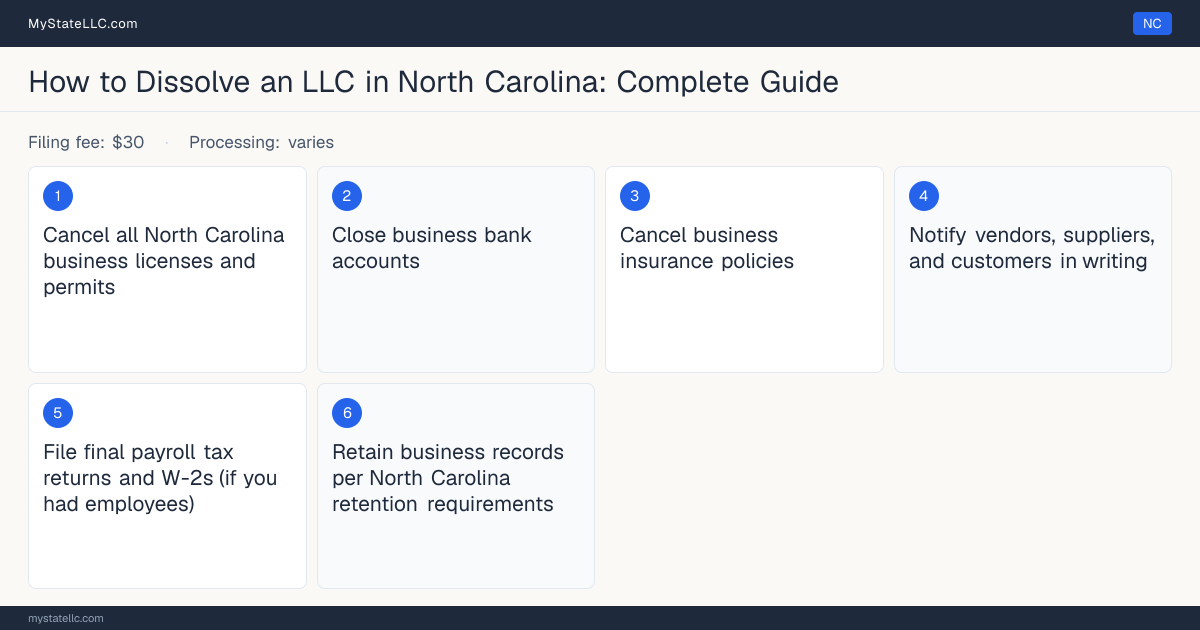
- Cancel all North Carolina business licenses and permits
Work from your own list: city and county privilege or zoning permits, alcohol and food service permits, and any occupational or professional license held in the company name. Cancel each with the agency that issued it, because dissolving with the Secretary of State does not reach those agencies.
- Close business bank accounts
Leave the account open until the last check clears, final tax payments settle, and any merchant processor reserve is released, then close it in writing. Closing early turns a routine refund or chargeback into a problem with no account to receive it.
- Cancel business insurance policies
Cancel general liability, property, auto, and workers compensation coverage effective on or after the day you stop operating, and ask about prorated refunds. For claims-made policies such as professional liability, price tail coverage before you cancel, because claims can arrive long after the doors close.
- Notify vendors, suppliers, and customers in writing
Send short written notice with the closing date, instructions for submitting final invoices, and a contact who will still be reading mail afterward. Written notice creates the record that a vendor was told, which matters when an auto-renewing subscription or standing order surfaces later.
- File final payroll tax returns and W-2s (if you had employees)
File final federal and state payroll returns marked final, deposit the last withholding, and issue W-2s by the normal January deadline for the year the wages were paid. Payroll trust fund taxes are the one category where individuals can be pursued personally, so clear these before anything else.
- Retain business records per North Carolina retention requirements
Keep the filed Form L-07, the dissolution resolution, final returns, creditor correspondence, and distribution records well past the closing date. The data verified for this page does not set a North Carolina retention period for dissolved LLCs, so follow IRS record retention guidance and your accountant's advice rather than a rule of thumb.
Frequently Asked Questions
Sources
Each entry below is a document recorded in our verified North Carolina sources, and each entry says what the document is. Some statutory text is read from an accurate mirror rather than from the state's own host, and those say so.
- sosnc.gov/divisions/business_registrationNorth Carolina Secretary of State: business entity filings
- sosnc.gov/divisions/business_registration/closing_nc_businessNorth Carolina Secretary of State: LLC dissolution
- sosnc.gov/webfiles/documents/forms/Business_Registration/limited_liability_companies/articles_of_dissolution.pdfNorth Carolina dissolution filing fee
- ncleg.gov/EnactedLegislation/Statutes/PDF/BySection/Chapter_57D/GS_57D-6-10.pdfNorth Carolina creditor notice period
- ncleg.gov/EnactedLegislation/Statutes/PDF/BySection/Chapter_57D/GS_57D-6-11.pdfNorth Carolina publication requirement on dissolution
Formation Services Compared
Forming an LLC in North Carolina?
See how Northwest Registered Agent, Bizee, ZenBusiness and LegalZoom, the formation services we partner with, compare on 3-year cost, BBB rating and Trustpilot score before you choose.

Edmond Hui · Founder, MyStateLLC
Edmond Hui is a software engineer and serial entrepreneur based in New York who has founded multiple online businesses across e-commerce, media, and information publishing. Before transitioning into tech, he spent years as a commercial real estate professional closing deals totaling over 100,000 square feet, giving him firsthand experience with business formation and entity structuring. He built MyStateLLC to provide the free, state-specific LLC guidance he wished existed when forming his own companies.