How to Dissolve an LLC in New Jersey: Complete 2026 Guide
Close your New Jersey LLC through the state's online Close a Business service. The filing fee is $125 and processing is typically 1 business day.
By Edmond Hui · Last updated: September 2026
At $125, New Jersey's LLC dissolution filing fee ranks 49th cheapest of the 50 states, and no other state charges exactly the same amount.
Only one state charges more to close an LLC, which makes New Jersey an outlier at the expensive end rather than a typical case. The offsetting fact is speed and simplicity: the filing is online, it is usually processed within a business day, and no tax clearance certificate stands in front of it.
Source: MyStateLLC 50-state dissolution index, verified 2026-08-13
Dissolution at a Glance
| Filing Fee | $125 |
| Form Name | Certificate of Dissolution / Termination (filed online with DORES as a Dissolve or Dissolve and Terminate transaction) |
| Processing Time | 1 business day |
| Creditor Notice Period | 120 days |
| Tax Clearance Required | No |
| Publication Required | No |
| File Online | SoS Dissolution Page → |
How to Form an LLC: Step-by-Step
- 1
Vote to Dissolve
Start with the operating agreement. A New Jersey LLC dissolves according to whatever procedure the members wrote for themselves, so check the agreement for the required vote, the notice members owe each other, and any conditions that have to be met first. If the agreement is silent, the safest course is written consent signed by every member, since unanimous consent removes any later argument about whether the vote was valid. Capture the decision in a dated written resolution naming the company, recording the members' approval, and stating the effective date of dissolution. Fix that date deliberately. Under N.J.S.A. 42:2C-49 a dissolved LLC has to wind up its activities, discharge its debts, settle its affairs and distribute its assets, and the statute requires only that this happen within a reasonable time rather than by a fixed number of days. A clear effective date is what makes reasonable measurable.
Pro tip: Sign the resolution before any company money moves. If a creditor surfaces later, the first thing they compare is the date members were paid against the date the company resolved to dissolve. - 2
File the Certificate of Dissolution / Termination with the New Jersey Division of Revenue and Enterprise Services
New Jersey has no Secretary of State for business filings. LLC dissolution is handled by the Division of Revenue and Enterprise Services, known as DORES, which sits within the Department of the Treasury. You file the dissolution online as a Dissolve or a Dissolve and Terminate transaction through the Annual Reports and Change Services portal, reachable at https://www.njportal.com/DOR/AnnualReports/Business?sessionType=Close. The state filing fee is $125, plus a small credit-card or e-check service fee charged by the payment processor. Submissions are typically processed within 1 business day. One prerequisite decides whether the filing goes through at all: the LLC must be current on its annual reports and in good standing before it can file to close. If reports are outstanding, bring them up to date first. No tax clearance certificate is required for a standard voluntary LLC dissolution filed while the company is in good standing, so nothing has to be obtained from another agency before you submit.
Pro tip: Check your annual report status in the portal before you start the dissolution session. Filing the missing reports first is a shorter path than having a $125 dissolution rejected and re-entered. - 3
Notify Creditors and Settle Debts
New Jersey attaches a specific number to known creditors. Under N.J.S.A. 42:2C-50, a known creditor who is given direct written notice must be allowed at least 120 days from receipt to submit a claim, and a claim not submitted within that window is barred. If you reject a claim in writing, the creditor then has 90 days to sue on it. So write to every creditor you know of, state the amount you believe is owed, say where to send a claim, and give the deadline the statute requires. On unknown creditors, be clear about what New Jersey actually asks for: publishing a newspaper notice is optional under N.J.S.A. 42:2C-51, phrased as something the LLC may do rather than must. If published, it bars claims from unknown and unnoticed claimants who do not sue within five years of publication. Nothing requires you to buy it, and the state sets no fee schedule for it. Pay or reserve for every known balance before members receive anything.
Pro tip: Send known-creditor notices by a method that records delivery, and calendar the 120 days from receipt rather than from mailing. The statute measures the window from when the creditor got it. - 4
Close New Jersey State Tax Accounts
File your final New Jersey returns and close each state tax account the LLC actually holds with the Division of Taxation. Depending on what the business did, that can include sales and use tax, employer withholding, and the LLC's own filing obligations. Mark the returns final rather than simply stopping, because an open account keeps generating filing duties and late penalties long after the business has gone quiet. Now the point that causes the most confusion in New Jersey: a tax clearance certificate is not a prerequisite for a standard voluntary LLC dissolution filed while the company is in good standing. The clearance track people read about belongs to for-profit corporations ending business, which is a separate procedure from the LLC Dissolve and Terminate filing. The one LLC situation where clearance becomes mandatory is narrow, and it is described in the reinstatement question below. Filing final returns and closing accounts is still correct and still protects you from later assessments. It is simply not a gate on the dissolution filing.
Pro tip: Close the tax accounts in the same week you file the dissolution. Wait, and the next filing period opens, leaving you to file a zero return for a company that no longer exists. - 5
Deactivate Your EIN with the IRS
The IRS cannot cancel an EIN, but it can deactivate it once any outstanding returns are filed and taxes owed are paid. See the FAQ below for the letter and mailing addresses. File the final federal returns before the deactivation letter goes out. A multi-member LLC taxed as a partnership files a final Form 1065 with the final return box checked and issues final Schedules K-1; an LLC taxed as a corporation files Form 1120 or 1120-S, also with the final return box checked; a single-member LLC that never elected corporate treatment reports the activity on the owner's return. If the company had employees, the final employment tax returns come first.
Pro tip: Keep the deactivation letter and proof of mailing. - 6
Distribute Remaining Assets to Members
Members are paid last. N.J.S.A. 42:2C-49 frames the wind-up as discharging debts, settling affairs and then distributing assets, in that order, so creditor claims come off the top and what remains goes to members according to the operating agreement. If the agreement sets percentages or a liquidation waterfall, that document controls the split. Where a known creditor's 120-day window is still running, hold a reserve rather than distributing against a guess, because a claim that arrives after the cash is gone becomes a problem for the people who received it. Record every distribution with the date, the amount, the recipient and the ownership percentage it reflects. Property counts as much as cash: transferring a vehicle, equipment or a domain name to a member is a distribution and needs the same paperwork.
Pro tip: Have each member sign a short receipt confirming what they received and that it was a liquidating distribution. It is the cheapest possible insurance against a disagreement two years later. - 7
Confirm Dissolution is Complete
Once the Division of Revenue and Enterprise Services processes the filing, confirm it rather than assuming. The online portal returns confirmation for the transaction; download it and store it somewhere other than the filing account, and check the company's status in the state's business records so you can see the change reflected there. Then keep one package together: the members' dissolution resolution, the filed Certificate of Dissolution or Termination confirmation, written creditor notices and any claim responses, the final federal and New Jersey returns, the EIN deactivation letter, and the member distribution receipts. Retain it for at least seven years. A rejected creditor has 90 days to sue, unknown claims can surface for years where no notice was published, and that file is what answers them without anyone paying an old invoice twice.
Pro tip: Save the portal confirmation as a PDF before you close the business bank account. Banks routinely ask for proof of dissolution, and pulling it later is slower than saving it now.
Winding-Up Checklist
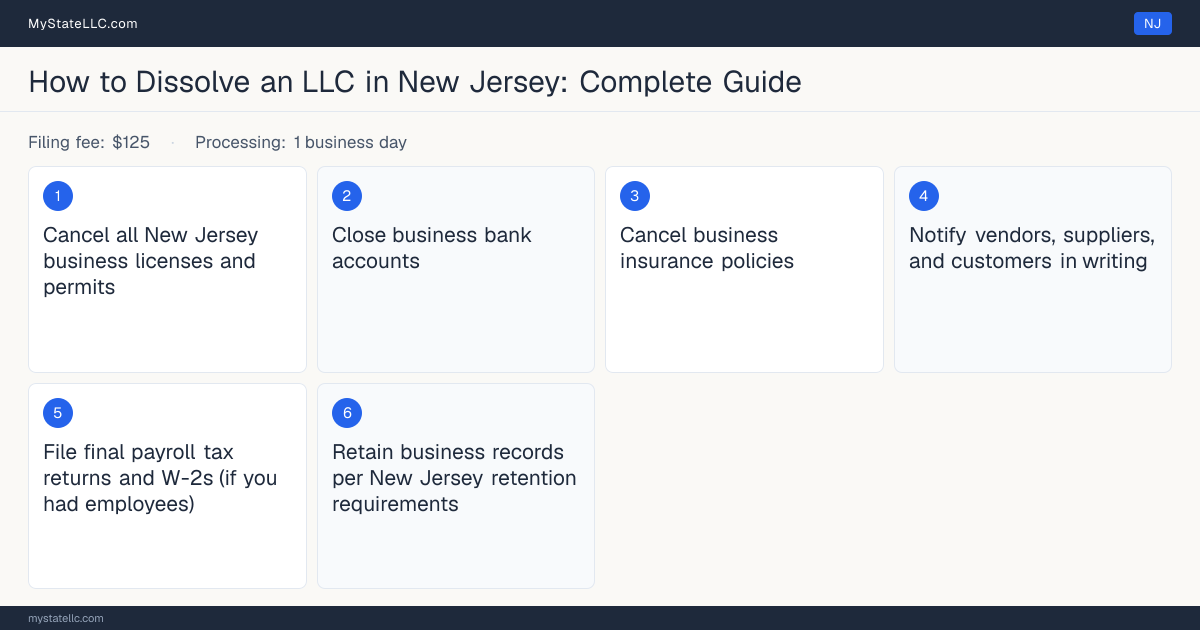
- Cancel all New Jersey business licenses and permits
Cancel every state, municipal and industry license or permit the LLC held, with the body that issued each one. Licenses renew on their own schedules, so one left open keeps billing after the company has closed.
- Close business bank accounts
Close accounts only after creditors are paid and the final distributions have cleared. Download the full statement history first and get written confirmation of closure, because access usually ends the day the account does.
- Cancel business insurance policies
Notify each carrier in writing with the dissolution date and ask about refunds of unearned premium. For professional liability, ask specifically whether tail coverage is worth buying, since claims can arrive after the policy period ends.
- Notify vendors, suppliers, and customers in writing
Send dated written notice stating that the company is dissolving, where to send a final invoice, and by when. For anyone who is also a known creditor, use one letter that satisfies the statutory notice rather than two that say different things.
- File final payroll tax returns and W-2s (if you had employees)
File the final federal employment tax returns, issue W-2s to every employee, and close the LLC's New Jersey employer withholding and unemployment accounts. An open payroll account keeps generating filing obligations even at zero wages.
- Retain business records per New Jersey retention requirements
Keep the dissolution resolution, portal confirmation, creditor notices, tax returns and distribution records for at least seven years. A rejected creditor has 90 days to sue and unnoticed claims can arrive later, so the file has to outlast the company.
Frequently Asked Questions
Sources
Each entry below is a document recorded in our verified New Jersey sources, and each entry says what the document is. Some statutory text is read from an accurate mirror rather than from the state's own host, and those say so. Where we hold the citation but no stable public link, the citation is printed on its own rather than pointed at a guessed address.
- nj.gov/treasury/revenue/New Jersey Division of Revenue and Enterprise Services: business entity filings
- njportal.com/DOR/AnnualReports/Business?sessionType=CloseNew Jersey Division of Revenue and Enterprise Services: LLC dissolution
- njportal.com/DOR/AnnualReports/Home/FAQNew Jersey dissolution filing fee
- nj.gov/treasury/revenue/business-end.shtmlNew Jersey Articles of Dissolution form
- New Jersey creditor notice period: N.J.S.A. 42:2C-50 (Known claims against dissolved limited liability company)
- New Jersey winding up period: N.J.S.A. 42:2C-49 (Winding up)
- New Jersey publication requirement on dissolution: N.J.S.A. 42:2C-51 (Other claims against dissolved limited liability company)
Formation Services Compared
Forming an LLC in New Jersey?
See how Northwest Registered Agent, Bizee, ZenBusiness and LegalZoom, the formation services we partner with, compare on 3-year cost, BBB rating and Trustpilot score before you choose.

Edmond Hui · Founder, MyStateLLC
Edmond Hui is a software engineer and serial entrepreneur based in New York who has founded multiple online businesses across e-commerce, media, and information publishing. Before transitioning into tech, he spent years as a commercial real estate professional closing deals totaling over 100,000 square feet, giving him firsthand experience with business formation and entity structuring. He built MyStateLLC to provide the free, state-specific LLC guidance he wished existed when forming his own companies.