How to Dissolve an LLC in Connecticut: Complete 2026 Guide
Connecticut charges no filing fee at all to dissolve an LLC, and standard processing time varies rather than being published as a fixed number of days. This guide covers the vote, the $0 filing, creditor notice, and closing your state tax accounts.
By Edmond Hui · Last updated: September 2026
Connecticut's $0 LLC dissolution filing fee ranks #1 of 50 cheapest, tied with 7 other states
A free filing means the state fee is simply not a factor in deciding when to close a Connecticut LLC. The cost that matters is the one you keep paying by leaving the entity open, because an LLC that stops filing its annual report drifts toward administrative dissolution by forfeiture instead of a clean exit on your own terms.
Source: MyStateLLC 50-state dissolution index, verified 2026-08-13
Dissolution at a Glance
| Filing Fee | $0 |
| Form Name | Certificate of Dissolution - Limited Liability Company - Domestic (Form BUS-035) |
| Processing Time | varies |
| Creditor Notice Period | 120 days minimum claims period (optional) |
| Tax Clearance Required | No |
| Publication Required | No |
| File Online | SoS Dissolution Page → |
How to Form an LLC: Step-by-Step
- 1
Vote to Dissolve
Authorize the dissolution the way your operating agreement requires. Connecticut operating agreements usually name who may approve a wind-up and what share of the members has to agree, and following that language exactly is what keeps the decision from being reopened later. If your agreement says nothing about dissolution, get a written consent signed by every member rather than relying on a conversation. Write down the date dissolution was authorized, who participated, and how each member voted. A single-member LLC still needs a dated written resolution, because that document is what a bank, a landlord, or the IRS will ask for when you tell them the business has closed.
Pro tip: Fix the effective dissolution date in the resolution before you file. Final returns, creditor notices, and insurance cancellations all key off that date, and changing it afterward means redoing the paperwork. - 2
File Certificate of Dissolution - Limited Liability Company - Domestic (Form BUS-035) with the Connecticut Secretary of the State
Domestic LLCs use the Certificate of Dissolution, Form BUS-035, filed with the Connecticut Secretary of the State. The filing fee is $0, so there is nothing to pay to close the entity. File it online through business.ct.gov, where the OneStop system selects the right filing for you automatically, using dissolution for a domestic LLC and cancellation or withdrawal for other entity types. Standard processing time varies rather than being published as a fixed number of days, so treat the confirmation you receive from the system as your milestone rather than a promised turnaround. Expedited handling is available online for an added fee if you have a deadline that depends on the record being updated. Step-by-step guidance is at https://business.ct.gov/knowledge-base/articles/business-dissolution---llc.
Pro tip: Confirm the entity is a domestic Connecticut LLC before you start. A foreign LLC registered in Connecticut goes through cancellation or withdrawal instead, and OneStop routes on entity type, so starting from the wrong record wastes the trip. - 3
Notify Creditors and Settle Debts
Giving notice to creditors is optional in Connecticut, but it is the step that actually protects the members. Under CGS Sec. 34-267c, a dissolved LLC may notify known claimants in writing and set a claim deadline, and that deadline must be at least 120 days after the claimant receives the notice. The 120 days is a minimum claims window you give creditors, not a wait before you can file, so it does not delay the dissolution filing at all. If you reject a claim that arrived on time, the claimant then has 90 days after receiving the rejection notice to bring suit. Build the creditor list first: lenders, landlords, suppliers, contractors, utilities, and anyone holding a guarantee from a member. Send notices in a way you can prove was received, and pay valid claims before members take anything.
Pro tip: State the claim deadline as a calendar date and count it from receipt, not from the day you mailed it. The statutory clock runs from when the claimant receives the notice. - 4
Close Connecticut State Tax Accounts
Connecticut does not require a tax clearance certificate to dissolve an LLC, and the Secretary of the State will not ask for one before accepting the filing. The tax obligations themselves remain. Settle what the LLC owes on sales and use tax, withholding, and unemployment, file the final returns, and close each account with the Connecticut Department of Revenue Services (DRS) as part of winding up. Mark the returns final so DRS knows to stop expecting them, and close accounts one at a time with written confirmation for each. An account left open keeps generating filing obligations and notices for an entity that no longer operates, which is how owners end up with penalties on a business they closed years earlier.
Pro tip: List every Connecticut tax registration the LLC ever opened, including seldom-used ones like an occasional sales tax permit, then close them individually. Dormant registrations are the ones people forget. - 5
Deactivate Your EIN with the IRS
The IRS cannot cancel an EIN, but it can deactivate it once any outstanding returns are filed and taxes owed are paid. See the FAQ below for the letter and mailing addresses. File the final federal return first: Form 1065 for an LLC taxed as a partnership, Form 1120-S if you elected S corporation treatment or Form 1120 if you elected C corporation treatment, each with the final return box checked, or the owner's return (Schedule C for most business activity) for a disregarded single-member LLC. An LLC that elected corporate treatment also files Form 966. Send the deactivation letter by certified mail so you can prove the date it went out.
Pro tip: Do not send the deactivation letter while a federal return is still outstanding. - 6
Distribute Remaining Assets to Members
Creditors are paid before members, without exception. Discharge or make provision for every debt and obligation of the LLC first, including claims still in dispute and bills that have not arrived yet, such as the accountant's fee for the final return or a final utility invoice. Whatever remains after that is what the members divide, and the split follows your operating agreement. If the agreement does not address it, get the members to agree in writing on the allocation before any money moves. When you distribute property rather than cash, document a value for it, because each member will report the transaction on a personal return and a number invented later will not hold up.
Pro tip: Have each member sign a dated receipt describing exactly what they received. Once the LLC is dissolved there is no entity left to arbitrate a disagreement about who got what. - 7
Confirm Dissolution is Complete
Look up the LLC in the business records on business.ct.gov and confirm the Certificate of Dissolution appears with the date you expect. Because standard processing time varies, check back rather than assuming the record updated the same day, and keep the submission confirmation from the OneStop system until the filing shows on the public record. Then assemble one file and keep it together: the authorizing resolution, the filed Certificate of Dissolution and its confirmation, creditor notices with proof of receipt, final federal and Connecticut returns, the DRS account closure confirmations, the IRS closure letter, and the member distribution receipts.
Pro tip: Save the dissolution file somewhere that outlasts the company email account and the business bank login. Former members routinely need these documents for personal tax questions years later.
Winding-Up Checklist
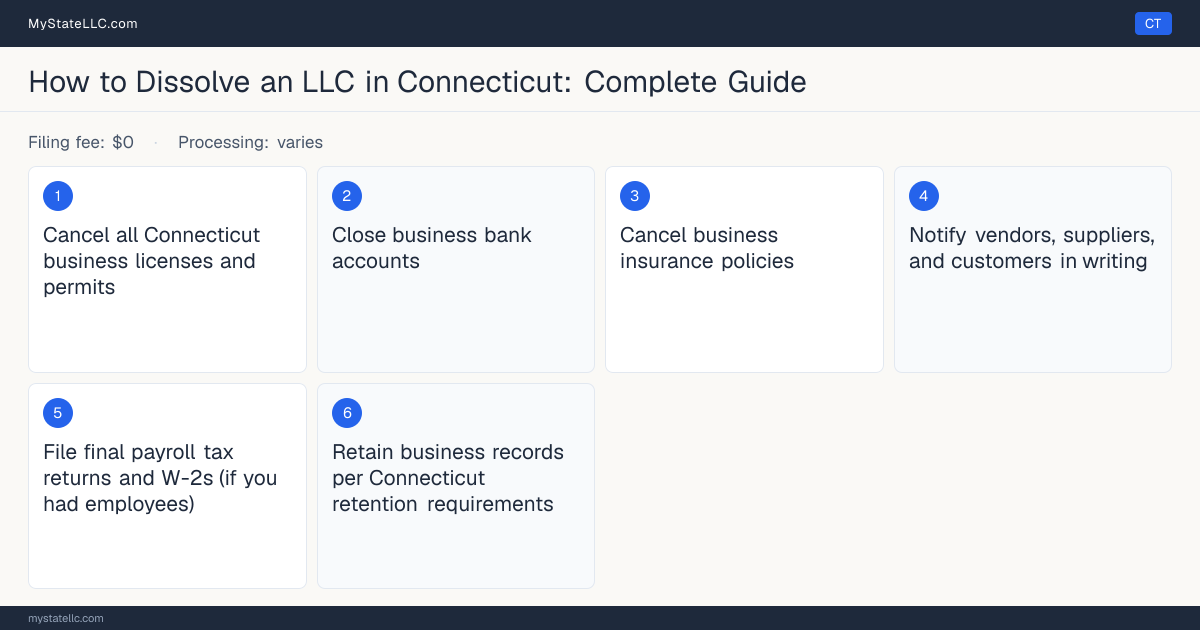
- Cancel all Connecticut business licenses and permits
Licenses and permits are issued by individual state agencies and by the town or city, so cancel with each issuer rather than assuming the dissolution filing reaches them. Professional and regulated licenses often renew automatically and keep billing until you cancel them.
- Close business bank accounts
Close the accounts only after every outstanding check has cleared and the final distributions to members are done. Ask the bank for written confirmation of the closing date, and close business credit lines and cards at the same time.
- Cancel business insurance policies
Give your general liability, property, auto, and workers' compensation carriers the operating end date so coverage stops cleanly. Ask about a refund of unearned premium, and about tail coverage if any policy is written on a claims-made basis.
- Notify vendors, suppliers, and customers in writing
Send a short dated notice with the closing date, how to submit any final invoice, and an address for correspondence afterward. Cancel recurring subscriptions and auto-renewing service contracts in writing rather than letting a card lapse.
- File final payroll tax returns and W-2s (if you had employees)
File the final Form 941 with the final-return box checked, issue W-2s and file Form W-3, and close the Connecticut withholding and unemployment accounts. Payroll registrations generate notices long after the last paycheck if they are left open.
- Retain business records per Connecticut retention requirements
Keep tax returns and their supporting records for at least 7 years, and hold the formation documents, operating agreement, and dissolution file indefinitely. Employment records carry federal retention periods that outlive the LLC itself.
Frequently Asked Questions
Sources
Each entry below is a document recorded in our verified Connecticut sources, and each entry says what the document is. Some statutory text is read from an accurate mirror rather than from the state's own host, and those say so.
- business.ct.gov/business-servicesConnecticut Secretary of State: business entity filings
- business.ct.gov/knowledge-base/articles/business-dissolution---llcConnecticut Secretary of State: LLC dissolution
- business.ct.gov/knowledge-base/articles/domestic-limited-liability-companies-forms-and-feesConnecticut dissolution filing fee
- business.ct.gov/-/media/BusinessOneStop/BSD_Forms/BUS-035-CERTIFICATE-OF-DISSOLUTION_LLC_Domestic-20211210.pdfConnecticut Articles of Dissolution form
- cga.ct.gov/current/pub/chap_613a.htmConnecticut creditor notice period
Formation Services Compared
Forming an LLC in Connecticut?
See how Northwest Registered Agent, Bizee, ZenBusiness and LegalZoom, the formation services we partner with, compare on 3-year cost, BBB rating and Trustpilot score before you choose.

Edmond Hui · Founder, MyStateLLC
Edmond Hui is a software engineer and serial entrepreneur based in New York who has founded multiple online businesses across e-commerce, media, and information publishing. Before transitioning into tech, he spent years as a commercial real estate professional closing deals totaling over 100,000 square feet, giving him firsthand experience with business formation and entity structuring. He built MyStateLLC to provide the free, state-specific LLC guidance he wished existed when forming his own companies.