How to Dissolve an LLC in Colorado: Complete 2026 Guide
Colorado charges a $10 filing fee for the Statement of Dissolution, and the filing is processed in about 1 business day. This guide walks through the vote, the filing, creditor notice, and closing your tax accounts.
By Edmond Hui · Last updated: September 2026
Colorado's $10 LLC dissolution filing fee ranks #11 of 50 cheapest, tied with 3 other states
The state fee is one of the smaller line items in closing a Colorado LLC. What the ranking does not show is that Colorado takes the filing only online, so the paperwork side of dissolution can be finished in a single sitting while the tax and creditor work runs on its own schedule.
Source: MyStateLLC 50-state dissolution index, verified 2026-08-13
Dissolution at a Glance
| Filing Fee | $10 |
| Form Name | Statement of Dissolution (Limited Liability Company) |
| Processing Time | 1 business day |
| Creditor Notice Period | 730 days |
| Tax Clearance Required | No |
| Publication Required | No |
| File Online | SoS Dissolution Page → |
How to Form an LLC: Step-by-Step
- 1
Vote to Dissolve
Start with the authorization your operating agreement calls for. Most Colorado operating agreements name the members or managers who can approve a dissolution and the vote share required, and following that language exactly is what makes the rest of the process defensible. If your agreement is silent, the safe course is a written consent signed by every member rather than an informal conversation. Record the decision the same day it is made: the date dissolution was authorized, who voted, and how each member voted. A single-member LLC still needs a dated written resolution, because the record is what a bank, a buyer of your assets, or the IRS will ask to see later.
Pro tip: Set the effective dissolution date in the resolution before you file anything. Every later step, from final tax returns to creditor notices, is dated from that decision. - 2
File Statement of Dissolution (Limited Liability Company) with the Colorado Secretary of State
Colorado accepts the Statement of Dissolution (Limited Liability Company) only through the Colorado Secretary of State website at coloradosos.gov. There is no paper option for this filing, so there is nothing to print, sign, and mail. The fee is $10, which is the online fee and the only fee. Filings submitted through the site are processed in real time, so the record is updated in about 1 business day and the filing is complete once the Confirmation page appears. Save or print that page immediately. If your LLC is delinquent for failure to file its Periodic Report, you can still file the Statement of Dissolution when the delinquency is under roughly 3 years; once it has run 3 years or more, the correct filing is the Statement of Dissolution of Delinquent Entity, which also costs $10. Filing instructions are at https://www.sos.state.co.us/pubs/business/helpFiles/DISS_LLC_HELP.html.
Pro tip: Ignore any advice about paying for expedited handling. The $150 expedite charge applies only to paper filings, and this filing has no paper path, so paying it buys you nothing. - 3
Notify Creditors and Settle Debts
Colorado gives a dissolved LLC a way to cut off known claims. Under CRS 7-90-911, a dissolved domestic entity may deliver written notice to a known claimant stating a deadline by which the claim must be received, and that deadline must be at least 730 days, or two years, after the notice is delivered. That is the notice period the statute names. Build your creditor list before you send anything: lenders, landlords, suppliers, contractors, utilities, equipment lessors, and anyone holding a personal guarantee from a member. Send each notice in a way you can prove was delivered, keep the delivery receipts with the dissolution file, and pay or settle every valid claim before any money reaches the members.
Pro tip: Write the deadline into the notice as an actual calendar date rather than a number of days. A recipient who has to do the arithmetic is a recipient who can later argue about what the notice said. - 4
Close Colorado State Tax Accounts
No tax clearance certificate is required to dissolve a Colorado LLC, and no agency has to sign off before the Secretary of State will take your filing. That does not make the tax work optional. File your final federal and Colorado returns separately with the Colorado Department of Revenue, mark them final, and close each account your LLC actually held, such as sales tax, wage withholding, and any industry-specific account. The Secretary of State database does not communicate with the tax agency or any other agency, so a dissolved status in the business record tells the Department of Revenue nothing. Every account you leave open keeps generating filing obligations for an entity that no longer trades.
Pro tip: Make a list of every Colorado tax account number the LLC ever opened and close them one at a time, confirming each closure in writing. A forgotten sales tax account is the most common source of notices arriving years after dissolution. - 5
Deactivate Your EIN with the IRS
The IRS cannot cancel an EIN, but it can deactivate it once any outstanding returns are filed and taxes owed are paid. See the FAQ below for the letter and mailing addresses. Send the deactivation letter only after your final federal return is filed: Form 1065 for an LLC taxed as a partnership, Form 1120-S for an S corporation election or Form 1120 for a C corporation election, each marked as the final return, or the owner's return (Schedule C for most business activity) for a disregarded single-member LLC. An LLC that elected corporate treatment also files Form 966. Send the letter by certified mail so you have proof of the date.
Pro tip: File the final return before you send the deactivation letter. - 6
Distribute Remaining Assets to Members
Creditors come first, members come last. Pay or make provision for every debt and obligation of the LLC before a single distribution goes out, including amounts still in dispute and liabilities that have not yet been billed, such as a final utility invoice or an accountant's fee for the closing return. Only what remains after that is available to the members, and it is divided the way your operating agreement says it should be. If the agreement is silent, the members need to agree in writing on the split before money moves. Distributions of property rather than cash need a documented value, because each member will report the transaction on a personal return.
Pro tip: Have each member sign a short receipt describing exactly what they received and the date. It costs nothing now and settles any argument that surfaces after the LLC no longer exists to be sued. - 7
Confirm Dissolution is Complete
Check the business record on the Colorado Secretary of State website and confirm the Statement of Dissolution appears in the filing history with the date you expect. Because Colorado processes these filings in real time, the record should reflect the change as soon as the Confirmation page appears. Dissolution records stay in the public record permanently, so the history is retrievable years later. A Certificate of Good Standing from the Secretary of State is free if you want one for a bank or a counterparty, though it is not required to dissolve. Keep the Confirmation page, the authorizing resolution, creditor notices and delivery proof, final federal and Colorado returns, the IRS closure letter, and the member distribution receipts together in one file.
Pro tip: Store the dissolution file somewhere that outlives the business email account. Former members often need these records for personal tax questions long after the LLC's mailbox is gone.
Winding-Up Checklist
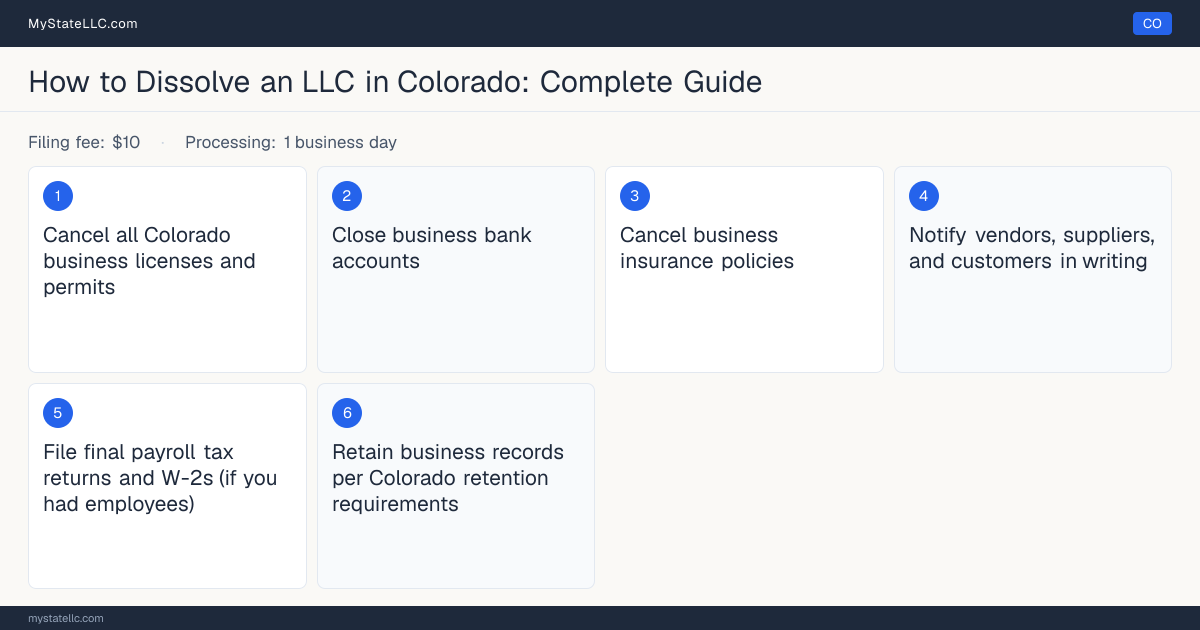
- Cancel all Colorado business licenses and permits
Colorado licensing runs through the state agency or the city and county that issued each one, so cancel with each issuer directly rather than assuming dissolution ends them. Professional and regulated licenses often renew automatically and keep billing until you cancel.
- Close business bank accounts
Wait until every outstanding check has cleared and the final member distributions are done, then close the accounts and any business credit lines. Ask the bank for written confirmation of the closing date and balance.
- Cancel business insurance policies
Tell your general liability, property, auto, and workers' compensation carriers the operating end date so coverage stops cleanly. Ask about unearned premium refunds, and about tail coverage if your policy is claims-made.
- Notify vendors, suppliers, and customers in writing
Send a short dated notice giving the closing date, how final invoices should be submitted, and where to send correspondence afterward. Cancel recurring subscriptions and auto-renewing contracts in writing, not by letting the card expire.
- File final payroll tax returns and W-2s (if you had employees)
File the final Form 941 with the final-return box checked, issue W-2s and file Form W-3, and close your Colorado wage withholding and unemployment insurance accounts. Payroll accounts keep generating notices long after the last paycheck if they are left open.
- Retain business records per Colorado retention requirements
Keep tax returns and supporting records for at least 7 years, and hold formation documents, the operating agreement, and the dissolution file indefinitely. Employment records carry their own federal retention periods that survive the LLC.
Frequently Asked Questions
Sources
Each entry below is a document recorded in our verified Colorado sources, and each entry says what the document is. Some statutory text is read from an accurate mirror rather than from the state's own host, and those say so.
- coloradosos.gov/pubs/business/businessHome.htmlColorado Secretary of State: business entity filings
- sos.state.co.us/pubs/business/helpFiles/DISS_LLC_HELP.htmlColorado Secretary of State: LLC dissolution
- sos.state.co.us/pubs/info_center/fees/business.htmlColorado dissolution filing fee
- sos.state.co.us/pubs/business/FAQs/dissolve.htmlColorado filing processing times
- codes.findlaw.com/co/title-7-corporations-and-associations/co-rev-st-sect-7-90-911Colorado creditor notice period
Formation Services Compared
Forming an LLC in Colorado?
See how Northwest Registered Agent, Bizee, ZenBusiness and LegalZoom, the formation services we partner with, compare on 3-year cost, BBB rating and Trustpilot score before you choose.

Edmond Hui · Founder, MyStateLLC
Edmond Hui is a software engineer and serial entrepreneur based in New York who has founded multiple online businesses across e-commerce, media, and information publishing. Before transitioning into tech, he spent years as a commercial real estate professional closing deals totaling over 100,000 square feet, giving him firsthand experience with business formation and entity structuring. He built MyStateLLC to provide the free, state-specific LLC guidance he wished existed when forming his own companies.