How to Dissolve an LLC in California: Complete 2026 Guide
California charges a $0 filing fee to dissolve and cancel an LLC. The state publishes no turnaround in business days, only the date of the filings it is working through now.
By Edmond Hui · Last updated: September 2026
California's $0 LLC dissolution filing fee ranks #1 of 50 states from cheapest to most expensive, tied with 7 other states.
California charges nothing at the counter to close an LLC, which puts it at the top of the table alongside a handful of other states. The real cost here is not the form but the calendar, because the annual minimum franchise tax keeps accruing until the cancellation is actually filed.
Source: MyStateLLC 50-state dissolution index, verified 2026-08-13
Dissolution at a Glance
| Filing Fee | $0 |
| Form Name | Certificate of Cancellation (Form LLC-4/7); Certificate of Dissolution (Form LLC-3) also required unless dissolution was by unanimous member vote |
| Processing Time | varies |
| Creditor Notice Period | None set by statute |
| Tax Clearance Required | No |
| Publication Required | No |
| File Online | SoS Dissolution Page → |
How to Form an LLC: Step-by-Step
- 1
Vote to Dissolve
Read the dissolution clause in your operating agreement first, because it controls. It normally sets the percentage of membership interests or the number of members needed to approve winding up, and it may require notice of the meeting or a particular form of written consent. In California the size of the majority does more than settle the vote: it decides how many forms you file. A dissolution approved by all of the members lets you skip the Certificate of Dissolution entirely, provided you state that fact on the Certificate of Cancellation. Anything short of unanimous means both forms. Record the vote and the tally in a signed resolution.
Pro tip: If unanimity is realistically available, get it in writing. It removes an entire filing from your list, and the only thing you have to do differently is note on the cancellation form that every member voted to dissolve. - 2
File the Certificate of Dissolution (Form LLC-3) and Certificate of Cancellation (Form LLC-4/7) with the California Secretary of State
California splits the closing into two documents. The Certificate of Dissolution (Form LLC-3) starts the winding up, and the Certificate of Cancellation (Form LLC-4/7) completes the termination. The LLC-3 is not required at all when the dissolution was voted by every member and that fact is noted on the LLC-4/7. The Secretary of State charges a $0 filing fee for either form. Two optional charges exist and neither is a filing fee: $15 for special handling on paper dropped off in person, which does not apply to mail, and $5 for a certified copy. File online at bizfileOnline.sos.ca.gov for priority processing. California publishes no turnaround in business days for these filings. The Secretary of State posts only the date of the submissions it is currently reviewing, broken out by online, in person, and mail, so check its processing times page to see how far behind the queue is before you plan around a date. Forms are at https://www.sos.ca.gov/business-programs/business-entities/forms.
Pro tip: Order a certified copy while you file. It is a small optional charge, it is much easier to obtain now than later, and it is what banks and county recorders ask for when you close accounts or clear title. - 3
Notify Creditors and Settle Debts
California sets no statutory notice period for creditors of a dissolving LLC, so there is no fixed number of days you are waiting out here. What the law does set is a limit on how far a creditor can reach the members. Under Corporations Code 17707.07(a)(2), a claim against the dissolved LLC can be enforced against the members who received assets in the dissolution, but only up to the value of what each member received, and the action has to be brought before the earlier of the applicable limitations period or four years after the dissolution took effect. That is a cap on member liability for distributions, not a four-year bar on claims against the LLC itself, which remain subject to their ordinary limitations periods and can be enforced against any undistributed assets. So notice is a matter of good practice rather than a countdown: write to lenders, landlords, suppliers, subcontractors, and any professional on a retainer, tell them the dissolution date and where to send a final invoice, and pay legitimate debts or reserve funds for them before anything reaches the members.
Pro tip: The absence of a statutory waiting period is not permission to move fast. Give creditors a real deadline of your own choosing in the notice letter, and send it by a method that produces a delivery record. - 4
Close California State Tax Accounts
California does not require a tax clearance certificate to dissolve an LLC. The Secretary of State will accept your forms without one, so ignore any service that sells clearance as a mandatory gate on the filing. The tax work is real regardless. File the LLC's final Franchise Tax Board return and mark it as final, and close any other state registrations the LLC holds, such as sales tax or employer withholding. Watch the timing on the franchise tax: the $800 annual minimum continues until the cancellation is filed, so an LLC that stops trading in one year and files its cancellation in the next has bought itself another year of it.
Pro tip: If you have already decided to close, file the cancellation rather than letting the entity drift. Every additional year the LLC stays on the register is another year of the annual minimum franchise tax, and that dwarfs the $0 cost of the forms. - 5
Deactivate Your EIN with the IRS
The IRS cannot cancel an EIN, but it can deactivate it once any outstanding returns are filed and taxes owed are paid. See the FAQ below for the letter and mailing addresses. File the final federal return first: Form 1065 for a multi-member LLC taxed as a partnership, or a corporate return (Form 1120 or 1120-S) if the LLC elected corporate treatment, each with the final return box checked, or the owner's return for a single-member LLC that never elected corporate treatment.
Pro tip: Send the deactivation letter after the final return has been filed, not before. - 6
Distribute Remaining Assets to Members
Members are paid last. Follow the order in your operating agreement, and where it is silent the sequence runs creditors first, then anything owed to a member acting as a creditor such as a documented member loan, then the members' remaining interests. In most California LLCs that final tier tracks each member's ownership percentage unless the agreement splits distributions on some other basis. Hold back enough to cover the final Franchise Tax Board return and any annual minimum franchise tax still running before the cancellation is filed. A distribution paid over an unpaid debt is the quickest route to a member being pursued personally for money the LLC owed.
Pro tip: Value non-cash assets before you hand them over. A vehicle, a domain name, or a piece of equipment transferred at an invented figure creates a tax problem for the member who receives it. - 7
Confirm Dissolution is Complete
Dissolution and cancellation are not the same milestone in California, and only the second one ends the entity. Check the Secretary of State's business search until the record shows the cancellation, and keep the endorsed copies the office returns along with any certified copy you ordered. Then build one file holding the filed LLC-3 where it applied, the filed LLC-4/7, the dissolution resolution and member consents, the creditor notices with their delivery receipts, the final federal and Franchise Tax Board returns, and the schedule showing what each member received. Those papers answer the questions a bank, a former creditor, or a tax examiner will ask years later.
Pro tip: Take a dated screenshot of the cancelled status in the state's business search. It costs nothing, it is available immediately, and it is often all a bank needs to close the business account.
Winding-Up Checklist
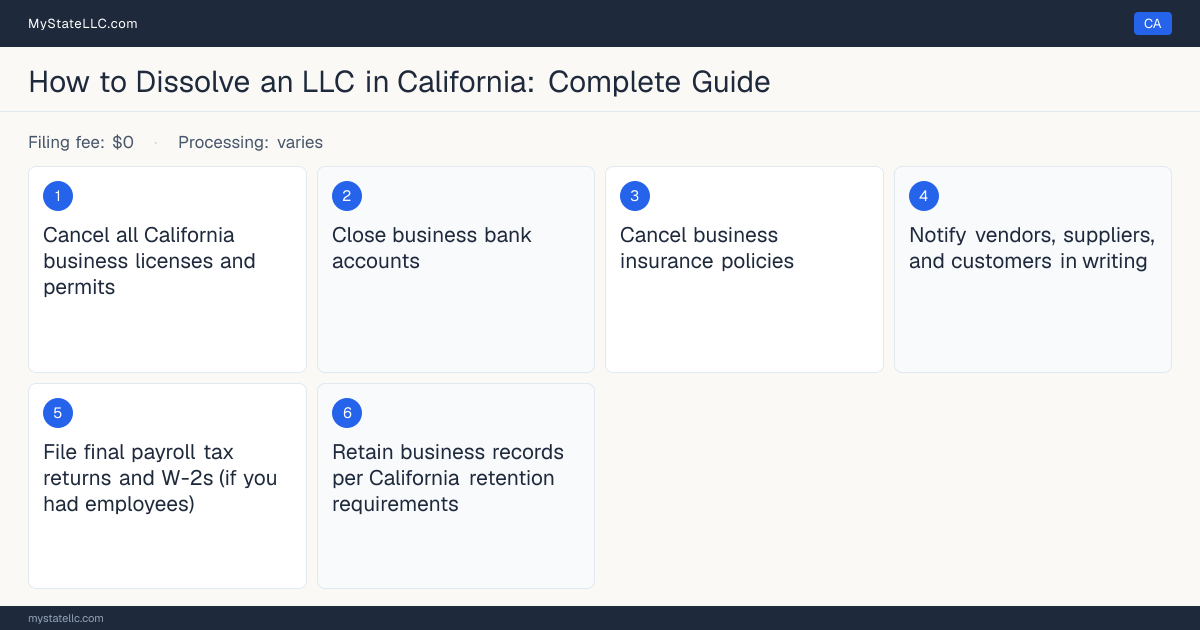
- Cancel all California business licenses and permits
California licensing sits with cities and counties as well as state agencies and professional boards, so cancel each one with the office that issued it. A city business tax certificate left open simply renews, and the invoice arrives for a business that no longer exists.
- Close business bank accounts
Close the LLC's accounts only after the last creditor payment has cleared, the final tax obligations are covered, and member distributions are complete. Ask for written confirmation of closure and keep the final statement.
- Cancel business insurance policies
Give each carrier the dissolution date and ask for cancellation effective then. Unearned premium is often refundable, and a claims-made policy may need tail coverage, which matters in California because a member who took a dissolution distribution can be pursued for the LLC's claims, up to the value of that distribution, for as long as four years afterwards.
- Notify vendors, suppliers, and customers in writing
Write to every open account with the dissolution date, instructions for final invoices, and where to send them. Auto-renewing software, freight, and marketing contracts are the ones that keep billing long after the doors close.
- File final payroll tax returns and W-2s (if you had employees)
File the final federal payroll returns along with your final California employer filings, then issue W-2s to everyone who worked for the LLC during the year. Close the payroll registrations as well, because a final return on its own does not shut them.
- Retain business records per California retention requirements
California does not publish one retention period covering every document, so keep the core set: formation papers, the operating agreement, the filed LLC-3 and LLC-4/7, tax returns, and the financial records behind them. Keeping the file for at least four years matches the outer limit on actions to reach members for what they received in the dissolution.
Frequently Asked Questions
Sources
Each entry below is a document recorded in our verified California sources, and each entry says what the document is. Some statutory text is read from an accurate mirror rather than from the state's own host, and those say so.
- sos.ca.gov/business-programs/business-entitiesCalifornia Secretary of State: business entity filings
- sos.ca.gov/business-programs/business-entities/formsCalifornia Secretary of State: LLC dissolution
- bpd.cdn.sos.ca.gov/llc/forms/llc-3--4-7.pdfCalifornia dissolution filing fee
- sos.ca.gov/business-programs/business-entities/processing-timesCalifornia filing processing times
- codes.findlaw.com/ca/corporations-code/corp-sect-17707-07/California creditor notice period
Formation Services Compared
Forming an LLC in California?
See how Northwest Registered Agent, Bizee, ZenBusiness and LegalZoom, the formation services we partner with, compare on 3-year cost, BBB rating and Trustpilot score before you choose.

Edmond Hui · Founder, MyStateLLC
Edmond Hui is a software engineer and serial entrepreneur based in New York who has founded multiple online businesses across e-commerce, media, and information publishing. Before transitioning into tech, he spent years as a commercial real estate professional closing deals totaling over 100,000 square feet, giving him firsthand experience with business formation and entity structuring. He built MyStateLLC to provide the free, state-specific LLC guidance he wished existed when forming his own companies.